2,281 posters, 63 videos, 56 audios, 43 topics, 18 sessions, 6,174 authors, 2,323 institutions
ePostersLive by SciGen Technologies S.A. All rights reserved.
RCOG World Congress 2025
June 23 - 25, 2025 | ExCeL London, UK
EP.0945
Placental histological findings in patients with sludge: A cross-sectional study
Poster Presenter
Part of Topic
High risk pregnancy
Placental histological findings in patients with sludge: A cross-sectional study
Background: Sludge has been associated with various obstetric complications, including intra-amniotic infection, preterm birth, and adverse neonatal outcomes.
Objective: To describe and compare the histopathological characteristics of placentas in singleton pregnancies with and without sludge.
Design: This cross-sectional study analyzed data collected from January 2021 through December 2023 at a tertiary academic center in Mexico City.
Methods:
Inclusion criteria: Singleton pregnancies screened for preterm delivery (i.e., transvaginal assessment of the cervical length) between 18.0-24.0 weeks of gestation.
Exclusion criteria: Major fetal structural anomalies, hypertensive disorders of pregnancy, fetal growth restriction, placental abruption, cervical insufficiency, placenta previa, and fetal death.
Placental lesions were characterized using the Amsterdam Placental Workshop Criteria and Freedman classification, classifying placental lesions into Acute Inflammation (AI), Chronic Inflammation (CI), Maternal Vascular Malperfusion (MVM), and Fetal Vascular Malperfusion (FVM).
Logistic regression models and corresponding odds ratios (OR) were calculated to assess the presence and the magnitude of a potential association of sludge with the placental outcomes of interest.
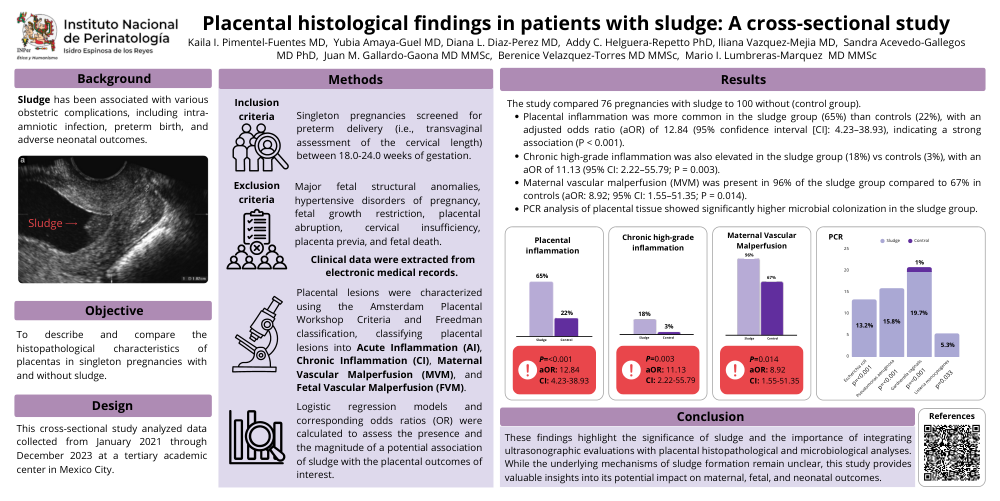
Results: The study compared 76 pregnancies with sludge to 100 without (control group).
- Placental inflammation was more common in the sludge group (65%) than controls (22%), with an adjusted odds ratio (aOR) of 12.84 (95% confidence interval [CI]: 4.23–38.93), indicating a strong association (P < 0.001).
- Chronic high-grade inflammation was also elevated in the sludge group (18%) vs controls (3%), with an aOR of 11.13 (95% CI: 2.22–55.79; P = 0.003).
- Maternal vascular malperfusion (MVM) was present in 96% of the sludge group compared to 67% in controls (aOR: 8.92; 95% CI: 1.55–51.35; P = 0.014).
- PCR analysis of placental tissue showed significantly higher microbial colonization in the sludge group.
Conclusion: These findings highlight the significance of sludge and the importance of integrating ultrasonographic evaluations with placental histopathological and microbiological analyses. While the underlying mechanisms of sludge formation remain unclear, this study provides valuable insights into its potential impact on maternal, fetal, and neonatal outcomes.