2,281 posters, 63 videos, 56 audios, 43 topics, 18 sessions, 6,174 authors, 2,323 institutions
ePostersLive by SciGen Technologies S.A. All rights reserved.
RCOG World Congress 2025
June 23 - 25, 2025 | ExCeL London, UK
EP.0942
Service Evaluation of Breech and External Cephalic Version in a Tertiary Unit
Poster Presenter
Authors
Affiliations
Part of Topic
High risk pregnancy
Service Evaluation of Breech and External Cephalic Version in a Tertiary Unit
C Williamson, K Machado, P Marsden. Royal Victoria Infirmary (RVI), The Newcastle upon Tyne Hospitals
Background
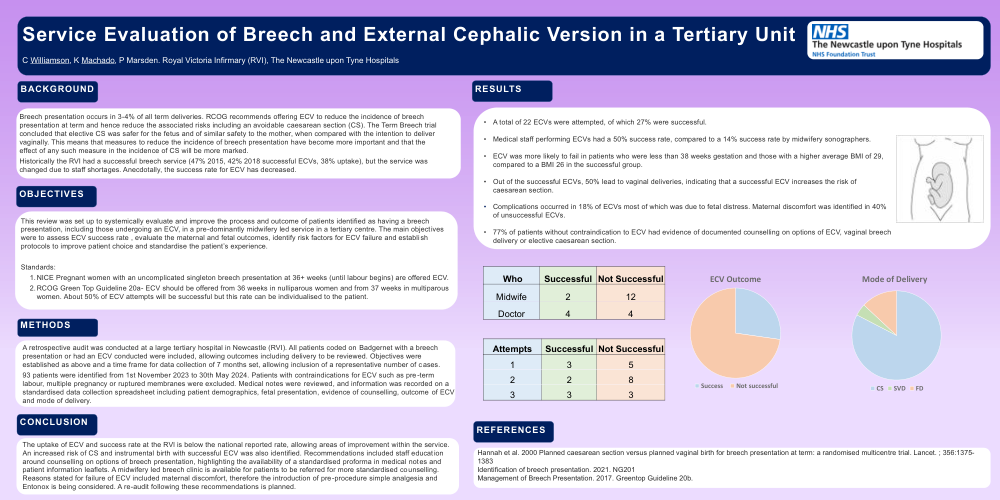
Breech presentation occurs in 3-4% of all term deliveries. RCOG recommends offering ECV to reduce the incidence of breech presentation at term and hence reduce the associated risks including an avoidable caesarean section (CS). The Term Breech trial concluded that elective CS was safer for the fetus and of similar safety to the mother, when compared with the intention to deliver vaginally. This means that measures to reduce the incidence of breech presentation have become more important and that the effect of any such measure in the incidence of CS will be more marked.
Historically the RVI had a successful breech service (47% 2015, 42% 2018 successful ECVs, 38% uptake), but the service was changed due to staff shortages. Anecdotally, the success rate for ECV has decreased.
Objectives
This review was set up to systemically evaluate and improve the process and outcome of patients identified as having a breech presentation, including those undergoing an ECV, in a pre-dominantly midwifery led service in a tertiary centre. The main objectives were to assess ECV success rate , evaluate the maternal and fetal outcomes, identify risk factors for ECV failure and establish protocols to improve patient choice and standardise the patient’s experience.
Standards:
Methods
A retrospective audit was conducted at a large tertiary hospital in Newcastle (RVI). All patients coded on Badgernet with a breech presentation or had an ECV conducted were included, allowing outcomes including delivery to be reviewed. Objectives were established as above and a time frame for data collection of 7 months set, allowing inclusion of a representative number of cases.
93 patients were identified from 1st November 2023 to 30th May 2024. Patients with contraindications for ECV such as pre-term labour, multiple pregnancy or ruptured membranes were excluded. Medical notes were reviewed, and information was recorded on a standardised data collection spreadsheet including patient demographics, fetal presentation, evidence of counselling, outcome of ECV and mode of delivery.
Results
The uptake of ECV and success rate at the RVl is below the national reported rate, allowing areas of improvement within the service. An increased risk of CS and instrumental birth with successful ECV was also identified. Recommendations included staff education around counselling on options of breech presentation, highlighting the availability of a standardised proforma in medical notes and patient information leaflets. A midwifery led breech clinic is available for patients to be referred for more standardised counselling. Reasons stated for failure of ECV included maternal discomfort, therefore the introduction of pre-procedure simple analgesia and Entonox is being considered. A re-audit following these recommendations is planned.