2,281 posters, 63 videos, 56 audios, 43 topics, 18 sessions, 6,174 authors, 2,323 institutions
ePostersLive by SciGen Technologies S.A. All rights reserved.
RCOG World Congress 2025
June 23 - 25, 2025 | ExCeL London, UK
EP.0939
Acute fatty liver of pregnancy: diagnostic and therapeutic approaches
Poster Presenter
Authors
Affiliations
Department of Gynaecology and Obstetrics, Charles Nicolle Hospital, Department B- Charles Nicolle Hospital, Gynaecology and Obstetrics Department B, Charles Nicolle Hospital, Department Bof Obstetrics and Gynaecology, Charles Nicolle Hospital, Department of Obstetrics and Gynecology B, Charles Nicolle Hospital, Gynaecology and Obstetrics Department B of Charles Nicolle Hospital, Gynaecology and Obstetrics department B- Charles Nicolle Hospital, Charles Nicolle Hospital, Obstetrics and Gynaecology Service B, Department B of Gynaecology and Obstetrics- Charles Nicolle Hospital, Department B of Obstetrics and Gynecology, Charles Nicolle Hospital
Part of Topic
High risk pregnancy
Acute fatty liver of pregnancy: diagnostic and therapeutic approaches
Introduction:
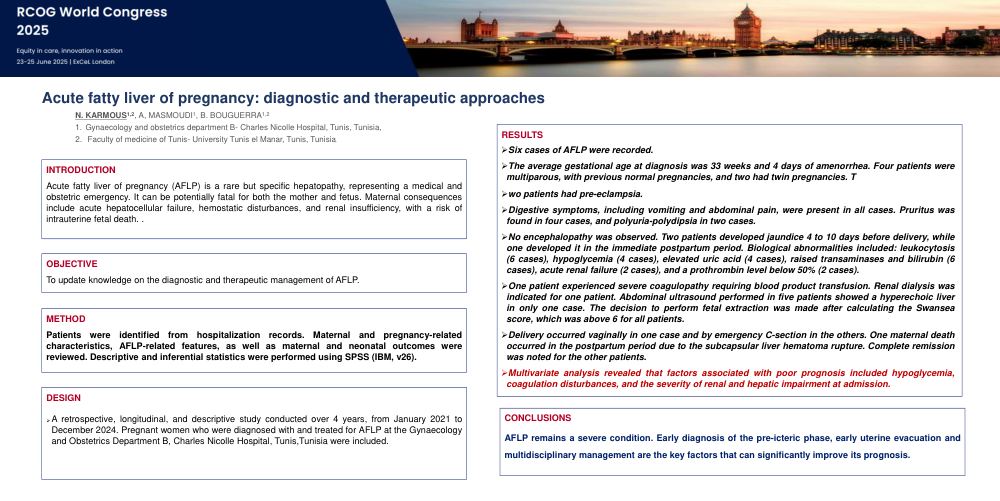
Acute fatty liver of pregnancy (AFLP) is a rare but specific hepatopathy, representing a medical and obstetric emergency. It can be potentially fatal for both the mother and fetus. Maternal consequences include acute hepatocellular failure, hemostatic disturbances, and renal insufficiency, with a risk of intrauterine fetal death.
Objective:
The aim of this study was to update knowledge on the diagnostic and therapeutic management of AFLP.
Design:
A retrospective, longitudinal, and descriptive study conducted over 4 years, from January 2021 to December 2024. Pregnant women who were diagnosed with and treated for AFLP at the Gynaecology and Obstetrics Department B, Charles Nicolle Hospital, Tunis,Tunisia were included.
Methods:
Patients were identified from hospitalization records. Maternal and pregnancy-related characteristics, AFLP-related features, as well as maternal and neonatal outcomes were reviewed. Descriptive and inferential statistics were performed using SPSS (IBM, v26).
Results:
Six cases of AFLP were recorded. The average gestational age at diagnosis was 33 weeks and 4 days of amenorrhea. Four patients were multiparous, with previous normal pregnancies, and two had twin pregnancies. Two patients had pre-eclampsia. Digestive symptoms, including vomiting and abdominal pain, were present in all cases. Pruritus was found in four cases, and polyuria-polydipsia in two cases. No encephalopathy was observed. Two patients developed jaundice 4 to 10 days before delivery, while one developed it in the immediate postpartum period. Biological abnormalities included: leukocytosis (6 cases), hypoglycemia (4 cases), elevated uric acid (4 cases), raised transaminases and bilirubin (6 cases), acute renal failure (2 cases), and a prothrombin level below 50% (2 cases). One patient experienced severe coagulopathy requiring blood product transfusion. Renal dialysis was indicated for one patient. Abdominal ultrasound performed in five patients showed a hyperechoic liver in only one case. The decision to perform fetal extraction was made after calculating the Swansea score, which was above 6 for all patients. Delivery occurred vaginally in one case and by emergency C-section in the others. One maternal death occurred in the postpartum period due to the subcapsular liver hematoma rupture. Complete remission was noted for the other patients.
Multivariate analysis revealed that factors associated with poor prognosis included hypoglycemia, coagulation disturbances, and the severity of renal and hepatic impairment at admission.
Conclusions:
AFLP remains a severe condition. Early diagnosis of the pre-icteric phase, early uterine evacuation and multidisciplinary management are the key factors that can significantly improve its prognosis.