2,281 posters, 63 videos, 56 audios, 43 topics, 18 sessions, 6,174 authors, 2,323 institutions
ePostersLive by SciGen Technologies S.A. All rights reserved.
RCOG World Congress 2025
June 23 - 25, 2025 | ExCeL London, UK
EP.0936
Myasthenia gravis: management issues during pregnancy
Poster Presenter
Authors
Affiliations
Department of Gynaecology and Obstetrics, Charles Nicolle Hospital, Department B- Charles Nicolle Hospital, Faculty of medicine of Tunis, University of Tunis el Manar, Gynaecology and Obstetrics Department B, Charles Nicolle Hospital, Department Bof Obstetrics and Gynaecology, Charles Nicolle Hospital, Department of Obstetrics and Gynecology B, Charles Nicolle Hospital, Gynaecology and Obstetrics Department B of Charles Nicolle Hospital, Gynaecology and Obstetrics department B- Charles Nicolle Hospital, Charles Nicolle Hospital, Obstetrics and Gynaecology Service B, Department B of Gynaecology and Obstetrics- Charles Nicolle Hospital, Department B of Obstetrics and Gynecology, Charles Nicolle Hospital
Part of Topic
High risk pregnancy
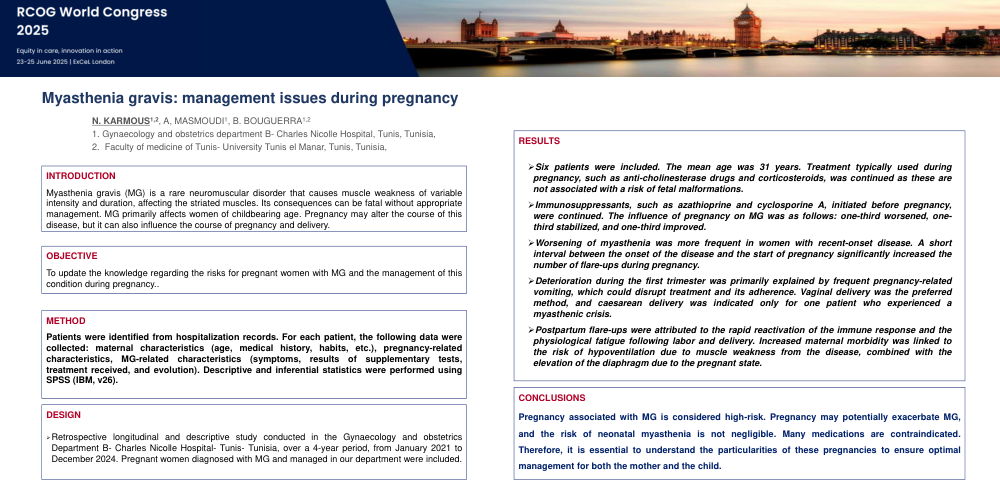
Myasthenia gravis: management issues during pregnancy
Objective
Myasthenia gravis (MG) is a rare neuromuscular disorder that causes muscle weakness of variable intensity and duration, affecting the striated muscles. Its consequences can be fatal without appropriate management. MG primarily affects women of childbearing age. Pregnancy may alter the course of this disease, but it can also influence the course of pregnancy and delivery. Our aim was to update the knowledge regarding the risks for pregnant women with MG and the management of this condition during pregnancy.
Design
Retrospective longitudinal and descriptive study conducted in the Gynaecology and obstetrics Department B- Charles Nicolle Hospital- Tunis- Tunisia, over a 4-year period, from January 2021 to December 2024. Pregnant women diagnosed with MG and managed in our department were included.
Method
Patients were identified from hospitalization records. For each patient, the following data were collected: maternal characteristics (age, medical history, habits, etc.), pregnancy-related characteristics, MG-related characteristics (symptoms, results of supplementary tests, treatment received, and evolution). Descriptive and inferential statistics were performed using SPSS (IBM, v26).
Results
Six patients were included. The mean age was 31 years. Treatment typically used during pregnancy, such as anti-cholinesterase drugs and corticosteroids, was continued as these are not associated with a risk of fetal malformations. Immunosuppressants, such as azathioprine and cyclosporine A, initiated before pregnancy, were continued. The influence of pregnancy on MG was as follows: one-third worsened, one-third stabilized, and one-third improved. Worsening of myasthenia was more frequent in women with recent-onset disease. A short interval between the onset of the disease and the start of pregnancy significantly increased the number of flare-ups during pregnancy. Deterioration during the first trimester was primarily explained by frequent pregnancy-related vomiting, which could disrupt treatment and its adherence. Vaginal delivery was the preferred method, and cesarean delivery was indicated only for one patient who experienced a myasthenic crisis. Postpartum flare-ups were attributed to the rapid reactivation of the immune response and the physiological fatigue following labor and delivery. Increased maternal morbidity was linked to the risk of hypoventilation due to muscle weakness from the disease, combined with the elevation of the diaphragm due to the pregnant state.
Conclusions
Pregnancy associated with MG is considered high-risk. Pregnancy may potentially exacerbate MG, and the risk of neonatal myasthenia is not negligible. Many medications are contraindicated. Therefore, it is essential to understand the particularities of these pregnancies to ensure optimal management for both the mother and the child.