2,281 posters, 63 videos, 56 audios, 43 topics, 18 sessions, 6,174 authors, 2,323 institutions
ePostersLive by SciGen Technologies S.A. All rights reserved.
RCOG World Congress 2025
June 23 - 25, 2025 | ExCeL London, UK
EP.0935
Community-Level Social Risk Predicts Severe Maternal Morbidity Independent of Clinical Factors
Poster Presenter
Part of Topic
High risk pregnancy
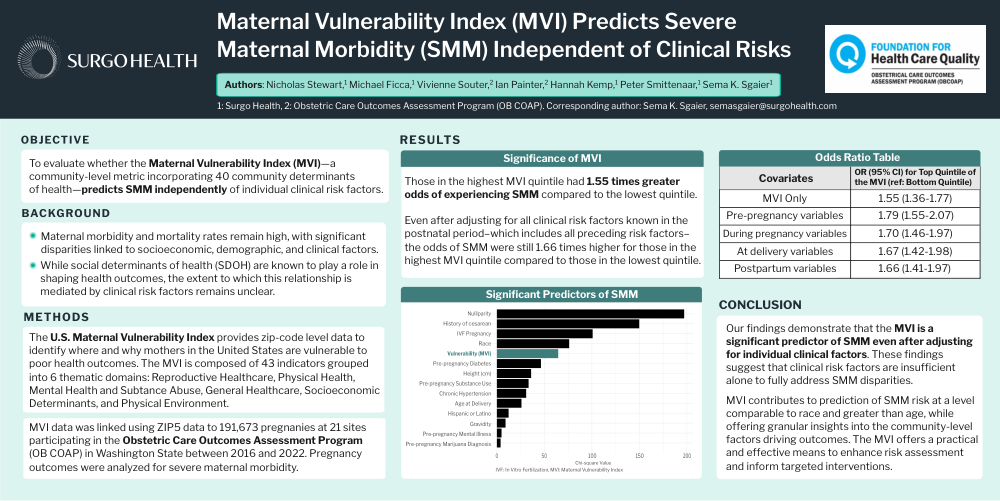
Maternal Vulnerability Index (MVI) Predicts Severe Maternal Morbidity (SMM) Independent of Clinical Risks
Authors: Nicholas Stewart,1 Michael Ficca,1 Vivienne Souter,2 Ian Painter,2 Hannah Kemp,1 Peter Smittenaar,1 Sema K. Sgaier1
1: Surgo Health, 2: Obstetric Care Outcomes Assessment Program (OB COAP). Corresponding author: Sema K. Sgaier, semasgaier@surgohealth.com
Objective: To evaluate whether the Maternal Vulnerability Index (MVI)—a community-level metric incorporating 40 community determinants of health—predicts SMM independently of individual clinical risk factors
Background: Maternal morbidity and mortality rates remain high, with significant disparities linked to socioeconomic, demographic, and clinical factors. While social determinants of health (SDOH) are known to play a role in shaping health outcomes, the extent to which this relationship is mediated by clinical risk factors remains unclear.
Methods: The U.S. Maternal Vulnerability Index provides zip-code level data to identify where and why mothers in the United States are vulnerable to poor health outcomes. The MVI is composed of 43 indicators grouped into 6 thematic domains: Reproductive Healthcare, Physical Health, Mental Health and Subtance Abuse, General Healthcare, Socioeconomic Determinants, and Physical Environment. MVI data was linked using ZIP5 data to 191,673 pregnanies at 21 sites participating in the Obstetric Care Outcomes Assessment Program (OB COAP) in Washington State between 2016 and 2022. Pregnancy outcomes were analyzed for severe maternal morbidity.
Results: Those in the highest MVI quintile had 1.55 times greater odds of experiencing SMM compared to the lowest quintile. Even after adjusting for all clinical risk factors known in the postnatal period–which includes all preceding risk factors– the odds of SMM were still 1.66 times higher for those in the highest MVI quintile compared to those in the lowest quintile.
Conclusion: Our findings demonstrate that the MVI is a significant predictor of SMM even after adjusting for individual clinical factors. These findings suggest that clinical risk factors are insufficient alone to fully address SMM disparities. MVI contributes to prediction of SMM risk at a level comparable to race and greater than age, while offering granular insights into the community-level factors driving outcomes. The MVI offers a practical and effective means to enhance risk assessment and inform targeted interventions.