2,281 posters, 63 videos, 56 audios, 43 topics, 18 sessions, 6,174 authors, 2,323 institutions
ePostersLive by SciGen Technologies S.A. All rights reserved.
RCOG World Congress 2025
June 23 - 25, 2025 | ExCeL London, UK
EP.0928
Antenatal experiences of pregnant women with cardiac conditions: systematic review and metasynthesis
Poster Presenter
Part of Topic
High risk pregnancy
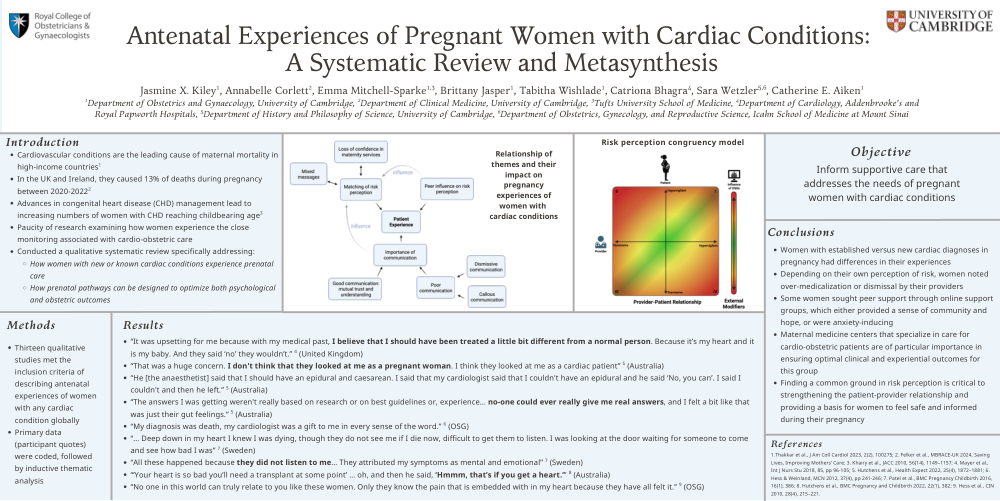
Antenatal Experiences of Pregnant Women with Cardiac Conditions:A Systematic Review and Metasynthesis
Introduction
- Cardiovascular conditions are the leading cause of maternal mortality in high-income countries1
- In the UK and Ireland, they caused 13% of deaths during pregnancy between 2020-20222
- Advances in congenital heart disease (CHD) management lead to increasing numbers of women with CHD reaching childbearing age3
- Paucity of research examining how women experience the close monitoring associated with cardio-obstetric care
- Conducted a qualitative systematic review specifically addressing:
- How women with new or known cardiac conditions experience prenatal care
- How prenatal pathways can be designed to optimize both psychological and obstetric outcomes
Objective: Inform supportive care that addresses the needs of pregnant women with cardiac conditions
Methods
- Thirteen qualitative studies met the inclusion criteria of describing antenatal experiences of women with any cardiac condition globally
- Primary data (participant quotes) were coded, followed by inductive thematic analysis
Results
- “It was upsetting for me because with my medical past, I believe that I should have been treated a little bit different from a normal person. Because it’s my heart and it is my baby. And they said ‘no’ they wouldn’t.” 4(United Kingdom)
- “that was a huge concern. I don't think that they looked at me as a pregnant woman. I think they looked at me as a cardiac patient” 5 (Australia)
- “He [the anaesthetist] said that I should have an epidural and caesarean. I said that my cardiologist said that I couldn't have an epidural and he said ‘No, you can’. I said I couldn't and then he left.” 5 (Australia)
- “The answers I was getting weren't really based on research or on best guidelines or, experience… no‐one could ever really give me real answers, and I felt a bit like that was just their gut feelings.” 5 (Australia)
- “My diagnosis was death, my cardiologist was a gift to me in every sense of the word.” 6 (OSG)
- “… Deep down in my heart I knew I was dying, though they do not see me if I die now, difficult to get them to listen. I was looking at the door waiting for someone to come and see how bad I was” 7 (Sweden)
- “All these happened because they did not listen to me… They attributed my symptoms as mental and emotional” 7(Sweden)
- “’Your heart is so bad you’ll need a transplant at some point’ … oh, and then he said, ‘Hmmm, that’s if you get a heart.’” 8 (Australia)
- ‘‘No one in this world can truly relate to you like these women. Only they know the pain that is embedded with in my heart because they have all felt it.’’ 9 (OSG)
Conclusions
- Women with established versus new cardiac diagnoses in pregnancy had differences in their experiences
- Depending on their own perception of risk, women noted over-medicalization or dismissal by their providers
- Some women sought peer support through online support groups, which either provided a sense of community and hope, or were anxiety-inducing
- Maternal medicine centers that specialize in care for cardio-obstetric patients are of particular importance in ensuring optimal clinical and experiential outcomes for this group
- Finding a common ground in risk perception is critical to strengthening the patient-provider relationship and providing a basis for women to feel safe and informed during their pregnancy
References
1.Thakkar et al., J Am Coll Cardiol 2023, 2(2), 100275; 2. Felker et al., MBRACE-UK 2024, Saving Lives, Improving Mothers’ Care; 3. Khairy et al., JACC 2010, 56(14), 1149–1157; 4. Mayer et al., Int J Nurs Stu 2018, 85, pp 96-105; 5. Hutchens et al., Health Expect 2022, 25(4), 1872–1881; 6. Hess & Weinland, MCN 2012, 37(4), pp 241-246; 7. Patel et al., BMC Pregnancy Childbirth 2016, 16(1), 386; 8. Hutchens et al., BMC Pregnancy and Childbirth 2022, 22(1), 382; 9. Hess et al., CIN 2010, 28(4), 215–221.