2,281 posters, 63 videos, 56 audios, 43 topics, 18 sessions, 6,174 authors, 2,323 institutions
ePostersLive by SciGen Technologies S.A. All rights reserved.
RCOG World Congress 2025
June 23 - 25, 2025 | ExCeL London, UK
EP.0925
PLACENTA ACCRETA : EPIDEMIOLOGICAL, THERAPEUTIC, PROGNOSTIC APPROACH
Poster Presenter
Authors
Imene Labidi, Sana Menjli, Haithem Aloui, Hassine Saber Abouda
Affiliations
Part of Topic
High risk pregnancy
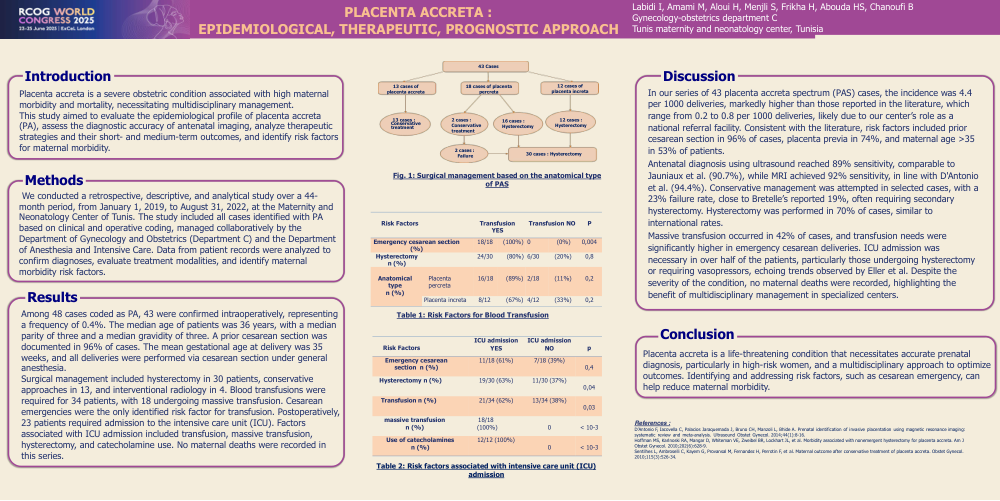
Introduction : Placenta accretais a severe obstetric condition associated with high maternal morbidity and mortality, necessitating multidisciplinary management. This study aimed to evaluate the epidemiological profile of placenta accreta (PA), assess the diagnostic accuracy of antenatal imaging, analyze therapeutic strategies and their short-and medium-term outcomes, and identify risk factors for maternal morbidity.
Methods : We conducted a retrospective, descriptive, and analytical study over a 44 month period, from January 1, 2019, to August 31, 2022, at the Maternity and Neonatology Center of Tunis. The study included all cases identified with PA based on clinical and operative coding, managed collaboratively by the Department of Gynecology and Obstetrics (Department C) and the Department of Anesthesia and Intensive Care. Data from patient records were analyzed to confirm diagnoses, evaluate treatment modalities, and identify maternal morbidity risk factors.
Results: Among 48 cases coded as PA, 43 were confirmed intraoperatively, representing a frequency of 0.4%. The median age of patients was 36 years, with a median parity of three and a median gravidity of three. A prior cesarean section was documented in 96% of cases. The mean gestational age at delivery was 35 weeks, and all deliveries were performed via cesarean section under general anesthesia. Surgical management included hysterectomy in 30 patients, conservative approaches in 13, and interventional radiology in 4. Blood transfusions were required for 34 patients, with 18 undergoing massive transfusion. Cesarean emergencies were the only identified risk factor for transfusion. Postoperatively, 23 patients required admission to the intensive care unit (ICU). Factors associated with ICU admission included transfusion, massive transfusion, hysterectomy, and catecholamine use. No maternal deaths were recorded in this series.
Discussion: In our series of 43 placenta accretaspectrum (PAS) cases, the incidence was 4.4 per 1000 deliveries, markedly higher than those reported in the literature, which range from 0.2 to 0.8 per 1000 deliveries, likely due to our center’s role as a national referral facility. Consistent with the literature, risk factors included prior cesarean section in 96% of cases, placenta previa in 74%, and maternal age >35 in 53% of patients. Antenatal diagnosis using ultrasound reached 89% sensitivity, comparable to Jauniauxet al. (90.7%), while MRI achieved 92% sensitivity, in line with D'Antonio et al. (94.4%). Conservative management was attempted in selected cases, with a 23% failure rate, close to Bretelle’s reported 19%, often requiring secondary hysterectomy. Hysterectomy was performed in 70% of cases, similar to international rates. Massive transfusion occurred in 42% of cases, and transfusion needs were significantly higher in emergency cesarean deliveries. ICU admission was necessary in over half of the patients, particularly those undergoing hysterectomy or requiring vasopressors, echoing trends observed by Eller et al. Despite the severity of the condition, no maternal deaths were recorded, highlighting the benefit of multidisciplinary management in specialized centers.
Conclusion: Placenta accretais a life-threatening condition that necessitates accurate prenatal diagnosis, particularly in high-risk women, and a multidisciplinary approach to optimize outcomes. Identifying and addressing risk factors, such as cesarean emergency, can help reduce maternal morbidity.