2,281 posters, 63 videos, 56 audios, 43 topics, 18 sessions, 6,174 authors, 2,323 institutions
ePostersLive by SciGen Technologies S.A. All rights reserved.
RCOG World Congress 2025
June 23 - 25, 2025 | ExCeL London, UK
EP.0922
Maternal-neonatal waterbirth vs. land-birth outcomes in high-risk & low-risk population in the Philippines
Poster Presenter
Authors
Affiliations
Part of Topic
High risk pregnancy
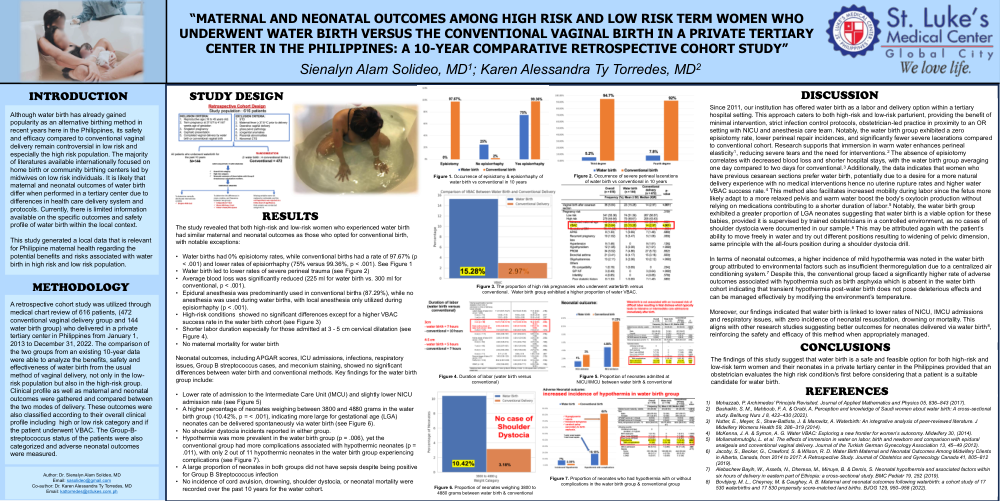
“MATERNAL AND NEONATAL OUTCOMES AMONG HIGH RISK AND LOW RISK TERM WOMEN WHO UNDERWENT WATER BIRTH VERSUS THE CONVENTIONAL VAGINAL BIRTH IN A PRIVATE TERTIARY CENTER IN THE PHILIPPINES: A 10-YEAR COMPARATIVE RETROSPECTIVE COHORT STUDY”
Sienalyn Alam Solideo, MD1; Karen Alessandra Ty Torredes, MD2
INTRODUCTION: Although water birth has already gained popularity as an alternative birthing method in recent years here in the Philippines, its safety and efficacy compared to conventional vaginal delivery remain controversial in low risk and especially the high risk population. The majority of literatures available internationally focused on home birth or community birthing centers led by midwives on low risk individuals. It is likely that maternal and neonatal outcomes of water birth differ when performed in a tertiary center due to differences in health care delivery system and protocols. Currently, there is limited information available on the specific outcomes and safety profile of water birth within the local context.
This study generated a local data that is relevant for Philippine maternal health regarding the potential benefits and risks associated with water birth in high risk and low risk population.
METHODOLOGY: A retrospective cohort study was utilized through medical chart review of 616 patients, (472 conventional vaginal delivery group and 144 water birth group) who delivered in a private tertiary center in Philippines from January 1, 2013 to December 31, 2022. The comparison of the two groups from an existing 10-year data were able to analyze the benefits, safety and effectiveness of water birth from the usual method of vaginal delivery, not only in the low-risk population but also in the high-risk group. Clinical profile as well as maternal and neonatal outcomes were gathered and compared between the two modes of delivery. These outcomes were also classified according to their overall clinical profile including high or low risk category and if the patient underwent VBAC. The Group-B-streptococcus status of the patients were also categorized and adverse neonatal outcomes were measured.
RESULTS: The study revealed that both high-risk and low-risk women who experienced water birth had similar maternal and neonatal outcomes as those who opted for conventional birth, with notable exceptions:
Neonatal outcomes, including APGAR scores, ICU admissions, infections, respiratory issues, Group B streptococcus cases, and meconium staining, showed no significant differences between water birth and conventional methods. Key findings for the water birth group include:
•Lower rate of admission to the Intermediate Care Unit (IMCU) and slightly lower NICU admission rate (see Figure 5)
DISCUSSION: Since 2011, our institution has offered water birth as a labor and delivery option within a tertiary hospital setting. This approach caters to both high-risk and low-risk parturient, providing the benefit of minimal intervention, strict infection control protocols, obstetrician-led practice in proximity to an OR setting with NICU and anesthesia care team. Notably, the water birth group exhibited a zero episiotomy rate, lower perineal repair incidences, and significantly fewer severe lacerations compared to conventional cohort. Research supports that immersion in warm water enhances perineal elasticity1, reducing severe tears and the need for interventions.2 The absence of episiotomy correlates with decreased blood loss and shorter hospital stays, with the water birth group averaging one day compared to two days for conventional.3 Additionally, the data indicates that women who have previous cesarean sections prefer water birth, potentially due to a desire for a more natural delivery experience with no medical interventions hence no uterine rupture rates and higher water VBAC success rate.4 This method also facilitates increased mobility during labor since the fetus more likely adapt to a more relaxed pelvis and warm water boost the body's oxytocin production without relying on medications contributing to a shorter duration of labor.5 Notably, the water birth group exhibited a greater proportion of LGA neonates suggesting that water birth is a viable option for these babies, provided it is supervised by trained obstetricians in a controlled environment, as no cases of shoulder dystocia were documented in our sample.6 This may be attributed again with the patient’s ability to move freely in water and try out different positions resulting to widening of pelvic dimension, same principle with the all-fours position during a shoulder dystocia drill.
In terms of neonatal outcomes, a higher incidence of mild hypothermia was noted in the water birth group attributed to environmental factors such as insufficient thermoregulation due to a centralized air conditioning system.7 Despite this, the conventional group faced a significantly higher rate of adverse outcomes associated with hypothermia such as birth asphyxia which is absent in the water birth cohort indicating that transient hypothermia post-water birth does not pose deleterious effects and can be managed effectively by modifying the environment’s temperature.
Moreover, our findings indicated that water birth is linked to lower rates of NICU, IMCU admissions and respiratory issues, with zero incidence of neonatal resuscitation, drowning or mortality. This aligns with other research studies suggesting better outcomes for neonates delivered via water birth8, reinforcing the safety and efficacy of this method when appropriately managed.
CONCLUSIONS: The findings of this study suggest that water birth is a safe and feasible option for both high-risk and low-risk term women and their neonates in a private tertiary center in the Philippines provided that an obstetrician evaluates the high risk condition/s first before considering that a patient is a suitable candidate for water birth.