2,281 posters, 63 videos, 56 audios, 43 topics, 18 sessions, 6,174 authors, 2,323 institutions
ePostersLive by SciGen Technologies S.A. All rights reserved.
RCOG World Congress 2025
June 23 - 25, 2025 | ExCeL London, UK
EP.0920
Pregnancy Outcomes In A Cohort Of Patients With Polycystic Ovarian Syndrome
Poster Presenter
Authors
Affiliations
Part of Topic
High risk pregnancy
PREGNANCY OUTCOMES IN A COHORT OF PATIENTS WITH POLYCYSTIC OVARIAN SYNDROME
(PCOS) AT THE UNIVERSITY HOSPITAL OF THE WEST INDIES (UHWI) BETWEEN 2012-2023
INTRODUCTION
• PCOS is characterized by hyperandrogenism, ovarian
dysfunction and hyperinsulinemia with reproductive
consequences
• Most common endocrine disorder in women of
reproductive age with reported prevalence of 6-15%1
• Cardiovascular, endocrine and metabolic sequelae increase
the risk of adverse pregnancy and neonatal outcomes
• Currently, there is a gap in existing literature on its
prevalence and adverse pregnancy outcomes in a
predominantly Afrocentric population
Aim of study: To determine the health outcomes of pregnant
women with PCOS at the University Hospital of the West
Indies (UHWI) between 2012-2023
METHODOLOGY
• Retrospective cohort study of obstetric patients seen at the
UHWI between January 1, 2012 - December 31, 2023.
• Cases were identified using documentation in the Labour
Ward records and subsequent docket review. Controls were
age-matched and delivered within a week of the index
cases.
• Sample size = 226 (113 cases, 113 controls) [79 cases
and 109 controls at time of preliminary analysis]
• Women with multiple gestation, pre-existing diabetes,
prior history of gestational diabetes (GDM) and age <18
or >45 were excluded
• Data on maternal and neonatal demographics, clinical
course and pregnancy outcomes were collected.
• Descriptive, bivariate and multivariate analyses were done.
Statistical significance was set at p<0.05
DISCUSSION
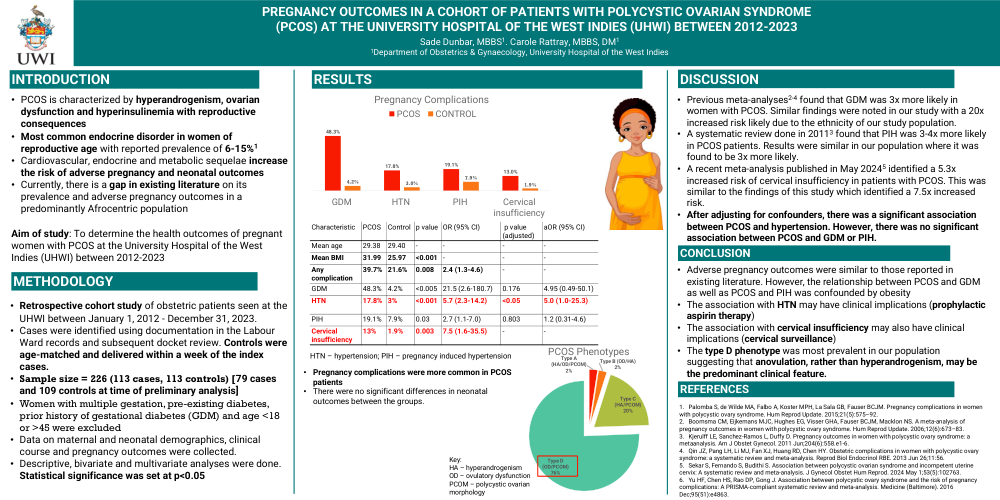
• Previous meta-analyses 2-4 found that GDM was 3x more likely in
women with PCOS. Similar findings were noted in our study with a 20x
increased risk likely due to the ethnicity of our study population.
• A systematic review done in 20113 found that PIH was 3-4x more likely
in PCOS patients. Results were similar in our population where it was
found to be 3x more likely.
• A recent meta-analysis published in May 20245 identified a 5.3x
increased risk of cervical insufficiency in patients with PCOS. This was
similar to the findings of this study which identified a 7.5x increased
risk.
• After adjusting for confounders, there was a significant association
between PCOS and hypertension. However, there was no significant
association between PCOS and GDM or PIH.
CONCLUSION
• Adverse pregnancy outcomes were similar to those reported in
existing literature. However, the relationship between PCOS and GDM
as well as PCOS and PIH was confounded by obesity
• The association with HTN may have clinical implications (prophylactic
aspirin therapy)
• The association with cervical insufficiency may also have clinical
implications (cervical surveillance)
• The type D phenotype was most prevalent in our population
suggesting that anovulation, rather than hyperandrogenism, may be
the predominant clinical feature.
REFERENCES
1. Palomba S, de Wilde MA, Falbo A, Koster MPH, La Sala GB, Fauser BCJM. Pregnancy complications in women
with polycystic ovary syndrome. Hum Reprod Update. 2015;21(5):575–92.
2. Boomsma CM, Eijkemans MJC, Hughes EG, Visser GHA, Fauser BCJM, Macklon NS. A meta-analysis of
pregnancy outcomes in women with polycystic ovary syndrome. Hum Reprod Update. 2006;12(6):673–83.
3. Kjerulff LE, Sanchez-Ramos L, Duffy D. Pregnancy outcomes in women with polycystic ovary syndrome: a
metaanalysis. Am J Obstet Gynecol. 2011 Jun;204(6):558.e1-6.
4. Qin JZ, Pang LH, Li MJ, Fan XJ, Huang RD, Chen HY. Obstetric complications in women with polycystic ovary
syndrome: a systematic review and meta-analysis. Reprod Biol Endocrinol RBE. 2013 Jun 26;11:56.
5. Sekar S, Fernando S, Budithi S. Association between polycystic ovarian syndrome and incompetent uterine
cervix: A systematic review and meta-analysis. J Gynecol Obstet Hum Reprod. 2024 May 1;53(5):102763.
6. Yu HF, Chen HS, Rao DP, Gong J. Association between polycystic ovary syndrome and the risk of pregnancy
complications: A PRISMA-compliant systematic review and meta-analysis. Medicine (Baltimore). 2016
Dec;95(51):e4863.