2,281 posters, 63 videos, 56 audios, 43 topics, 18 sessions, 6,174 authors, 2,323 institutions
ePostersLive by SciGen Technologies S.A. All rights reserved.
RCOG World Congress 2025
June 23 - 25, 2025 | ExCeL London, UK
EP.0916
Analysing LMWH requirements for VTE prophylaxis in pregnant women with antithrombin deficiency
Poster Presenter
Authors
Affiliations
Part of Topic
High risk pregnancy
Analysing LMWH requirements for VTE prophylaxis in pregnant women with antithrombin deficiency
Juanita Virk, Michelle Kemp
Background
•Pregnancy is a hypercoagulable state which puts pregnant women higher risk of venous thromboembolisms (VTEs), with VTE events being the leading cause of maternal morbidity and mortality.
•This VTE risk is further elevated in those with coagulation disorders such as antithrombin deficiency.
•Low molecular weight heparin (LMWH) is the first-line prophylactic treatment however it requires antithrombin to exert its effects; enhancing antithrombin activity to inhibit thrombin formation thereby exhibiting an anticoagulant effect.
Methods
•The aim of the audit was to evaluate current LMWH dosing protocols in clinical practice for VTE prophylaxis in pregnancy.
•The data source used was patient records from the Rosie Hospital via EPIC of pregnant women who had antithrombin levels measured in the last ten years.
•Data collected included: LMWH dosage, anti-Xa levels, frequency of VTE events, and overall compliance with RCOG guidelines.
•This was supported by a literature review conducted through OVID-MEDLINE, 2020-2024.
Results
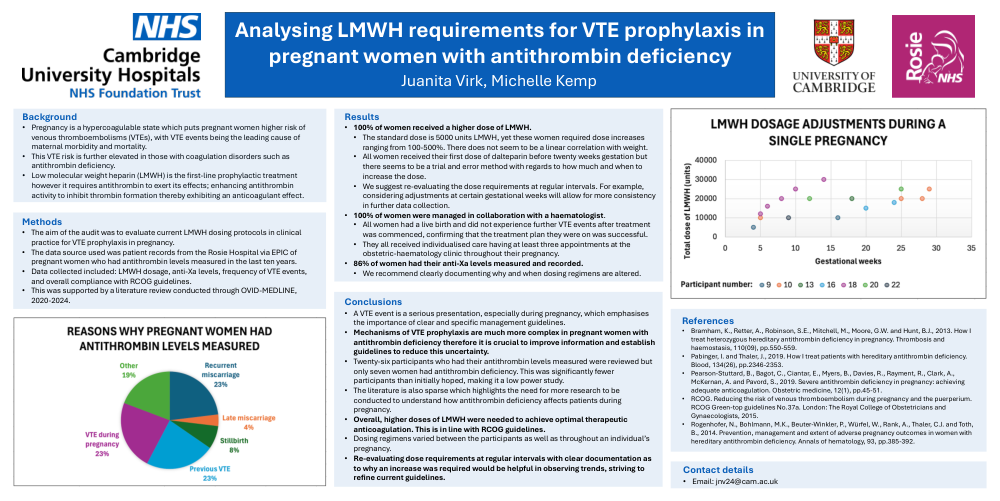
•100% of women received a higher dose of LMWH.
•The standard dose is 5000 units LMWH, yet these women required dose increases ranging from 100-500%. There does not seem to be a linear correlation with weight.
•All women received their first dose of dalteparin before twenty weeks gestation but there seems to be a trial and error method with regards to how much and when to increase the dose.
•We suggest re-evaluating the dose requirements at regular intervals. For example, considering adjustments at certain gestational weeks will allow for more consistency in further data collection.
•100% of women were managed in collaboration with a haematologist.
•All women had a live birth and did not experience further VTE events after treatment was commenced, confirming that the treatment plan they were on was successful.
•They all received individualised care having at least three appointments at the obstetric-haematology clinic throughout their pregnancy.
•86% of women had their anti-Xa levels measured and recorded.
•We recommend clearly documenting why and when dosing regimens are altered.
Conclusions
•A VTE event is a serious presentation, especially during pregnancy, which emphasises the importance of clear and specific management guidelines.
•Mechanisms of VTE prophylaxis are much more complex in pregnant women with antithrombin deficiency therefore it is crucial to improve information and establish guidelines to reduce this uncertainty.
•Twenty-six participants who had their antithrombin levels measured were reviewed but only seven women had antithrombin deficiency. This was significantly fewer participants than initially hoped, making it a low power study.
•The literature is also sparse which highlights the need for more research to be conducted to understand how antithrombin deficiency affects patients during pregnancy.
•Overall, higher doses of LMWH were needed to achieve optimal therapeutic anticoagulation. This is in line with RCOG guidelines.
•Dosing regimens varied between the participants as well as throughout an individual’s pregnancy.
•Re-evaluating dose requirements at regular intervals with clear documentation as to why an increase was required would be helpful in observing trends, striving to refine current guidelines.
References
•Bramham, K., Retter, A., Robinson, S.E., Mitchell, M., Moore, G.W. and Hunt, B.J., 2013. How I treat heterozygous hereditary antithrombin deficiency in pregnancy. Thrombosis and haemostasis, 110(09), pp.550-559.
•Pabinger, I. and Thaler, J., 2019. How I treat patients with hereditary antithrombin deficiency. Blood, 134(26), pp.2346-2353.
•Pearson-Stuttard, B., Bagot, C., Ciantar, E., Myers, B., Davies, R., Rayment, R., Clark, A., McKernan, A. and Pavord, S., 2019. Severe antithrombin deficiency in pregnancy: achieving adequate anticoagulation. Obstetric medicine, 12(1), pp.45-51.
•RCOG. Reducing the risk of venous thromboembolism during pregnancy and the puerperium. RCOG Green-top guidelines No.37a. London: The Royal College of Obstetricians and Gynaecologists, 2015.
•Rogenhofer, N., Bohlmann, M.K., Beuter-Winkler, P., Würfel, W., Rank, A., Thaler, C.J. and Toth, B., 2014. Prevention, management and extent of adverse pregnancy outcomes in women with hereditary antithrombin deficiency. Annals of hematology, 93, pp.385-392.
Contact details
•Email: jnv24@cam.ac.uk