2,281 posters, 63 videos, 56 audios, 43 topics, 18 sessions, 6,174 authors, 2,323 institutions
ePostersLive by SciGen Technologies S.A. All rights reserved.
RCOG World Congress 2025
June 23 - 25, 2025 | ExCeL London, UK
EP.0915
The impact of placentas with ‘at risk’ pathologies on pregnancy outcomes
Poster Presenter
Authors
Victoria Bryant, Sangeeta Agnihotri, Valeria Angioni, Ayomide Esan, Rehan Khan, Man Ho Kwok, Kate Wiles
Affiliations
The Royal London Hospital, Barts Health NHS Trust, Newham University Hospital, Barts Health NHS Trust, Whipps Cross Hospital, Barts Health NHS Trust, Homerton University Hospital
Part of Topic
High risk pregnancy
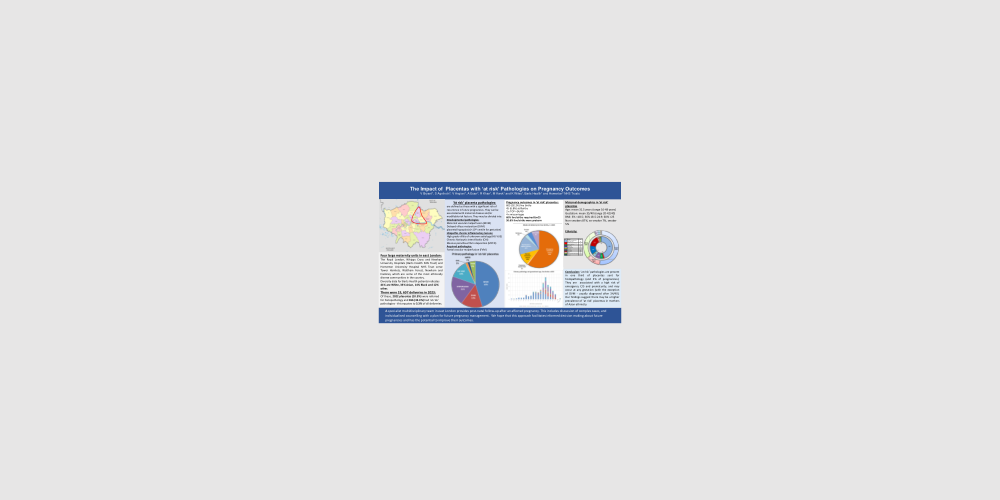
The Impact of Placentas with ‘at risk’ Pathologies on Pregnancy Outcomes.
Four large maternity units in east London:
The Royal London, Whipps Cross and Newham University Hospitals (Barts Health NHS Trust) and Homerton University Hospital NHS Trust serve Tower Hamlets, Waltham Forest, Newham and Hackney which are some of the most ethnically diverse communities in the country.
Diversity data for Barts Health patients indicates 41% are White, 33% Asian, 14% Black and 12% other.
There were 19, 607 deliveries in 2023:
Of these, 2022 placentas (10.3%) were referred for histopathology and 656 (32.4%) had ‘at risk’ pathologies - this equates to 3.3% of all deliveries.
‘At risk’ placenta pathologies:
are defined as those with a significant risk of recurrence in future pregnancies. They can be associated with maternal disease and/or modifiable risk factors. They may be divided into:
Developmental pathologies:
Maternal vascular malperfusion (MVM)
Delayed villous maturation (DVM)
placental hypoplasia (<10th centile for gestation)
Idiopathic chronic inflammatory lesions:
High grade villitis of unknown aetiology (HG VUE)
Chronic histiocytic intervillositis (CHI)
Massive perivillous fibrin deposition (MPFD)
Acquired pathologies:
Foetal vascular malperfusion (FVM)
Pregnancy outcomes in ‘at risk’ placentas:
605 (92.2%) live births
45 (6.8%) stillbirths
2 x TOP >24/40
4 x miscarriages
60% live births required EmCS
50.6% live births were preterm
Maternal demographics in ‘at risk’ placentas
Age: mean 31.5 years (range 16-48 years)
Gestation: mean 35/40 (range 20-42/40)
BMI: 3% <18.5; 36% 18.5-24.9; 60% >25
Non-smokers 87%, ex-smoker 7%, smoker 5%
Conclusion: ‘at risk’ pathologies are present in one third of placentas sent for histopathology (and 3% of pregnancies). They are associated with a high risk of emergency C/S and prematurity, and may occur at any gestation (with the exception of DVM - usually diagnosed after 34/40). Our findings suggest there may be a higher prevalence of ‘at risk’ placentas in mothers of Asian ethnicity.
A specialist multidisciplinary team in east London provides post-natal follow-up after an affected pregnancy. This includes discussion of complex cases, and individualised counselling with a plan for future pregnancy management. We hope that this approach facilitates informed decision making about future pregnancies and has the potential to improve their outcomes.