2,281 posters, 63 videos, 56 audios, 43 topics, 18 sessions, 6,174 authors, 2,323 institutions
ePostersLive by SciGen Technologies S.A. All rights reserved.
RCOG World Congress 2025
June 23 - 25, 2025 | ExCeL London, UK
EP.0912
Review on Pregnancy Outcomes for Non-Diabetic Women with Large-For-Gestational- Age Fetuses
Part of Topic
High risk pregnancy
Pregnancy Outcomes for Women with Large-For-Gestational-Age Fetuses- A Systematic Review and Meta-analysis
Shwetha SHANMUGAM,¹ Jessele Lai Shian YI,²Ruochen DU,² Shiao-Yng CHAN,¹′³ Citra MATTAR,¹′³Mahesh CHOOLANI,¹′³ Ling-Jun LI ³’⁴′⁵′⁶
¹Department of Obstetrics and Gynaecology, National University Health System, Singapore ²NUS Yong Loo Lin School of Medicine, National University Singapore, Singapore³Department of Obstetrics and Gynaecology, NUS Yong Loo Lin School of Medicine, Singapore⁴Global Centre for Asian Women’s Health (GloW), Yong Loo Lin School of Medicine, National University of Singapore, Singapore ⁵Bia-Echo Centre for Asian Women’s Reproductive Longevity and Equality (ACRLE), Yong Loo Lin School of Medicine, National University of Singapore, Singapore , ⁶Institute for Human Development & Potential (iHDP), Agency for Sciences, Technologies & Research (A*STAR), Singapore. Email: Shwetha.Shanmugam@mohh.com.sg
Objective :
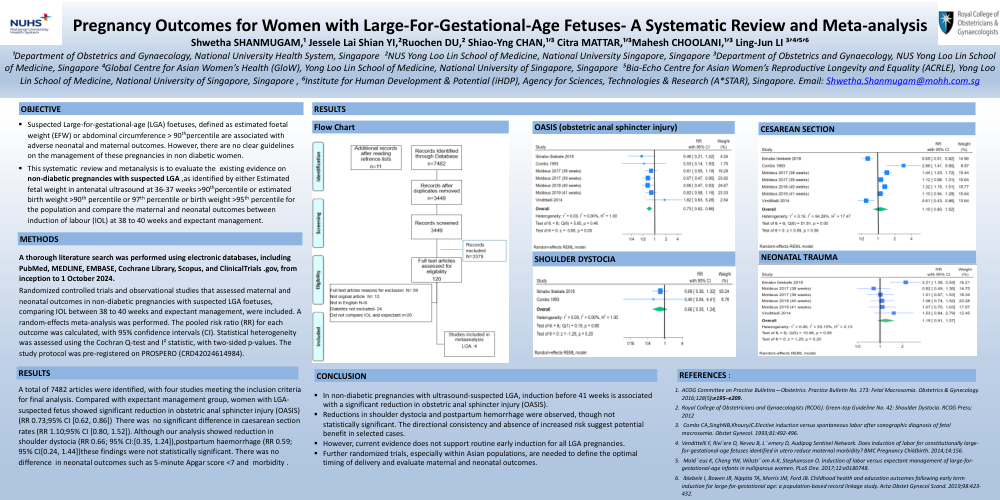
Suspected Large-for-gestational-age (LGA) fetuses, defined as estimated fetal weight (EFW) or abdominal circumference > 90thpercentile are associated with adverse neonatal and maternal outcomes. However, there are no clear guidelines on the management of these pregnancies in non diabetic women.
A thorough literature search was performed using electronic databases, including PubMed, MEDLINE, EMBASE, Cochrane Library, Scopus, and ClinicalTrials .gov, from inception to 1 October 2024.
Randomized controlled trials and observational studies that assessed maternal and neonatal outcomes in non-diabetic pregnancies with suspected LGA foetuses, comparing IOL between 38 to 40 weeks and expectant management, were included. A random-effects meta-analysis was performed. The pooled risk ratio (RR) for each outcome was calculated, with 95% confidence intervals (CI). Statistical heterogeneity was assessed using the Cochran Q-test and I² statistic, with two-sided p-values. The study protocol was pre-registered on PROSPERO (CRD42024614984).
RESULTS :
A total of 7482 articles were identified, with four studies meeting the inclusion criteria for final analysis. Compared with expectant management group, women with LGA-suspected fetus showed significant reduction in obstetric anal sphincter injury (OASIS) (RR 0.73 ;95% CI:[0.62, 0.86] There was no significant difference in caesarean section rates (RR 1.10; 95% CI [0.80, 1.52). Although our analysis showed reduction in shoulder dystocia (RR 0.66; 95% CI:0.35, 1.24 )postpartum haemorrhage (RR 0.59; 95% CI: 0.24, 1.44 )these findings were not statistically significant. There was no difference in neonatal outcomes such as 5-minute Apgar score <7 and morbidity .
CONCLUSION: