2,281 posters, 63 videos, 56 audios, 43 topics, 18 sessions, 6,174 authors, 2,323 institutions
ePostersLive by SciGen Technologies S.A. All rights reserved.
RCOG World Congress 2025
June 23 - 25, 2025 | ExCeL London, UK
EP.0911
An audit of ‘Cervical Cerclage Outcomes’ at Queen Alexandra Hospital, Portsmouth
Poster Presenter
Authors
Dalia Cardenes Trujillo, Savitha Shetty, Nirmala Vaithilingham
Affiliations
Part of Topic
High risk pregnancy
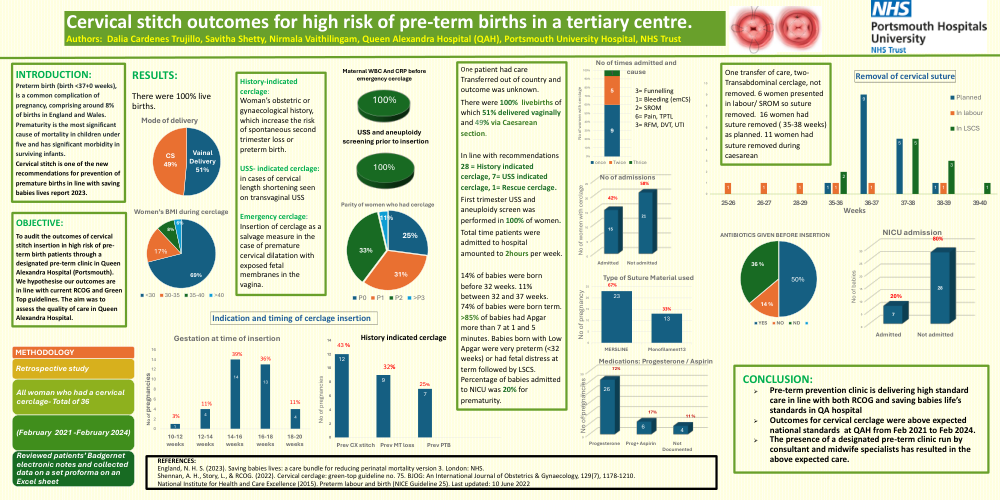
INTRODUCTION: Preterm birth (birth <37+0 weeks), is a common complication of pregnancy, comprising around 8% of births in England and Wales. Prematurity is the most significant cause of mortality in children under five and has significant morbidity in surviving infants.
Cervical stitch is one of the new recommendations for prevention of premature births in line with saving babies lives report 2023.
OBJECTIVE: To audit the outcomes of cervical stitch insertion in high risk of pre-term birth patients through a designated pre-term clinic in Queen Alexandra Hospital (Portsmouth). We hypothesise our outcomes are in line with current RCOG and Green Top guidelines. The aim was to assess the quality of care in Queen Alexandra Hospital.
METHODOLOGY: Retrospective study, All woman who had a cervical cerclage- Total of 36 (February 2021 -Frbruary 2024). Reviewed patients’ Badgernet electronic notes and collected data on a set proforma on an Excel sheet.
History-indicated cerclage:
Woman’s obstetric or gynaecological history, which increase the risk of spontaneous second trimester loss or preterm birth.
USS- indicated cerclage: in cases of cervical length shortening seen on transvaginal USS
Emergency cerclage: Insertion of cerclage as a salvage measure in the case of premature cervical dilatation with exposed fetal membranes in the vagina.
RESULTS:
One patient had care Transferred out of country and outcome was unknown.
There were 100% livebirths of which 51% delivered vaginally and 49% via Caesarean section.
In line with recommendations 28 = History indicated cerclage, 7= USS indicated cerclage, 1= Rescue cerclage.
First trimester USS and aneuploidy screen was performed in 100% of women.
Total time patients were admitted to hospital amounted to 2hours per week.
14% of babies were born before 32 weeks. 11% between 32 and 37 weeks. 74% of babies were born term.
>85% of babies had Apgar more than 7 at 1 and 5 minutes. Babies born with Low Apgar were very preterm (<32 weeks) or had fetal distress at term followed by LSCS.
Percentage of babies admitted to NICU was 20% for prematurity.
CONCLUSION: