2,281 posters, 63 videos, 56 audios, 43 topics, 18 sessions, 6,174 authors, 2,323 institutions
ePostersLive by SciGen Technologies S.A. All rights reserved.
RCOG World Congress 2025
June 23 - 25, 2025 | ExCeL London, UK
EP.0909
T cell metabolomics in Pre-eclampsia, Pregnancy with Chronic hypertension & Normal pregnancy
Part of Topic
High risk pregnancy
T cell metabolomics in Pre-eclampsia, Pregnancy with Chronic hypertension & Normal pregnancy
Pandey Amita, Gautam Nisha, Agarwal Vikas, Kaul Anupama
Objective
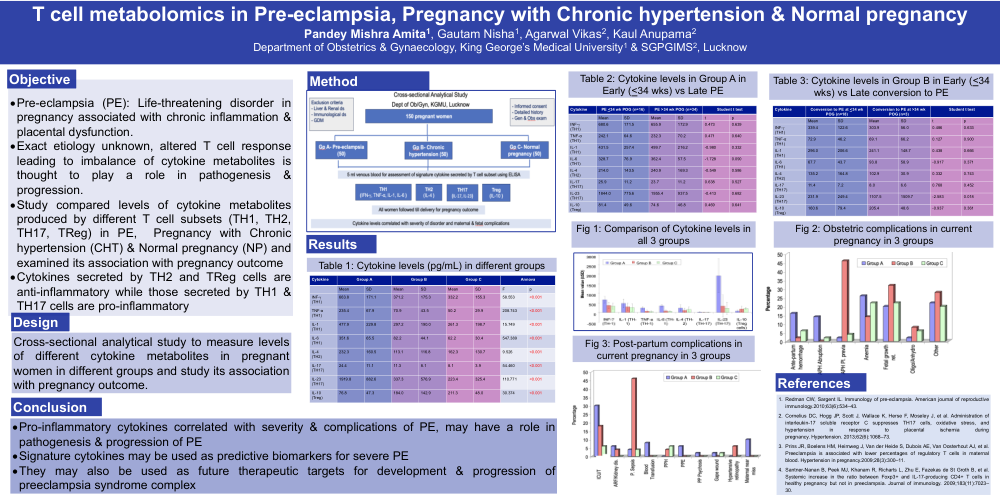
Pre-eclampsia (PE) is a life-threatening disorder in pregnancy associated with chronic inflammation & placental dysfunction. Although exact etiology is unknown, altered T cell response leading to imbalance of cytokine metabolites is thought to play a role in pathogenesis & progression. We compared levels of cytokine metabolites produced by different T cell subsets (TH1, TH2, TH17, TReg) in PE, Pregnancy with Chronic hypertension (CHT) & Normal pregnancy (NP) and studied its association with pregnancy outcome.
Design
Cross-sectional analytical study to measure levels of different cytokine metabolites in pregnant women in different groups and study its association with pregnancy outcome.
Method
150 pregnant women, 50 each with PE, CHT & NP were registered in the study from antenatal OPD of a tertiary care centre in North India. Women with co-morbidities like gestational diabetes, autoimmune disorder, chronic renal or liver diseases were excluded. After history & examination, 5 ml venous blood was collected & signature cytokine metabolites secreted by the different T cell subtypes – TH1 (IFN-g, TNF-α, IL-1, IL-6); Th2 (IL-4); TH17 (IL-17, IL-23); TRegs (IL-10) were estimated in serum by sandwich ELISA technique and compared in the 3 groups. All registered women were followed till delivery to assess pregnancy outcome and cytokine levels were correlated with severity of disorder and maternal & fetal complications.
Results
Pro-inflammatory TH1 & TH17 cytokines were increased in PE (p>0.001) as compared to CHT & NP. Anti-inflammatory TH2 & TReg cytokines were higher in NP (p<0.001) and CHT without superimposed PE (p<0.05). Higher levels of pro-inflammatory cytokines were associated with placental abruption, intrauterine death, superimposed severe PE, postpartum eclampsia, need for postpartum ICU care, renal injury, postpartum sepsis and fetal growth restriction.
Conclusion
Correlation of pro-inflammatory cytokines with PE, its severity & complications provides an insight into its role in pathogenesis & progression of PE. These signature cytokines may further be used as predictive biomarkers for severe pre-eclampsia & future therapeutic targets for development & progression of preeclampsia syndrome complex.