2,281 posters, 63 videos, 56 audios, 43 topics, 18 sessions, 6,174 authors, 2,323 institutions
ePostersLive by SciGen Technologies S.A. All rights reserved.
RCOG World Congress 2025
June 23 - 25, 2025 | ExCeL London, UK
EP.0908
Measurement of eGFR in pregnancy: Serum Creatinine-Based Alternative to 24-Hour-Urine Creatinine Clearance
Poster Presenter
Part of Topic
High risk pregnancy
Measurement of eGFR in pregnancy: Serum Creatinine-Based Alternative to 24-Hour-Urine Creatinine Clearance
Amita Pandey, Priya Agarwal, Anupama Kaul
Objective
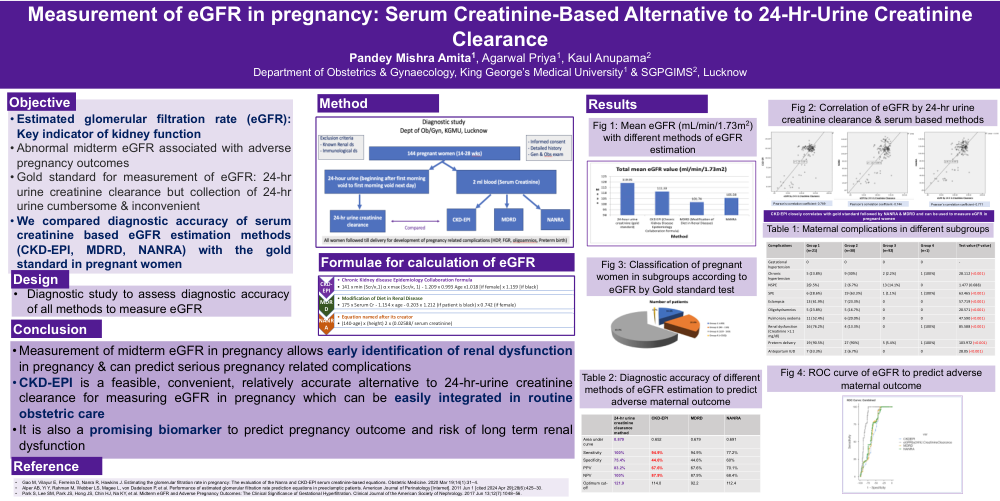
Pre-existing or new-onset renal dysfunction is common in hypertensive disorders & high risk pregnancies. Estimated Glomerular Filtration Rate (eGFR) is a key indicator for kidney dysfunction. Abnormal eGFR in midterm pregnancy is known to be associated with adverse pregnancy outcomes. The Gold standard for measurement of eGFR is 24-hr urine creatinine clearance but collection of 24-hr urine is cumbersome & inconvenient. We compared the diagnostic accuracy of serum creatinine based eGFR estimation methods (CKD-EPI, MDRD, NANRA) with the gold standard in pregnant women.
Design
Diagnostic study to assess diagnostic accuracy of all methods to measure eGFR
Method
144 pregnant women were registered from antenatal OPD of a Tertiary care Hospital in North India after excluding renal & immunological diseases. Between 14-28 weeks gestation, each participant collected a 24-hour urine sample for measurement of 24-hr-urine creatinine clearance. Simultaneously, 2 ml blood sample was taken to measure serum creatinine from which eGFR was calculated using CKD-EPI, MDRD, and NANRA formulae. All women were followed till delivery for development of pregnancy related complications.
Results
The mean eGFR measured by 24-hour-urine creatinine clearance in 144 pregnant women was 119 ± 27.89 mL/min/1.73m². All serum creatinine-based methods underestimated eGFR, with CKD-EPI averaging 111.33 ± 31.45 mL/min/1.73m², NANRA 105.58 ± 30.10 mL/min/1.73m² and MDRD 101.74 ± 32.34 mL/min/1.73m². Pearson’s Correlation coefficient was highest for CKD-EPI (0.789), followed by NANRA (0.771) and MDRD (0.744) indicating its strong correlation with the gold standard. 35.4% women had lower than normal eGFR and on follow-up, they had significantly more complications like preeclampsia, fetal growth restriction, preterm delivery, intrauterine death and renal dysfunction requiring treatment. ROC curve of eGFR to predict pregnancy complications showed the best diagnostic accuracy of gold standard followed by CKD-EPI method.
Conclusion
Measurement of midterm eGFR in pregnancy allows early identification of renal dysfunction in pregnancy and can predict serious pregnancy related complications. CKD-EPI is a feasible, convenient, relatively accurate alternative to 24-hr-urine creatinine clearance for measuring eGFR in pregnancy which can be easily integrated in routine obstetric care. It is also a promising biomarker to predict pregnancy outcome and risk of long term renal dysfunction.