2,281 posters, 63 videos, 56 audios, 43 topics, 18 sessions, 6,174 authors, 2,323 institutions
ePostersLive by SciGen Technologies S.A. All rights reserved.
RCOG World Congress 2025
June 23 - 25, 2025 | ExCeL London, UK
EP.0906
Pregnancy and Kawasaki disease: A systematic review
Poster Presenter
Authors
Yomna W. Mahmoud, Yara Ali Eltobgi, Raghad W.Y. Mahmoud, Yassin El-Shnawy, Mariam S. Abdulhafiz, Mohamed Ramadan S., Mohamed A. Ali, Rahaf A. M. Elzayat, Sara Naser Sebie, Maryam Ahmed Yehia Ahmed Farid, Maryam A. Elashmawi, Rana A. Elashmawi, Mohammad T. Abuawwad, Mohammad J. Taha
Affiliations
Faculty of Medicine, Cairo University, Faculty of Pharmacy and Biotechnology, German University in Cairo, Faculty of Medicine, New Giza University
Part of Topic
High risk pregnancy
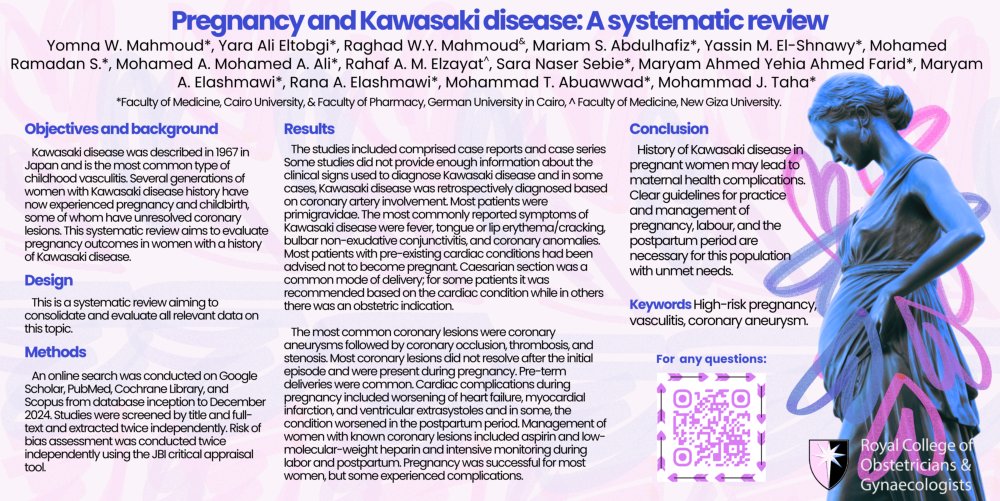
Pregnancy and Kawasaki disease: A systematic review
Objectives and background: Kawasaki disease was described in 1967 in Japan and is the most common type of childhood vasculitis. Several generations of women with Kawasaki disease history have now experienced pregnancy and childbirth, some of whom have unresolved coronary lesions. This systematic review aims to evaluate pregnancy outcomes in women with a history of Kawasaki disease.
Design: This is a systematic review aiming to consolidate and evaluate all relevant data on this topic.
Methods: An online search was conducted on Google Scholar, PubMed, Cochrane Library, and Scopus from database inception to December 2024. Studies were screened by title and full-text and extracted twice independently. Risk of bias assessment was conducted twice independently using the JBI critical appraisal tool.
Results:
The studies included comprised case reports and case series. Some studies did not provide enough information about the clinical signs used to diagnose Kawasaki disease and in some cases, Kawasaki disease was retrospectively diagnosed based on coronary artery involvement. Most patients were primigravidae. The most commonly reported symptoms of Kawasaki disease were fever, tongue or lip erythema/cracking, bulbar non-exudative conjunctivitis, and coronary anomalies. Most patients with pre-existing cardiac conditions had been advised not to become pregnant. Caesarian section was a common mode of delivery; for some patients it was recommended based on the cardiac condition while in others there was an obstetric indication.
The most common coronary lesions were coronary aneurysms followed by coronary occlusion, thrombosis, and stenosis. Most coronary lesions did not resolve after the initial episode and were present during pregnancy. Pre-term deliveries were common. Cardiac complications during pregnancy included worsening of heart failure, myocardial infarction, and ventricular extrasystoles and in some, the condition worsened in the postpartum period. Management of women with known coronary lesions included aspirin and low-molecular-weight heparin and intensive monitoring during labor and postpartum. Pregnancy was successful for most women, but some experienced complications.
Conclusion: History of Kawasaki disease in pregnant women may lead to maternal health complications. Clear guidelines for practice and management of pregnancy, labour, and the postpartum period are necessary for this population with unmet needs.
Keywords: High-risk pregnancy, vasculitis, coronary aneurysm.
For any questions please contact: Yomna.w.mahmoud@outlook.com