2,281 posters, 63 videos, 56 audios, 43 topics, 18 sessions, 6,174 authors, 2,323 institutions
ePostersLive by SciGen Technologies S.A. All rights reserved.
RCOG World Congress 2025
June 23 - 25, 2025 | ExCeL London, UK
EP.0905
Experience and Outcomes of a Specialised Preterm Birth Clinic in Singapore
Poster Presenter
Part of Topic
High risk pregnancy
Experience and Outcomes of a Specialised Preterm Birth Clinic in Singapore
Objective:
Since July 2021, the Preterm Birth Clinic at KK Women’s and Children’s Hospital has aimed to provide comprehensive care for at-risk pregnant individuals. The clinic focuses on early screening, risk assessment, and targeted interventions to reduce PTB rates. We evaluate the outcomes of the first consultant-led preterm birth (PTB) clinic in KK Women's and Children's Hospital (KKH), Singapore.
Methods:
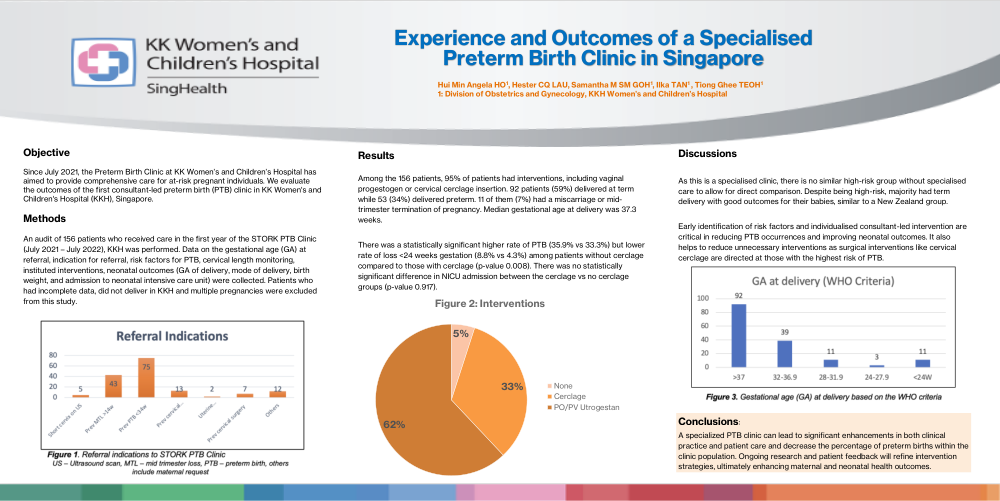
An audit of 156 patients who received care in the first year of the STORK PTB Clinic (July 2021 – July 2022), KKH was performed. Data on the gestational age (GA) at referral, indication for referral, risk factors for PTB, cervical length monitoring, instituted interventions, neonatal outcomes (GA of delivery, mode of delivery, birth weight, and admission to neonatal intensive care unit) were collected. Patients who had incomplete data, did not deliver in KKH and multiple pregnancies were excluded from this study.
Results:
Among the 156 patients, 95% of patients had interventions, including vaginal progestogen or cervical cerclage insertion. 92 patients (59%) delivered at term while 53 (34%) delivered preterm. 11 of them (7%) had a miscarriage or mid-trimester termination of pregnancy. Median gestational age at delivery was 37.3 weeks.
There was a statistically significant higher rate of PTB (35.9% vs 33.3%) but lower rate of loss <24 weeks gestation (8.8% vs 4.3%) among patients without cerclage compared to those with cerclage (p-value 0.008). There was no statistically significant difference in NICU admission between the cerclage vs no cerclage groups (p-value 0.917).
Discussions:
As this is a specialised clinic, there is no similar high-risk group without specialised care to allow for direct comparison. Despite being high-risk, majority had term delivery with good outcomes for their babies, similar to a New Zealand group.
Early identification of risk factors and individualised consultant-led intervention are critical in reducing PTB occurrences and improving neonatal outcomes. It also helps to reduce unnecessary interventions as surgical interventions like cervical cerclage are directed at those with the highest risk of PTB.
Conclusions: A specialized PTB clinic can lead to significant enhancements in both clinical practice and patient care and decrease the percentage of preterm births within the clinic population. Ongoing research and patient feedback will refine intervention strategies, ultimately enhancing maternal and neonatal health outcomes.