2,281 posters, 63 videos, 56 audios, 43 topics, 18 sessions, 6,174 authors, 2,323 institutions
ePostersLive by SciGen Technologies S.A. All rights reserved.
RCOG World Congress 2025
June 23 - 25, 2025 | ExCeL London, UK
EP.0902
Comparing Phenotypic Severity of Different Diagnostic Criteria of Preeclampsia - a Retrospective Study
Poster Presenter
Part of Topic
High risk pregnancy
Comparing Phenotypic Severity of Preeclampsia Using Different Diagnostic Criteria of Preeclampsia - A Retrospective Cohort Study
Li Justin, Lee MK Mandy, Au Sin Tung Tiffany, Chan Tat On, Seto Tin Yan Mimi, Cheung Ka Wang
Objective
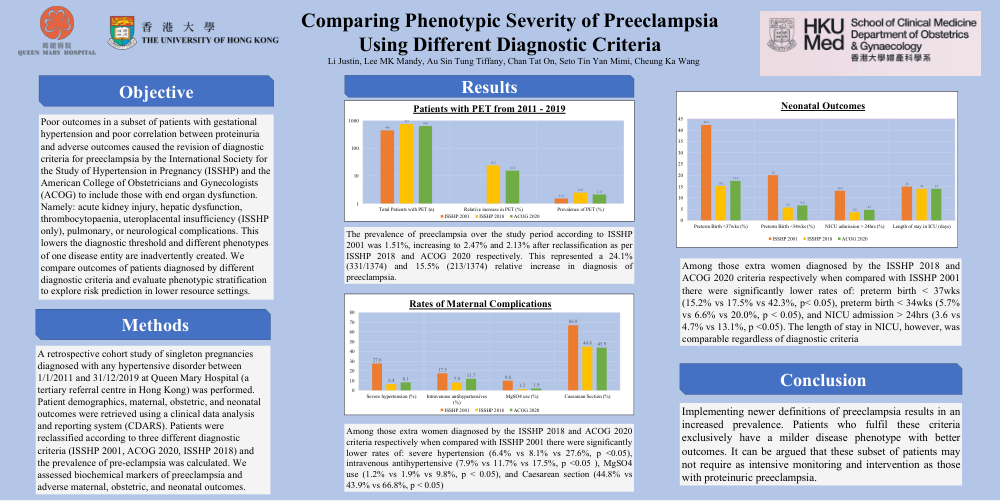
Poor outcomes in a subset of patients with gestational hypertension and poor correlation between proteinuria and adverse outcomes caused the revision of diagnostic criteria for preeclampsia by the International Society for the Study of Hypertension in Pregnancy (ISSHP) and the American College of Obstetricians and Gynecologists (ACOG) to include those with end organ dysfunction. Namely: acute kidney injury, hepatic dysfunction, thrombocytopaenia, uteroplacental insufficiency (ISSHP only), pulmonary, or neurological complications. This lowers the diagnostic threshold and different phenotypes of one disease entity are inadvertently created. We compare outcomes of patients diagnosed by different diagnostic criteria and evaluate phenotypic stratification to explore risk prediction in lower resource settings.
Methods
A retrospective cohort study of singleton pregnancies diagnosed with any hypertensive disorder between 1/1/2011 and 31/12/2019 at Queen Mary Hospital (a tertiary referral centre in Hong Kong) was performed. Patient demographics, maternal, obstetric, and neonatal outcomes were retrieved using a clinical data analysis and reporting system (CDARS). Patients were reclassified according to three different diagnostic criteria (ISSHP 2001, ACOG 2020, ISSHP 2018) and the prevalence of pre-eclampsia was calculated. We assessed biochemical markers of preeclampsia and adverse maternal, obstetric, and neonatal outcomes.
Results
The prevalence of preeclampsia over the study period according to ISSHP 2001 was 1.51%, increasing to 2.47% and 2.13% after reclassification as per ISSHP 2018 and ACOG 2020 respectively. This represented a 24.1% (331/1374) and 15.5% (213/1374) relative increase in diagnosis of preeclampsia. Among those extra women diagnosed by the ISSHP 2018 and ACOG 2020 criteria respectively when compared with ISSHP 2001 there were significantly lower rates of: severe hypertension (6.4% vs 8.1% vs 27.6%, p <0.05), intravenous antihypertensive (7.9% vs 11.7% vs 17.5%, p <0.05 ) and MgSO4 use (1.2% vs 1.9% vs 9.8%, p < 0.05), preterm birth < 37wks (15.2% vs 17.5% vs 42.3%) and preterm birth < 34wks (5.7% vs 6.6% vs 20.0%, p < 0.05), Caesarean section (44.8% vs 43.9% vs 66.8%, p < 0.05) and NICU admission > 24hrs (3.6 vs 4.7% vs 13.1%, p <0.05). The
Conclusion
Implementing newer definitions of preeclampsia results in an increased prevalence. Patients who fulfil these criteria exclusively have a milder disease phenotype with better outcomes. It can be argued that these subset of patients may not require as intensive monitoring and intervention as those with proteinuric preeclampsia.