2,281 posters, 63 videos, 56 audios, 43 topics, 18 sessions, 6,174 authors, 2,323 institutions
ePostersLive by SciGen Technologies S.A. All rights reserved.
RCOG World Congress 2025
June 23 - 25, 2025 | ExCeL London, UK
EP.0900
Preeclampsia with and without Fetal Growth Restriction at High Altitude
Poster Presenter
Authors
Victor Rangel, Violeta Avendaño, Jose Daza, Juliana Malagon, Juan Duarte, Mariana Abril, Alejandra Vivas
Affiliations
Part of Topic
High risk pregnancy
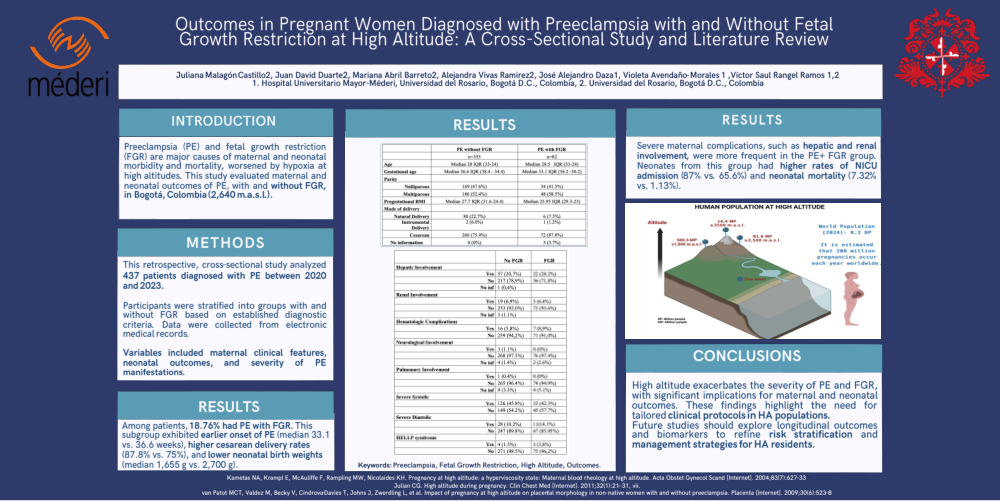
Outcomes in Pregnant Women Diagnosed with Preeclampsia with and Without Fetal Growth Restriction at High Altitude: A Cross-Sectional Study and Literature Review
Background:
Preeclampsia (PE) and fetal growth restriction (FGR) are major contributors to maternal and neonatal morbidity
and mortality globally. The pathophysiology of these conditions is further complicated by high-altitude (HA)
environments due to hypoxia-induced changes in maternal and fetal physiology. This study aimed to evaluate
the maternal and neonatal outcomes of PE, with and without FGR, in a HA setting (Bogotá, Colombia, 2,640
m.a.s.l.).
Methods:
This retrospective, cross-sectional study analyzed 437 patients diagnosed with PE between 2020 and 2023.
Participants were stratified into groups with and without FGR based on established diagnostic criteria. Data
were collected from electronic medical records. Variables included maternal clinical features, neonatal
outcomes, and severity of PE manifestations.
Findings:
Among patients, 18.76% had PE with FGR. This subgroup exhibited earlier onset of PE (median 33.1 vs. 36.6
weeks), higher cesarean delivery rates (87.8% vs. 75%), and lower neonatal birth weights (median 1,655 g vs.
2,700 g). Severe maternal complications, such as hepatic and renal involvement, were more frequent in the PE
+ FGR group. Neonates from this group had higher rates of NICU admission (87% vs. 65.6%) and neonatal
mortality (7.32% vs. 1.13%).
Interpretation:
High altitude exacerbates the severity of PE and FGR, with significant implications for maternal and neonatal
outcomes. These findings highlight the need for tailored clinical protocols in HA populations and underscore
the importance of further research into genetic and adaptive mechanisms influencing these conditions. Future
studies should explore longitudinal outcomes and biomarkers to refine risk stratification and management
strategies for HA residents.