2,281 posters, 63 videos, 56 audios, 43 topics, 18 sessions, 6,174 authors, 2,323 institutions
ePostersLive by SciGen Technologies S.A. All rights reserved.
RCOG World Congress 2025
June 23 - 25, 2025 | ExCeL London, UK
EP.0895
Maternal and Neonatal Outcomes in Rh-Isoimmunised Pregnancies Post RAADP: A Retrospective Study
Poster Presenter
Authors
Affiliations
Part of Topic
High risk pregnancy
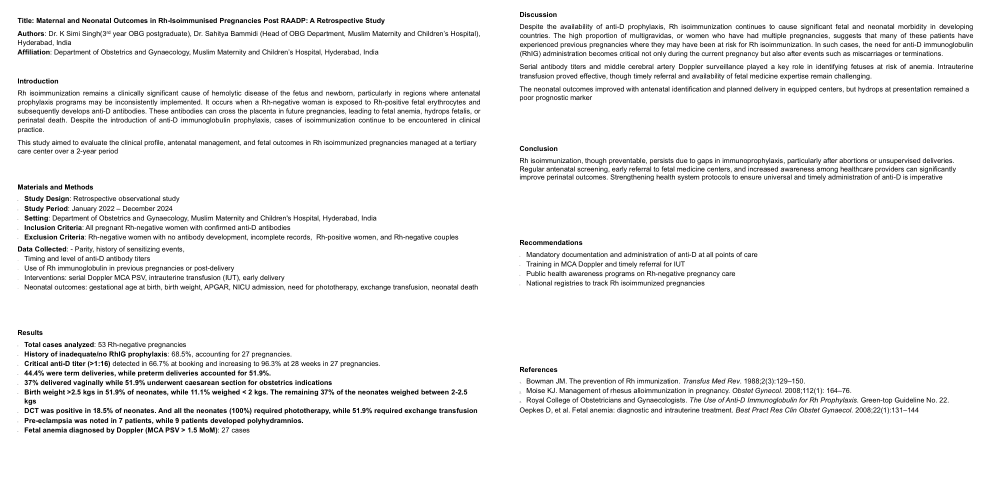
Title: Maternal and Neonatal Outcomes in Rh-Isoimmunised Pregnancies Post RAADP: A Retrospective Study
Authors: Dr. K Simi Singh(3rd year OBG postgraduate), Dr. Sahitya Bammidi (Head of OBG Department, Muslim Maternity and Children’s Hospital), Hyderabad, India
Affiliation: Department of Obstetrics and Gynaecology, Muslim Maternity and Children’s Hospital, Hyderabad, India
Introduction
Rh isoimmunization remains a clinically significant cause of hemolytic disease of the fetus and newborn, particularly in regions where antenatal prophylaxis programs may be inconsistently implemented. It occurs when an Rh-negative woman is exposed to Rh-positive fetal erythrocytes and subsequently develops anti-D antibodies. These antibodies can cross the placenta in future pregnancies, leading to fetal anemia, hydrops fetalis, or perinatal death. Despite the introduction of anti-D immunoglobulin prophylaxis, cases of isoimmunization continue to be encountered in clinical practice.
This study aimed to evaluate the clinical profile, antenatal management, and fetal outcomes in Rh isoimmunized pregnancies managed at a tertiary care center over a 2-year period.
Materials and Methods
- • Study Design: Retrospective observational study
- • Study Period: January 2022 – December 2024
- • Setting: Department of Obstetrics and Gynaecology, Muslim Maternity and Children's Hospital, Hyderabad, India
- • Inclusion Criteria: All pregnant Rh-negative women with confirmed anti-D antibodies
- • Exclusion Criteria: Rh-negative women with no antibody development, incomplete records, Rh-positive women, and Rh-negative couples
Data Collected: - Parity, history of sensitizing events,
- Timing and level of anti-D antibody titers
- Use of Rh immunoglobulin in previous pregnancies or post-delivery
- Interventions: serial Doppler MCA PSV, intrauterine transfusion (IUT), early delivery
- Neonatal outcomes: gestational age at birth, birth weight, APGAR, NICU admission, need for phototherapy, exchange transfusion, neonatal death
Results
- • Total cases analyzed: 53 Rh-negative pregnancies
- • History of inadequate/no RhIG prophylaxis: 68.5%, accounting for 27 pregnancies.
- • Critical anti-D titer (>1:16) detected in 66.7% at booking and increasing to 96.3% at 28 weeks in 27 pregnancies.
- • 44.4% were term deliveries, while preterm deliveries accounted for 51.9%.
- • 37% delivered vaginally while 51.9% underwent caesarean section for obstetrics indications
- • Birth weight >2.5 kgs in 51.9% of neonates, while 11.1% weighed < 2 kgs. The remaining 37% of the neonates weighed between 2-2.5 kgs
- • DCT was positive in 18.5% of neonates. And all the neonates (100%) required phototherapy, while 51.9% required exchange transfusion
- • Pre-eclampsia was noted in 7 patients, while 9 patients developed polyhydramnios.
- • Fetal anemia diagnosed by Doppler (MCA PSV > 1.5 MoM): 27 cases
Discussion
Despite the availability of anti-D prophylaxis, Rh isoimmunization continues to cause significant fetal and neonatal morbidity in developing countries. The high proportion of multigravidas, or women who have had multiple pregnancies, suggests that many of these patients have experienced previous pregnancies where they may have been at risk for Rh isoimmunization. In such cases, the need for anti-D immunoglobulin (RhIG) administration becomes critical not only during the current pregnancy but also after events such as miscarriages or terminations.
Serial antibody titers and middle cerebral artery Doppler surveillance played a key role in identifying fetuses at risk of anemia. Intrauterine transfusion proved effective, though timely referral and availability of fetal medicine expertise remain challenging.
The neonatal outcomes improved with antenatal identification and planned delivery in equipped centers, but hydrops at presentation remained a poor prognostic marker.
Conclusion
Rh isoimmunization, though preventable, persists due to gaps in immunoprophylaxis, particularly after abortions or unsupervised deliveries. Regular antenatal screening, early referral to fetal medicine centers, and increased awareness among healthcare providers can significantly improve perinatal outcomes. Strengthening health system protocols to ensure universal and timely administration of anti-D is imperative.
Recommendations
- • Mandatory documentation and administration of anti-D at all points of care
- • Training in MCA Doppler and timely referral for IUT
- • Public health awareness programs on Rh-negative pregnancy care
- • National registries to track Rh isoimmunized pregnancies
References
- Bowman JM. The prevention of Rh immunization. Transfus Med Rev. 1988;2(3):129–150.
- Moise KJ. Management of rhesus alloimmunization in pregnancy. Obstet Gynecol. 2008;112(1): 164–76.
- Royal College of Obstetricians and Gynaecologists. The Use of Anti-D Immunoglobulin for Rh Prophylaxis. Green-top Guideline No. 22.
- Oepkes D, et al. Fetal anemia: diagnostic and intrauterine treatment. Best Pract Res Clin Obstet Gynaecol. 2008;22(1):131–144.