2,281 posters, 63 videos, 56 audios, 43 topics, 18 sessions, 6,174 authors, 2,323 institutions
ePostersLive by SciGen Technologies S.A. All rights reserved.
RCOG World Congress 2025
June 23 - 25, 2025 | ExCeL London, UK
EP.0889
Prevalence and factors associated with low 5th minute APGAR score
Poster Presenter
Part of Topic
High risk pregnancy
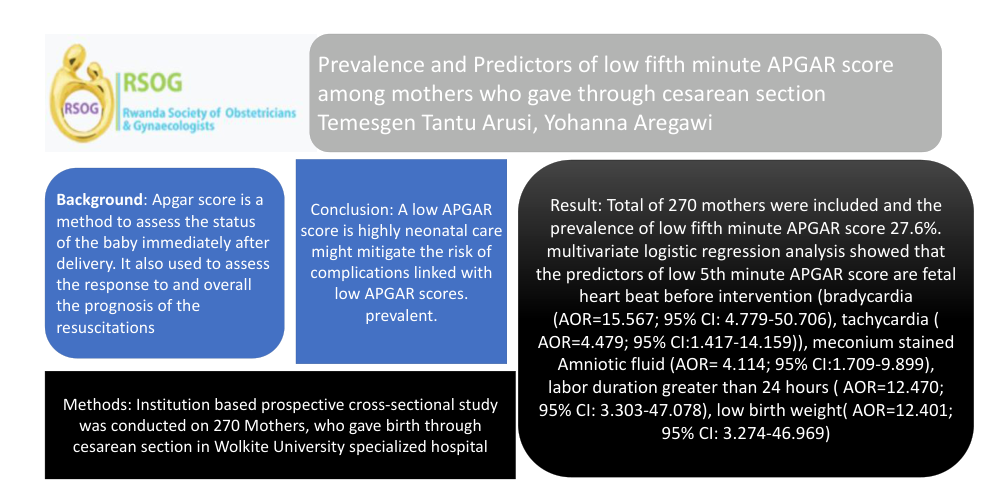
Prevalence and Predictors of low fifth minute APGAR score among mothers who gave through cesarean section at Wolkite University specialized hospital, Gurage zone south Ethiopia.
Background: Apgar score is a method to assess the status of the baby immediately after delivery. It also used to assess the response to and overall the prognosis of the resuscitations. It is one of the simple and commonest way of conveying the neonatal status among the health professionals as well as to intervene as early as possible without delay. In Ethiopia Birth asphyxia is the one leading cause of neonatal mortality and morbidity. The APGAR score especially the 5th minute one has strong prediction of the neonatal outcome than the 1st minute APGAR score so this study focuses on identifying the predictors of 5th minute APGAR score among mothers who gave birth through cesarean section in Wolkite University specialized hospital in May 2023 G.C
Methods: Institution based prospective cross-sectional study was conducted on 270 Mothers, who gave birth through cesarean section in Wolkite University specialized hospital from March – May 2024 GC. The data collection was conducted through meticulous chart review and interviews. Data were entered using Epi data 7 and analyzed with SPSS 26. The association between independent variables and the 5th minute APGAR was estimated using an odds ratio with 95% confidence intervals. The statistical significance of the association was declared at P-value < 0.05.
Results: Total of 270 mothers were included and the prevalence of low fifth minute APGAR score 27.6%. multivariate logistic regression analysis showed that the predictors of low 5th minute APGAR score are fetal heart beat before intervention (bradycardia (AOR=15.567; 95% CI: 4.779-50.706), tachycardia ( AOR=4.479; 95% CI:1.417-14.159)), meconium stained Amniotic fluid (AOR= 4.114; 95% CI:1.709-9.899), labor duration greater than 24 hours ( AOR=12.470; 95% CI: 3.303-47.078), low birth weight( AOR=12.401; 95% CI: 3.274-46.969)
Conclusion: A low APGAR score is highly prevalent. The aforementioned characteristics are statistically significant predictors of poor APGAR. Enhancing the quality of obstetric and neonatal care might mitigate the risk of complications linked with low APGAR scores.
Key words: APGAR score, perinatal asphyxia, low birth weight, meconium