2,281 posters, 63 videos, 56 audios, 43 topics, 18 sessions, 6,174 authors, 2,323 institutions
ePostersLive by SciGen Technologies S.A. All rights reserved.
RCOG World Congress 2025
June 23 - 25, 2025 | ExCeL London, UK
EP.0885
ANALYSIS OF MATERNAL & FETAL ABO AND RHESUS STATUS IN CASES OF PREECLAMPSIA
Poster Presenter
Authors
Affiliations
Part of Topic
High risk pregnancy
Corrections
Title: THE ANALYSIS OF MATERNAL AND FETAL ABO AND RHESUS STATUS IN CASES OF PREECLAMPSIA
Authors:
Prof. Uma Pandey1
Prof. Sandip Kumar 4 Prof. SW Lindow3
Dr. Arti Kumari 2
1. Professor, , Department of Obstetrics and Gynecology, Institute of Medical Sciences, Banaras Hindu University, Varanasi.
2. Junior resident, Department of Obstetrics and Gynecology , Institute of Medical Sciences, Banaras Hindu University, Varanasi
3. Director Masters Projects. The Coombe Hospital. Dublin . Ireland. Hon Professor of Obstetrics and Gynaecology. University Cape Town. South Africa.
4. Professor & Head, Department of Pathology, Institute of Medical Science, Banaras Hindu University, Varanasi.
Introduction -Preeclampsia (PE), a severe pregnancy-related condition, affects various organ systems. PE poses significant risks to maternal and fetal health making careful monitoring and proactive management throughout pregnancy to improve prenatal care and outcomes.
Aim - The study aimed to prospectively investigate the relationship between maternal and fetal ABO and Rhesus status and PE
Patients and methods - A case control study was performed with 100 cases of PE (cases) and 200 cases of pregnancies not diagnosed with PE (controls). All cases and controls were women more than 18 years old, having their first baby.
In all cases maternal and fetal (umbilical vein) blood samples were taken for ABO and Rhesus C, c, D, E and e status. Direct Coombs (DCT) and Indirect Coombs (ICT) tests were performed on umbilical blood.
Statistical analysis
The associated parameters were not normally distributed therefore were analysed using non-parametric analyses.
The maternal blood groups were analysed separately from the fetal blood groups and both were analysed (case v control) using a chi-sq analysis. All data were analysed using SPSS (IBM, Armonk, USA).
Results
The total number of cases and controls were 100 and 200, respectively.
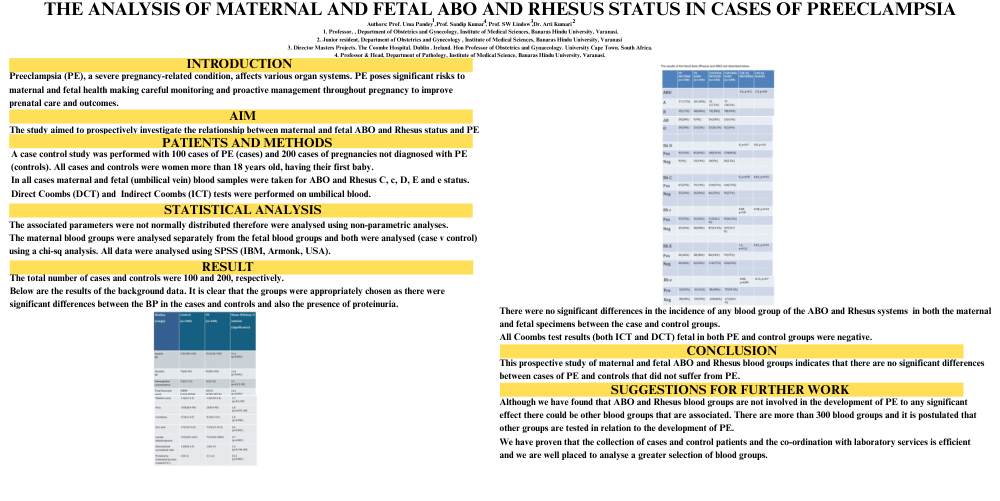
Below are the results of the background data. It is clear that the groups were appropriately chosen as there were significant differences between the BP in the cases and controls and also the presence of proteinuria.
There were no significant differences in the incidence of any blood group of the ABO and Rhesus systems in both the maternal and fetal specimens between the case and control groups.
All Coombs test results (both ICT and DCT) fetal in both PE and control groups were negative.
Conclusion
This prospective study of maternal and fetal ABO and Rhesus blood groups indicates that there are no significant differences between cases of PE and controls that did not suffer from PE.
Suggestions for further work
Although we have found that ABO and Rhesus blood groups are not involved in the development of PE to any significant effect there could be other blood groups that are associated. There are more than 300 blood groups and it is postulated that other groups are tested in relation to the development of PE.
We have proven that the collection of cases and control patients and the co-ordination with laboratory services is efficient and we are well placed to analyse a greater selection of blood groups.