2,281 posters, 63 videos, 56 audios, 43 topics, 18 sessions, 6,174 authors, 2,323 institutions
ePostersLive by SciGen Technologies S.A. All rights reserved.
RCOG World Congress 2025
June 23 - 25, 2025 | ExCeL London, UK
EP.0712
"The Twisting Sign": A Novel Indirect Ultrasonographic Marker for Diagnosing Deep Endometriosis
Poster Presenter
Authors
Fabio Barra, Simone Ferrero, Umberto Perrone, Giulio Evangelisti, Alessandra Pulliero, Alberto Izzotti, Umberto Leone Roberti Maggiore, Stefano Bogliolo
Affiliations
Unit of Obstetrics and Gynecology, IRCCS Ospedale Policlinico San Martino, Department of Health Sciences (DISSAL), University of Genoa, Department of Experimental Medicine (DIMES), University of Genoa, Unit of Obstetrics and Gynecology, P.O. "Ospedale del Tigullio"-ASL4, Academic Unit of Obstetrics and Gynecology, IRCCS Ospedale Policlinico San Martino, Unit of Obstetrics and Gynecology, San Paolo Hospital - ASL2, Gynecologic Oncology, Fondazione IRCCS Istituto Nazionale Tumori di Milano
Part of Topic
Gynaecological imaging
Audio
BACKGROUND AND OBJECTIVE
Despite advances in the sonographic evaluation of deependometriosis (DE), the orientation and positioning of the uterus —particularly in relation to posterior pelvic lesions—remain underexplored. To assess the "twisting sign" defined as uterine fundus rotation observed on transvaginal sonography (TVS), as a novel indirect ultrasonographic marker for DE and its correlation with specific endometrioticlocalizations and indirect signs of pelvic adhesions.
METHODS
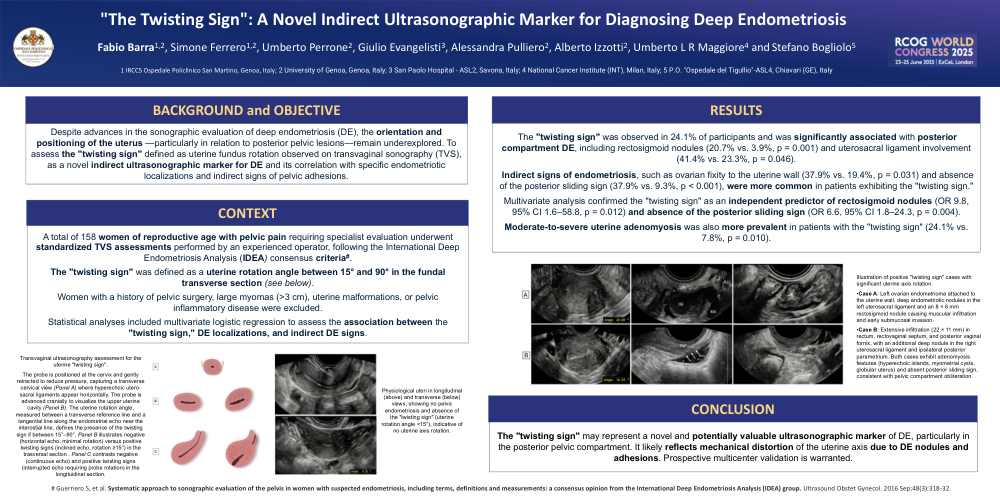
A total of 158 women of reproductive age with pelvic painrequiring specialist evaluationunderwent standardized TVS assessments performed by an experienced operator, following the International Deep Endometriosis Analysis (IDEA) consensus criteria. The "twisting sign" was defined as a uterine rotation angle between 15° and 90° in the fundaltransverse section (see below). Women with a history of pelvicsurgery, large myomas (>3 cm), uterine malformations, or pelvic inflammatory disease were excluded. Statistical analyses includedmultivariate logistic regression to assess the association between the "twisting sign," DE localizations, and indirect DE signs.
RESULTS
The "twisting sign" was observed in 24.1% of participants and wassignificantly associated with posterior compartment DE, including rectosigmoid nodules (20.7% vs. 3.9%, p = 0.001) and uterosacral ligament involvement (41.4% vs. 23.3%, p = 0.046). Indirect signs of endometriosis, such as ovarian fixity to the uterine wall (37.9% vs. 19.4%, p = 0.031) and absence of the posterior sliding sign (37.9% vs. 9.3%, p < 0.001), were more common in patientsexhibiting the "twisting sign". Multivariate analysis confirmed the "twisting sign" as an independen tpredictor of rectosigmoid nodules(OR 9.8, 95% CI 1.6–58.8, p = 0.012) and absence of the posterior sliding sign (OR 6.6, 95% CI 1.8–24.3, p = 0.004). Moderate-to-severe uterine adenomyosis was also more prevalent in patients with the "twisting sign" (24.1% vs. 7.8%, p = 0.010).
CONCLUSION
The "twisting sign" may represent a novel and potentially valuable ultrasonographic marker of DE, particularly in the posterior pelvic compartment. It likely reflects mechanical distortion of the uterine axis due to DE nodules and adhesions. Prospective multicenter validation is warranted.