2,281 posters, 63 videos, 56 audios, 43 topics, 18 sessions, 6,174 authors, 2,323 institutions
ePostersLive by SciGen Technologies S.A. All rights reserved.
RCOG World Congress 2025
June 23 - 25, 2025 | ExCeL London, UK
EP.0710
Assessing the Accuracy of Radiology Imaging in Identifying Ovarian Cyst Nature
Part of Topic
Gynaecological imaging
10% of women will undergo surgery for an ovarian mass during their lifetime. Accurate diagnosis is crucial to avoid unnecessary surgeries and associated risks. The International
Ovarian Tumour Analysis (IOTA) ultrasound study has sensitivity of 95% and a specificity of 91%. Ultrasound should be the initial diagnostic tool for characterizing ovarian
masses, guiding management decisions between conservative approaches and surgical intervention, thereby reducing unnecessary surgeries and associated risks.
DESIGN
This retrospective audit was conducted at Darent Valley Hospital to evaluate the
accuracy of preoperative ultrasound in diagnosing ovarian cysts and compared
findings to standards from the Getting It Right First Time (GIRFT) national
initiative. The study reviewed patient outcomes to assess the correlation between
pre-operative imaging, surgical findings, and histology.
METHODOLOGY
This audit included 99 patients who underwent ovarian cyst surgery from January to
August 2022. Patient list was provided by theatre administrator. Data was collected
from electronic patient records, including clinic letters, operation notes and histology
reports.
RESULTS
•Of the 99 women, 92 underwent elective surgery and 7 required emergency
surgery.
•Laparoscopic surgery was performed in 89% while 13% required laparotomy.
•85% of patients were discharged within 24 hours post-elective surgery. The
median length of stay for emergency ovarian surgery was 3 days, exceeding the
GIRFT benchmark of 2 days, primariliy due to postoperative pain
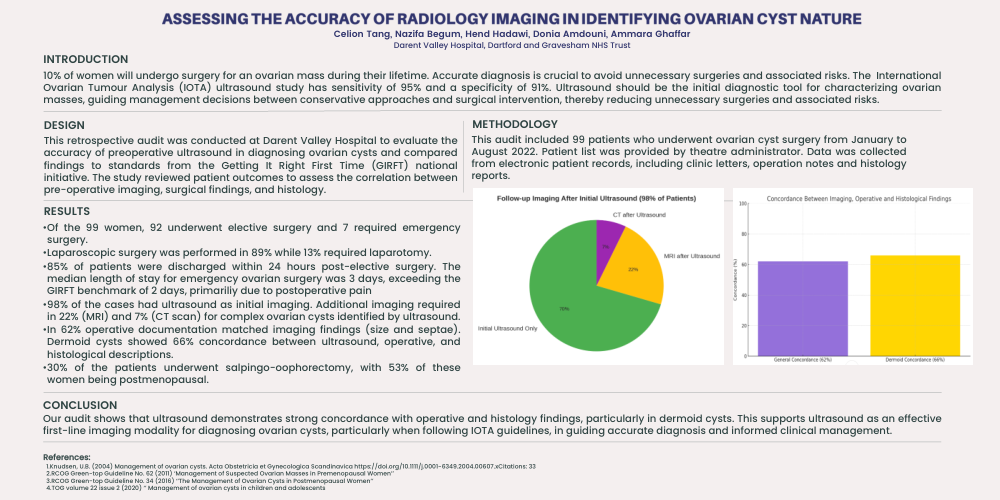
•98% of the cases had ultrasound as initial imaging. Additional imaging required
in 22% (MRI) and 7% (CT scan) for complex ovarian cysts identified by ultrasound.
•In 62% operative documentation matched imaging findings (size and septae).
Dermoid cysts showed 66% concordance between ultrasound, operative, and
histological descriptions.
•30% of the patients underwent salpingo-oophorectomy, with 53% of these
women being postmenopausal.