2,281 posters, 63 videos, 56 audios, 43 topics, 18 sessions, 6,174 authors, 2,323 institutions
ePostersLive by SciGen Technologies S.A. All rights reserved.
RCOG World Congress 2025
June 23 - 25, 2025 | ExCeL London, UK
EP.0706
Pelvic Abscess Following Outpatient Hysteroscopy in Women with Endometriosis: Two Case Reports
Poster Presenter
Authors
Affiliations
Part of Topic
Gynaecological endoscopy
Pelvic Abscess Following Outpatient Hysteroscopy in Women with Endometriosis: Two Case Reports
Mr.SharadaSiriwardena, Ms.SarojiniBurugapalli
Southend University Hospital, Southend on Sea, Essex, United Kingdom
Objective:
A fresh Perspective on Current Standards in Antibiotic Prophylaxis for outpatient hysteroscopy.
This report highlights two cases of pelvic abscess following outpatient hysteroscopy, emphasizing the increased infection with predisposing factors such as pelvic inflammatory disease(PID) & endometriosis.
Case Report- We encountered two complex cases during May 2024 to October 2024 period, among women who had outpatient hysteroscopy
Case 1
A 38-year-old woman with a history of bilateral endometrioma’s underwent endometrial polypectomy during outpatient hysteroscopy.
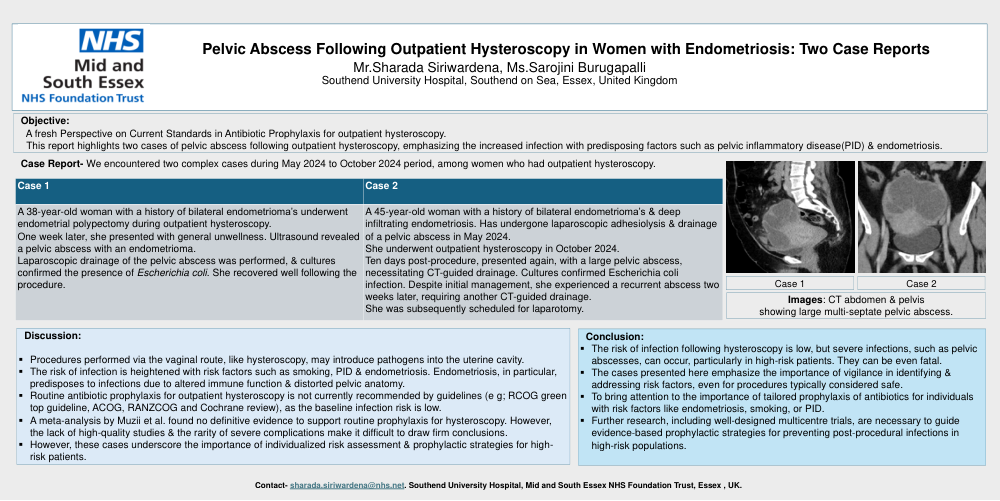
One week later, she presented with general unwellness. Ultrasound revealed a pelvic abscess with an endometrioma.
Laparoscopic drainage of the pelvic abscess was performed, & cultures confirmed the presence of Escherichia coli. She recovered well following the procedure.
Case 2
A 45-year-old woman with a history of bilateral endometrioma’s & deep infiltrating endometriosis. Has undergone laparoscopic adhesiolysis & drainage of a pelvic abscess in May 2024.
She underwent outpatient hysteroscopy in October 2024.
Ten days post-procedure, presented again, with a large pelvic abscess, necessitating CT-guided drainage. Cultures confirmed Escherichia coli infection. Despite initial management, she experienced a recurrent abscess two weeks later, requiring another CT-guided drainage.
She was subsequently scheduled for laparotomy.
Discussion:
Conclusion: