2,281 posters, 63 videos, 56 audios, 43 topics, 18 sessions, 6,174 authors, 2,323 institutions
ePostersLive by SciGen Technologies S.A. All rights reserved.
RCOG World Congress 2025
June 23 - 25, 2025 | ExCeL London, UK
EP.0675
Efficacy of misoprostol for cervical preparation during operative hysteroscopy using mini resectoscope.
Poster Presenter
Authors
Affiliations
Part of Topic
Gynaecological endoscopy
Efficacy of misoprostol for cervical preparation during operative hysteroscopy using mini resectoscope.
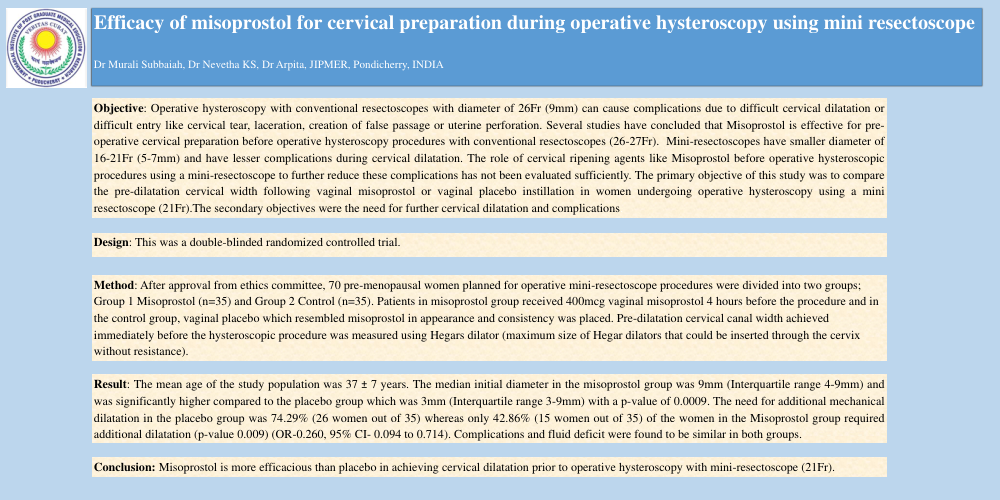
Objective: Operative hysteroscopy with conventional resectoscopes with diameter of 26Fr (9mm) can cause complications due to difficult cervical dilatation or difficult entry like cervical tear, laceration, creation of false passage or uterine perforation. Several studies have concluded that Misoprostol is effective for pre-operative cervical preparation before operative hysteroscopy procedures with conventional resectoscopes (26-27Fr). Mini-resectoscopes have smaller diameter of 16-21Fr (5-7mm) and have lesser complications during cervical dilatation. The role of cervical ripening agents like Misoprostol before operative hysteroscopic procedures using a mini-resectoscope to further reduce these complications has not been evaluated sufficiently. The primary objective of this study was to compare the pre-dilatation cervical width following vaginal misoprostol or vaginal placebo instillation in women undergoing operative hysteroscopy using a mini resectoscope (21Fr).The secondary objectives were the need for further cervical dilatation and complications.
Design: This was a double-blinded randomized controlled trial.
Method: After approval from ethics committee, 70 pre-menopausal women planned for operative mini-resectoscope procedures were divided into two groups; Group 1 Misoprostol (n=35) and Group 2 Control (n=35). Patients in misoprostol group received 400mcg vaginal misoprostol 4 hours before the procedure and in the control group, vaginal placebo which resembled misoprostol in appearance and consistency was placed. Pre-dilatation cervical canal width achieved immediately before the hysteroscopic procedure was measured using Hegars dilator (maximum size of Hegar dilators that could be inserted through the cervix without resistance).
Result: The mean age of the study population was 37 ± 7 years. The median initial diameter in the misoprostol group was 9mm (Interquartile range 4-9mm) and was significantly higher compared to the placebo group which was 3mm (Interquartile range 3-9mm) with a p-value of 0.0009. The need for additional mechanical dilatation in the placebo group was 74.29% (26 women out of 35) whereas only 42.86% (15 women out of 35) of the women in the Misoprostol group required additional dilatation (p-value 0.009) (OR-0.260, 95% CI- 0.094 to 0.714). Complications and fluid deficit were found to be similar in both groups.
Conclusion: Misoprostol is more efficacious than placebo in achieving cervical dilatation prior to operative hysteroscopy with mini-resectoscope (21Fr).