2,281 posters, 63 videos, 56 audios, 43 topics, 18 sessions, 6,174 authors, 2,323 institutions
ePostersLive by SciGen Technologies S.A. All rights reserved.
RCOG World Congress 2025
June 23 - 25, 2025 | ExCeL London, UK
EP.0705
Postmenopausal Bleeding Unveiling Actinomyces: A Forgotten 47-Year-old Intrauterine Contraceptive Device
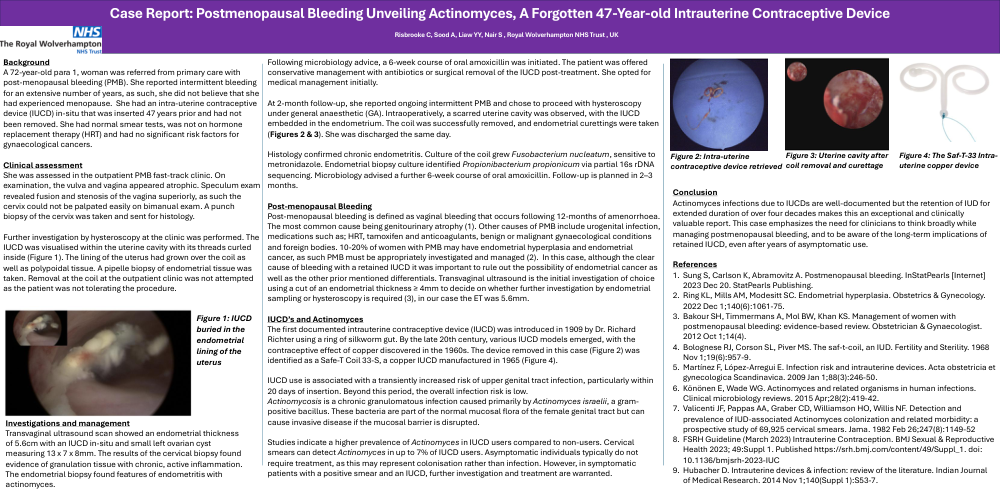
Poster Presenter
Authors
Affiliations
Part of Topic
Gynaecological endoscopy
Case Report: Postmenopausal Bleeding Unveiling Actinomyces, A Forgotten 47-Year-old Intrauterine Contraceptive Device
Background
A 72-year-old para 1, woman was referred from primary care with post-menopausal bleeding (PMB). She reported intermittent bleeding for an extensive number of years, as such, she did not believe that she had experienced menopause. She had an intra-uterine contraceptive device (IUCD) in-situ that was inserted 47 years prior and had not been removed. She had normal smear tests, was not on hormone replacement therapy (HRT) and had no significant risk factors for gynaecological cancers.
Clinic assessment
She was assessed in the outpatient PMB fast-track clinic. On examination, the vulva and vagina appeared atrophic. Speculum exam revealed fusion and stenosis of the vagina superiorly, as such the cervix could not be palpated easily on bimanual exam. A punch biopsy of the cervix was taken and sent for histology.
Further investigation by hysteroscopy at the clinic was performed. The IUCD was visualised within the uterine cavity with its threads curled inside (Figure 1). The lining of the uterus had grown over the coil as well as polypoidal tissue. A pipelle biopsy of endometrial tissue was taken. Removal at the coil at the outpatient clinic was not attempted as the patient was not tolerating the procedure.
Figure 1: IUCD buried in the endometrial lining of the uterus
Investigations and management
Transvaginal ultrasound scan showed an endometrial thickness of 5.6cm with an IUCD in-situ and small left ovarian cyst measuring 13 x 7 x 8mm. The results of the cervical biopsy found evidence of granulation tissue with chronic, active inflammation. The endometrial biopsy found features of endometritis with actinomyces.
Advice from microbiology was sought in view of the histology result for which they recommended a 6-week course of oral antibiotics. The patient was seen in clinic to discuss the options of conservative, medical management with antibiotics or surgical management for removal of the coil upon completion of antibiotics. She opted to continue medical management with oral amoxicillin as she was undecided on surgical management. She was seen in clinic 2-months later following completion of antibiotics. She reported persisting intermittent PMB. She opted to have hysteroscopy under general anaesthetic (GA).
At hysteroscopy under GA, she was found to have a scarred uterine cavity with the coil buried within the endometrial lining. The coil was removed and endometrial curettings were taken and sent for histology. Images of the IUCD device and the uterine cavity following removal are illustrated in Figure 2 and Figure 3 respectively. The patient was discharged on the same day.
Figure 2: Intra-uterine contraceptive device retrieved
Figure 3: Uterine cavity after coil removal and curettage
Histology from the endometrial biopsies taken at the 2nd hysteroscopy remained consistent with chronic endometritis. The coil was sent for culture and sensitivity and grew gram positive bacilli identified as fusobacterium nucleatum, sensitive to metronidazole. The endometrial biopsy culture was positive for Propionibacterium propionicum, this was identified by partial sequencing of 16sDNA. It was recommended by microbiology to treat with a further of 6-weeks of oral amoxicillin. The patient is due to have further follow-up in 2-3 months from her procedure.
Post-menopausal bleeding is defined as vaginal bleeding that occurs following 12-months of amenorrhoea. The most common cause being genitourinary atrophy (1). Other causes of PMB include urogenital infection, medications such as; HRT, tamoxifen and anticoagulants, benign or malignant gynaecological conditions and foreign bodies. 10-20% of women with PMB may have endometrial hyperplasia and endometrial cancer, as such PMB must be appropriately investigated and managed (2). In this case, although the clear cause of bleeding with a retained IUCD it was important to rule out the possibility of endometrial cancer as well as the other prior mentioned differentials. Transvaginal ultrasound is the initial investigation of choice using a cut of an endometrial thickness ≥ 4mm to decide on whether further investigation by endometrial sampling or hysteroscopy is required (3), in our case the ET was 5.6mm.
The first documented use of an intra-uterine contraceptive device dates to 1909 by Dr Richard Richeter by inserting a ring of silk-worm gut into the uterus. By the late 20th century there were many models and variations of IUCDs. The contraceptive effect of copper was discovered in 1960s. The device removed from the patient (Figure 2), can be identified as the Safe-T Coil 33-S (Figure 4) a copper IUCD manufactured in 1965 (4). IUCDs have been linked to an increased risk of upper female genital tract infections within 20- days of insertion following this, the overall infection risk is low (5).
Figure 4: The Saf-T-33 Intra-uterine copper device
Actinomycosis is a chronic infection causing granulomatous disease. Actinomyces israelii, represents the most common species of actinomyces bacteria, which are gram negative bacilli (6). These are endogenous bacteria that live on the mucosal surfaces of the female genital tract and can be infiltrated into deeper structures through disruption of the mucosal barrier (6). Data identifies the prevalence of actinomycosis in women with IUCD, are higher than women without (7). The literature suggests that almost 7% of women using an IUCD can have a finding of actinomyces on cervical smear (7). Asymptomatic individuals are not routinely treated for actinomycosis detected on cervical smear as this may represent colonisation. If a woman with a positive smear and IUCD is symptomatic further investigation and treatment is required (5,8)
Conclusion
Actinomyces infections due to IUCDs are well-documented but the retention of IUD for extended duration of over four decades makes this an exceptional and clinically valuable report. This case emphasizes the need for clinicians to think broadly while managing postmenopausal bleeding, and to be aware of the long-term implications of retained IUCD, even after years of asymptomatic use.