2,281 posters, 63 videos, 56 audios, 43 topics, 18 sessions, 6,174 authors, 2,323 institutions
ePostersLive by SciGen Technologies S.A. All rights reserved.
RCOG World Congress 2025
June 23 - 25, 2025 | ExCeL London, UK
EP.0684
Elective Gynaecological Laparoscopy: Rethinking Blood Loss, Risk, and Resource Optimisation
Poster Presenter
Authors
Affiliations
Part of Topic
Gynaecological endoscopy
Elective Gynaecological Laparoscopy:
Rethinking Blood Loss, Risk, and Resource Optimisation
Authors: Dr Wan Idoracaera Calisa binti Ikhwan, Miss Evangelia Bakali
Background
Elective gynaecological laparoscopy is a key component
of minimally invasive surgery, providing benefits such as
reduced postoperative pain, shorter hospital stays, and
faster recovery compared to open procedures. The Royal
College of Obstetricians and Gynaecologists (RCOG)
.
underscores the importance of tailoring preoperative
planning to individual patient risk profiles, while the
National Institute for Health and Care Excellence (NICE)
advocates for cost-effective use of resources.
Despite the low risk of significant haemorrhage in
laparoscopic procedures, routine Group & Save (G&S)
testing is often performed, incurring costs without clear
evidence of necessity.
Objective
This study aimed to evaluate perioperative blood loss,
the use of Group & Save (G&S) testing, cross-matching,
transfusion requirements, and complications in elective
gynaecological laparoscopy. Additionally, it explored the
potential for cost savings by considering a more
selective, risk-based approach to G&S testing, in
alignment with RCOG and NICE recommendations for
individualised and cost-effective care
Design
A retrospective cohort analysis was conducted to
examine perioperative outcomes and resource utilisation
in elective gynaecological laparoscopy. The study
sought to identify patterns in G&S testing and assess its
clinical and economic implications, while maintaining
patient safety as the primary consideration.
Method
Data were retrospectively reviewed for 410 patients who underwent elective gynaecological laparoscopy at University
Hospitals Birmingham between October 2021 and September 2022. After excluding cases involving total laparoscopic
hysterectomy and staging procedures, 225 cases were analysed. The procedures included diagnostic laparoscopy,
ovarian cystectomy, treatment of endometriosis, sterilisation, adhesiolysis, and others. Information on perioperative
blood loss, G&S utilisation, cross-matching, transfusion rates, and complications was extracted.
Results
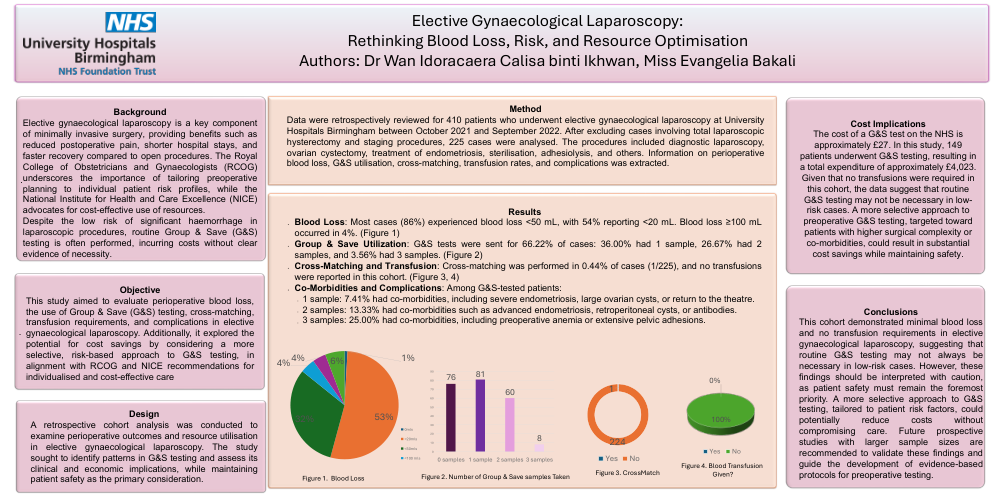
• Blood Loss: Most cases (86%) experienced blood loss <50 mL, with 54% reporting <20 mL. Blood loss ≥100 mL
occurred in 4%. (Figure 1)
• Group & Save Utilization: G&S tests were sent for 66.22% of cases: 36.00% had 1 sample, 26.67% had 2
samples, and 3.56% had 3 samples. (Figure 2)
• Cross-Matching and Transfusion: Cross-matching was performed in 0.44% of cases (1/225), and no transfusions
were reported in this cohort. (Figure 3, 4)
• Co-Morbidities and Complications: Among G&S-tested patients:
o 1 sample: 7.41% had co-morbidities, including severe endometriosis, large ovarian cysts, or return to the theatre.
o 2 samples: 13.33% had co-morbidities such as advanced endometriosis, retroperitoneal cysts, or antibodies.
o 3 samples: 25.00% had co-morbidities, including preoperative anemia or extensive pelvic adhesions.
4%4% 6%
32%
53%
1%
0mls
<20mls
<50mls
<100 mls
90
80
70
60
50
40
30
20
10
0
76 81
60
8
0 samples 1 sample 2 samples 3 samples
1
224
Yes No
0%
100%
Yes No
Figure 1. Blood Loss
Figure 3. CrossMatch
Figure 2. Number of Group & Save samples Taken
Figure 4. Blood Transfusion
Given?
Cost Implications
The cost of a G&S test on the NHS is
approximately £27. In this study, 149
patients underwent G&S testing, resulting in
a total expenditure of approximately £4,023.
Given that no transfusions were required in
this cohort, the data suggest that routine
G&S testing may not be necessary in low-
risk cases. A more selective approach to
preoperative G&S testing, targeted toward
patients with higher surgical complexity or
co-morbidities, could result in substantial
cost savings while maintaining safety.
Conclusions
This cohort demonstrated minimal blood loss
and no transfusion requirements in elective
gynaecological laparoscopy, suggesting that
routine G&S testing may not always be
necessary in low-risk cases. However, these
findings should be interpreted with caution,
as patient safety must remain the foremost
priority. A more selective approach to G&S
testing, tailored to patient risk factors, could
potentially reduce costs without
compromising care. Future prospective
studies with larger sample sizes are
recommended to validate these findings and
guide the development of evidence-based
protocols for preoperative testing