2,281 posters, 63 videos, 56 audios, 43 topics, 18 sessions, 6,174 authors, 2,323 institutions
ePostersLive by SciGen Technologies S.A. All rights reserved.
RCOG World Congress 2025
June 23 - 25, 2025 | ExCeL London, UK
EP.0683
Early versus Routine removal of urinary catheter after Total Laparoscopic Hysterectomy: RCT
Poster Presenter
Authors
Affiliations
Part of Topic
Gynaecological endoscopy
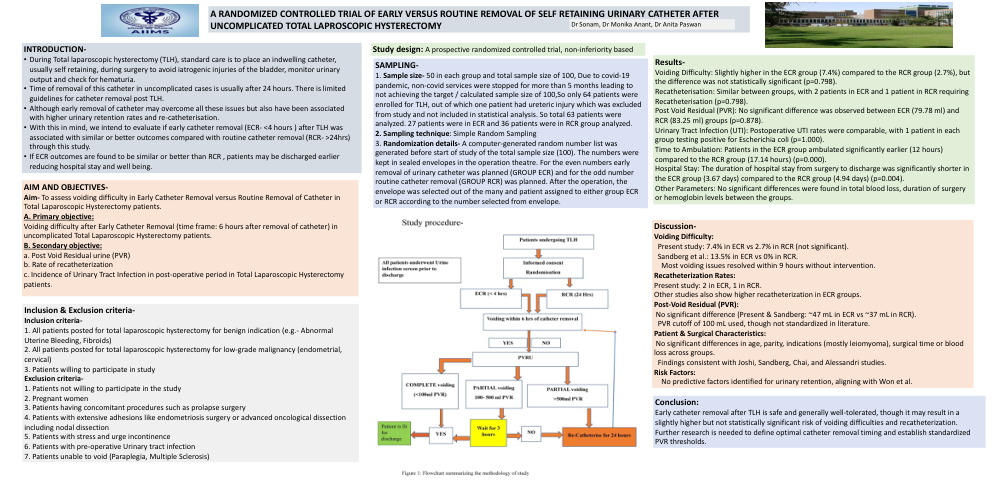
A RANDOMIZED CONTROLLED TRIAL OF EARLY VERSUS ROUTINE REMOVAL OF SELF RETAINING URINARY CATHETER AFTER
UNCOMPLICATED TOTAL LAPROSCOPIC HYSTERECTOMY Dr
Sonam, Dr Monika Anant, Dr Anita Paswan
INTRODUCTION
•
During Total laparoscopic hysterectomy (TLH), standard care is to place an indwelling catheter,
usually self retaining, during surgery to avoid iatrogenic injuries of the bladder, monitor urinary
output and check for hematuria.
•
Time of removal of this catheter in uncomplicated cases is usually after 24 hours. There is limited
guidelines for catheter removal post TLH.
•
Although early removal of catheter may overcome all these issues but also have been associated
with higher urinary retention rates and re catheterisation.
•
With this in mind, we intend to evaluate if early catheter removal (ECR --<4 hours ) after TLH was
associated with similar or better outcomes compared with routine catheter removal (RCR -->24hrs)
through this study.
•
If ECR outcomes are found to be similar or better than RCR , patients may be discharged earlier
reducing hospital stay and well being.
AIM AND OBJECTIVES
Aim
To assess voiding difficulty in Early Catheter Removal versus Routine Removal of Catheter in
Total Laparoscopic Hysterectomy patients.
A. Primary objective:
Voiding difficulty after Early Catheter Removal (time frame: 6 hours after removal of catheter) in
uncomplicated Total Laparoscopic Hysterectomy patients.
B. Secondary objective:
a. Post Void Residual urine (PVR)
b. Rate of recatheterization
c. Incidence of Urinary Tract Infection in post
operative period in Total Laparoscopic Hysterectomy
patients
SAMPLING
1.
Sample size 50 in each group and total sample size of 100, Due to covid 19
pandemic, non covid services were stopped for more than 5 months leading to
not achieving the target / calculated sample size of 100,So only 64 patients were
enrolled for TLH, out of which one patient had ureteric injury which was excluded
from study and not included in statistical analysis. So total 63 patients were
analyzed. 27 patients were in ECR and 36 patients were in RCR group analyzed.
2. Sampling technique
: Simple Random Sampling
3.
Randomization details A computer generated random number list was
generated before start of study of the total sample size (100). The numbers were
kept in sealed envelopes in the operation theatre. For the even numbers early
removal of urinary catheter was planned (GROUP ECR) and for the odd number
routine catheter removal (GROUP RCR) was planned. After the operation, the
envelope was selected out of the many and patient assigned to either group ECR
or RCR according to the number selected from envelope.
Results
Voiding Difficulty: Slightly higher in the ECR group (7.4%) compared to the RCR group (2.7%), but
the difference was not statistically significant (p=0.798).
Recatheterisation: Similar between groups, with 2 patients in ECR and 1 patient in RCR requiring
Recatheterisation (p=0.798).
Post Void Residual (PVR): No significant difference was observed between ECR (79.78 ml) and
RCR (83.25 ml) groups (p=0.878).
Urinary Tract Infection (UTI): Postoperative UTI rates were comparable, with 1 patient in each
group testing positive for Escherichia coli (p=1.000).
Time to Ambulation: Patients in the ECR group ambulated significantly earlier (12 hours)
compared to the RCR group (17.14 hours) (p=0.000).
Hospital Stay: The duration of hospital stay from surgery to discharge was significantly shorter in
the ECR group (3.67 days) compared to the RCR group (4.94 days) (p=0.004).
Other Parameters: No significant differences were found in total blood loss, duration of surgery
or hemoglobin levels between the groups.
Discussion
Voiding Difficulty:
Present study: 7.4% in ECR vs 2.7% in RCR (not significant).
Sandberg et al.: 13.5% in ECR vs 0% in RCR.
Most voiding issues resolved within 9 hours without intervention.
Recatheterization Rates:
Present study: 2 in ECR, 1 in RCR.
Other studies also show higher recatheterization in ECR groups.
Post
Void Residual (PVR):
No significant difference (Present & Sandberg: ~47 mL in ECR vs ~37 mL in RCR).
PVR cutoff of 100 mL used, though not standardized in literature.
Patient & Surgical Characteristics:
No significant differences in age, parity, indications (mostly leiomyoma), surgical time or blood
loss across groups.
Findings consistent with Joshi, Sandberg, Chai, and Alessandri studies.
Risk Factors:
No predictive factors identified for urinary retention, aligning with Won et al.