2,281 posters, 63 videos, 56 audios, 43 topics, 18 sessions, 6,174 authors, 2,323 institutions
ePostersLive by SciGen Technologies S.A. All rights reserved.
RCOG World Congress 2025
June 23 - 25, 2025 | ExCeL London, UK
EP.0681
To monitor and maintain best standards of practice for out-patient Hysteroscopy.
Poster Presenter
Part of Topic
Gynaecological endoscopy
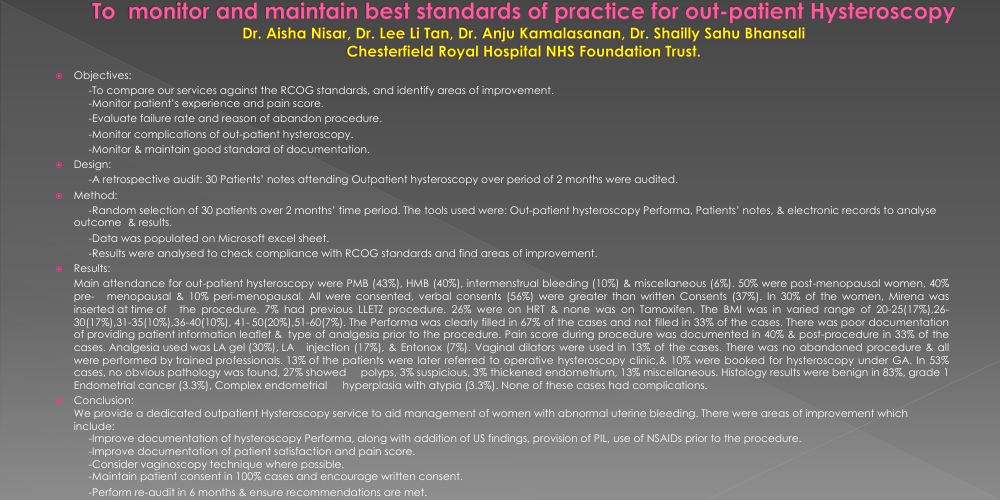
To monitor and maintain best standards of practice for out-patient Hysteroscopy
-To compare our services against the RCOG standards, and identify areas of improvement.
-Monitor patient’s experience and pain score.
-Evaluate failure rate and reason of abandon procedure.
-Monitor complications of out-patient hysteroscopy.
-Monitor & maintain good standard of documentation.
-A retrospective audit: 30 Patients’ notes attending Outpatient hysteroscopy over period of 2 months were audited.
-Random selection of 30 patients over 2 months’ time period. The tools used were: Out-patient hysteroscopy Performa, Patients’ notes, & electronic records to analyse outcome & results.
-Data was populated on Microsoft excel sheet.
-Results were analysed to check compliance with RCOG standards and find areas of improvement.
Main attendance for out-patient hysteroscopy were PMB (43%), HMB (40%), intermenstrual bleeding (10%) & miscellaneous (6%). 50% were post-menopausal women, 40% pre- menopausal & 10% peri-menopausal. All were consented, verbal consents (56%) were greater than written Consents (37%). In 30% of the women, Mirena was inserted at time of the procedure. 7% had previous LLETZ procedure. 26% were on HRT & none was on Tamoxifen. The BMI was in varied range of 20-25(17%),26-30(17%),31-35(10%),36-40(10%), 41- 50(20%),51-60(7%). The Performa was clearly filled in 67% of the cases and not filled in 33% of the cases. There was poor documentation of providing patient information leaflet & type of analgesia prior to the procedure. Pain score during procedure was documented in 40% & post-procedure in 33% of the cases. Analgesia used was LA gel (30%), LA injection (17%), & Entonox (7%). Vaginal dilators were used in 13% of the cases. There was no abandoned procedure & all were performed by trained professionals. 13% of the patients were later referred to operative hysteroscopy clinic,& 10% were booked for hysteroscopy under GA. In 53% cases, no obvious pathology was found, 27% showed polyps, 3% suspicious, 3% thickened endometrium, 13% miscellaneous. Histology results were benign in 83%, grade 1 Endometrial cancer (3.3%), Complex endometrial hyperplasia with atypia (3.3%). None of these cases had complications.
We provide a dedicated outpatient Hysteroscopy service to aid management of women with abnormal uterine bleeding. There were areas of improvement which include:
-Improve documentation of hysteroscopy Performa, along with addition of US findings, provision of PIL, use of NSAIDs prior to the procedure.
-Improve documentation of patient satisfaction and pain score.
-Consider vaginoscopy technique where possible.
-Maintain patient consent in 100% cases and encourage written consent.
-Perform re-audit in 6 months & ensure recommendations are met.