2,281 posters, 63 videos, 56 audios, 43 topics, 18 sessions, 6,174 authors, 2,323 institutions
ePostersLive by SciGen Technologies S.A. All rights reserved.
RCOG World Congress 2025
June 23 - 25, 2025 | ExCeL London, UK
EP.0041
PREVALENCE OF POLYCYSTIC OVARIAN SYNDROME (PCOS) IN TEENAGE GIRLS”
Poster Presenter
Authors
Tehmina Kanwal, Sadia Nazir, Naushin Farooq, Qurrat-ul -Ain, Lubna Bashir, Sabeen Aslam
Affiliations
Part of Topic
Adolescent gynaecology
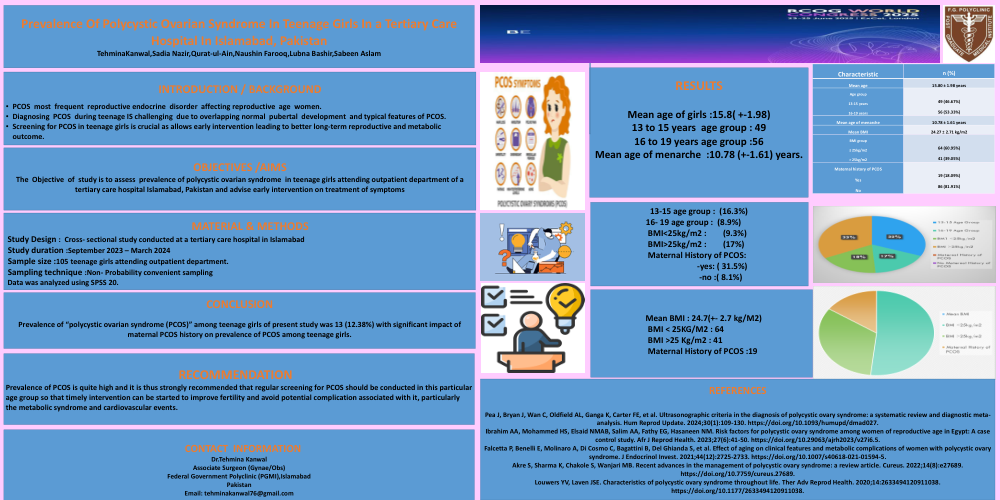
Prevalence Of Polycystic Ovarian Syndrome In Teenage Girls In a Tertiary Care Hospital In Islamabad, Pakistan
TehminaKanwal,Sadia Nazir,Qurat-ul-Ain,Naushin Farooq,Lubna Bashir,Sabeen Aslam
INTRODUCTION / BACKGROUND
Screening for PCOS in teenage girls is crucial as allows early intervention leading to better long-term reproductive and metabolic
OBJECTIVES /AIMS
The Objective of study is to assess prevalence of polycystic ovarian syndrome in teenage girls attending outpatient department of a tertiary care hospital Islamabad, Pakistan and advise early intervention on treatment of symptoms
MATERIAL & METHODS
Study Design : Cross- sectional study conducted at a tertiary care hospital in Islamabad
Study duration :September 2023 – March 2024
Sample size :105 teenage girls attending outpatient department.
Sampling technique :Non- Probability convenient sampling
Data was analyzed using SPSS 20.
CONCLUSION
Prevalence of “polycystic ovarian syndrome (PCOS)” among teenage girls of present study was 13 (12.38%) with significant impact of maternal PCOS history on prevalence of PCOS among teenage girls.
RECOMMENDATION
Prevalence of PCOS is quite high and it is thus strongly recommended that regular screening for PCOS should be conducted in this particular age group so that timely intervention can be started to improve fertility and avoid potential complication associated with it, particularly the metabolic syndrome and cardiovascular events.
REFERENCES
Pea J, Bryan J, Wan C, Oldfield AL, Ganga K, Carter FE, et al. Ultrasonographic criteria in the diagnosis of polycystic ovary syndrome: a systematic review and diagnostic meta-analysis. Hum Reprod Update. 2024;30(1):109-130. https://doi.org/10.1093/humupd/dmad027.
Ibrahim AA, Mohammed HS, Elsaid NMAB, Salim AA, Fathy EG, Hasaneen NM. Risk factors for polycystic ovary syndrome among women of reproductive age in Egypt: A case control study. Afr J Reprod Health. 2023;27(6):41-50. https://doi.org/10.29063/ajrh2023/v27i6.5.
Falcetta P, Benelli E, Molinaro A, Di Cosmo C, Bagattini B, Del Ghianda S, et al. Effect of aging on clinical features and metabolic complications of women with polycystic ovary syndrome. J Endocrinol Invest. 2021;44(12):2725-2733. https://doi.org/10.1007/s40618-021-01594-5.
Akre S, Sharma K, Chakole S, Wanjari MB. Recent advances in the management of polycystic ovary syndrome: a review article. Cureus. 2022;14(8):e27689. https://doi.org/10.7759/cureus.27689.
Louwers YV, Laven JSE. Characteristics of polycystic ovary syndrome throughout life. Ther Adv Reprod Health. 2020;14:2633494120911038. https://doi.org/10.1177/2633494120911038.