2,281 posters, 63 videos, 56 audios, 43 topics, 18 sessions, 6,174 authors, 2,323 institutions
ePostersLive by SciGen Technologies S.A. All rights reserved.
RCOG World Congress 2025
June 23 - 25, 2025 | ExCeL London, UK
EP.0037
LONG-TERM SEQUELAE OF VAGINOPLASTY: AN EXPERIENCE AT PIMS, PAKISTAN
Poster Presenter
Authors
Nosheela Javed, Shubana Tabasum, Sidra Rauf, Shirza Sharafat Ali
Affiliations
Part of Topic
Adolescent gynaecology
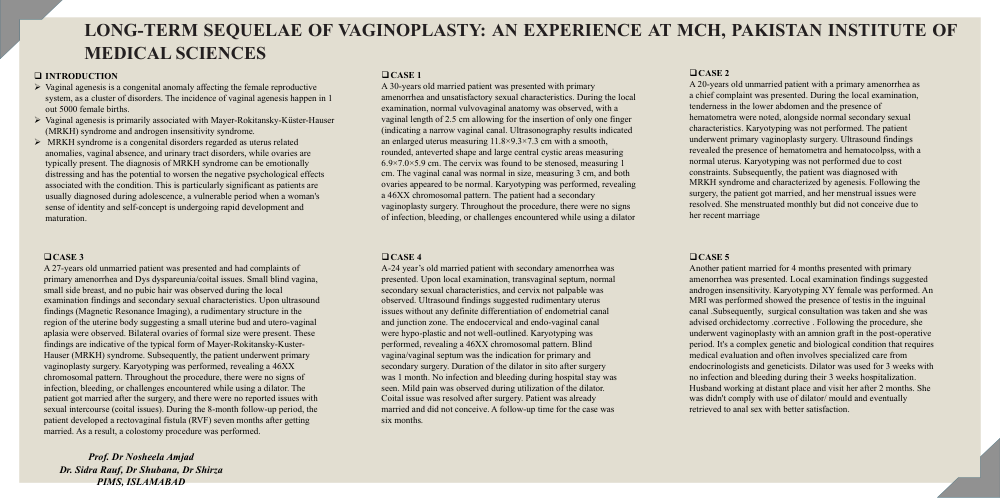
LONG-TERM SEQUELAE OF VAGINOPLASTY: AN EXPERIENCE AT MCH, PAKISTAN INSTITUTE OF MEDICAL SCIENCES
MRKH syndrome is a congenital disorders regarded as uterus related anomalies, vaginal absence, and urinary tract disorders, while ovaries are typically present. The diagnosis of MRKH syndrome can be emotionally distressing and has the potential to worsen the negative psychological effects associated with the condition. This is particularly significant as patients are usually diagnosed during adolescence, a vulnerable period when a woman's sense of identity and self-concept is undergoing rapid development and maturation.
CASE 1
A 30-years old married patient was presented with primary amenorrhea and unsatisfactory sexual characteristics. During the local examination, normal vulvovaginal anatomy was observed, with a vaginal length of 2.5 cm allowing for the insertion of only one finger (indicating a narrow vaginal canal. Ultrasonography results indicated an enlarged uterus measuring 11.8×9.3×7.3 cm with a smooth, rounded, anteverted shape and large central cystic areas measuring 6.9×7.0×5.9 cm. The cervix was found to be stenosed, measuring 1 cm. The vaginal canal was normal in size, measuring 3 cm, and both ovaries appeared to be normal. Karyotyping was performed, revealing a 46XX chromosomal pattern. The patient had a secondary vaginoplasty surgery. Throughout the procedure, there were no signs of infection, bleeding, or challenges encountered while using a dilator
A 20-years old unmarried patient with a primary amenorrhea as a chief complaint was presented. During the local examination, tenderness in the lower abdomen and the presence of hematometra were noted, alongside normal secondary sexual characteristics. Karyotyping was not performed. The patient underwent primary vaginoplasty surgery. Ultrasound findings revealed the presence of hematometra and hematocolpss, with a normal uterus. Karyotyping was not performed due to cost constraints. Subsequently, the patient was diagnosed with MRKH syndrome and characterized by agenesis. Following the surgery, the patient got married, and her menstrual issues were resolved. She menstruated monthly but did not conceive due to her recent marriage
Case 3
A 27-years old unmarried patient was presented and had complaints of primary amenorrhea and Dys dyspareunia/coital issues. Small blind vagina, small side breast, and no pubic hair was observed during the local examination findings and secondary sexual characteristics. Upon ultrasound findings (Magnetic Resonance Imaging), a rudimentary structure in the region of the uterine body suggesting a small uterine bud and utero-vaginal aplasia were observed. Bilateral ovaries of formal size were present. These findings are indicative of the typical form of Mayer-Rokitansky-Kuster-Hauser (MRKH) syndrome. Subsequently, the patient underwent primary vaginoplasty surgery. Karyotyping was performed, revealing a 46XX chromosomal pattern. Throughout the procedure, there were no signs of infection, bleeding, or challenges encountered while using a dilator. The patient got married after the surgery, and there were no reported issues with sexual intercourse (coital issues). During the 8-month follow-up period, the patient developed a rectovaginal fistula (RVF) seven months after getting married. As a result, a colostomy procedure was performed.
Case 4
A-24 year’s old married patient with secondary amenorrhea was presented. Upon local examination, transvaginal septum, normal secondary sexual characteristics, and cervix not palpable was observed. Ultrasound findings suggested rudimentary uterus issues without any definite differentiation of endometrial canal and junction zone. The endocervical and endo-vaginal canal were hypo-plastic and not well-outlined. Karyotyping was performed, revealing a 46XX chromosomal pattern. Blind vagina/vaginal septum was the indication for primary and secondary surgery. Duration of the dilator in sito after surgery was 1 month. No infection and bleeding during hospital stay was seen. Mild pain was observed during utilization of the dilator. Coital issue was resolved after surgery. Patient was already married and did not conceive. A follow-up time for the case was six months.
Another patient married for 4 months presented with primary amenorrhea was presented. Local examination findings suggested androgen insensitivity. Karyotyping XY female was performed. An MRI was performed showed the presence of testis in the inguinal canal .Subsequently, surgical consultation was taken and she was advised orchidectomy .corrective . Following the procedure, she underwent vaginoplasty with an amnion graft in the post-operative period. It's a complex genetic and biological condition that requires medical evaluation and often involves specialized care from endocrinologists and geneticists. Dilator was used for 3 weeks with no infection and bleeding during their 3 weeks hospitalization. Husband working at distant place and visit her after 2 months. She was didn't comply with use of dilator/ mould and eventually retrieved to anal sex with better satisfaction.