2,281 posters, 63 videos, 56 audios, 43 topics, 18 sessions, 6,174 authors, 2,323 institutions
ePostersLive by SciGen Technologies S.A. All rights reserved.
RCOG World Congress 2025
June 23 - 25, 2025 | ExCeL London, UK
EP.0033
Laparoscopic Management of 15 cm Torted Parafallopian Tube Cyst in Adolescent
Poster Presenter
Authors
Affiliations
Part of Topic
Adolescent gynaecology
Laparoscopic Management of 15 cm Torted Parafallopian Tube Cyst in Adolescent Imaan Kayani, Salma Kayani
Objective:
This case highlights the importance of early and decisive surgical intervention in adolescents presenting with persistent pelvic pain and adnexal masses. It underscores the value of minimally invasive surgery in this age group and emphasizes the need for developing guidelines on managing large parafallopian tube cysts.
Case study:
A 13-year-old presented with severe pelvic pain and was found on ultrasound to have a haemorrhagic ovarian cyst.
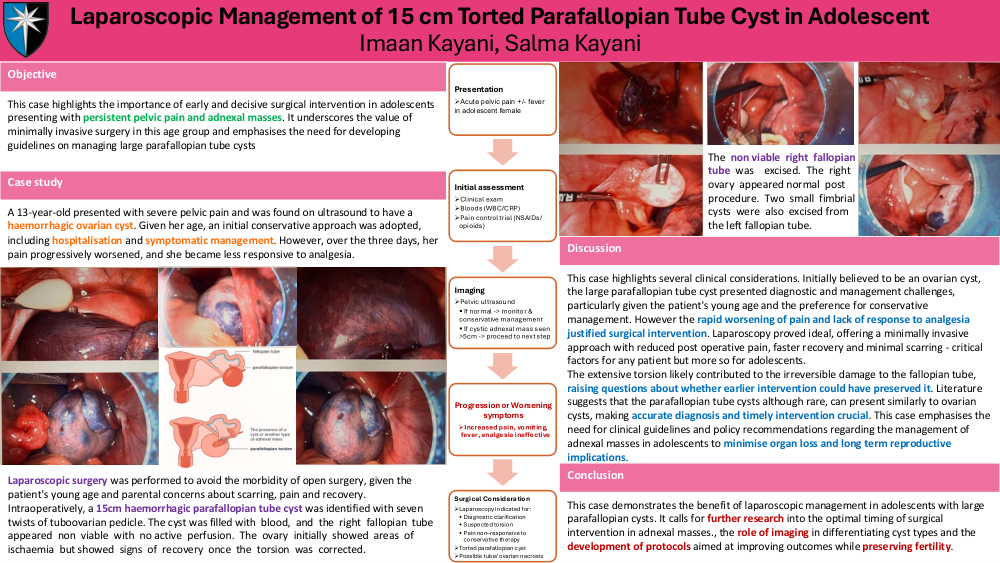
Given her age, an initial conservative approach was adopted, including hospitalisation and symptomatic management. However, over the three days, her pain progressively worsened, and she became less responsive to analgesia. Laparoscopic surgery was performed to avoid the morbidity of open surgery, given the patient's young age and parental concerns about scarring, pain and recovery.
Intraoperatively, a 15 cm haemorrhagic parafallopian tube cyst was identified with seven twists of tuboovarian torsion. The cyst was filled with blood, and the right fallopian tube appeared non viable with no active perfusion. The ovary initially showed areas of ischaemia but showed signs of recovery once the torsion was corrected. The non viable right fallopian tube was excised. The right ovary appeared normal
post procedure. Two small fimbrial cysts were also excised from the left fallopian tube
Discussion:
This case highlights several clinical considerations. Initially believed to be an ovarian cyst, the large parafallopian tube cyst presented diagnostic and management challenges, particularly given the patient's young age and the preference for conservative management. However the rapid worsening of pain and lack of response to analgesia justified surgical intervention. Laparoscopy proved ideal, offering a minimally invasive approach with reduced post operative pain, faster recovery and minimal scarring - which are critical factors for any patient but more so for adolescents.
The extensive torsion likely contributed to the irreversible damage to the fallopian tube, raising questions about whether earlier intervention could have preserved it.
Literature suggests that the parafallopian tube cysts although rare, can present similarly to ovarian cysts, making accurate diagnosis and timely intervention crucial.
This case emphasises the need for clinical guidelines and policy recommendations regarding the management of adnexal masses in adolescents to minimise organ loss and long term reproductive implications.
Conclusion:
This case demonstrates the benefit of laparoscopic management in adolescents with large parafallopian cysts. It calls for further research into the optimal timing of surgical intervention in adnexal masses., the role of imaging in differentiating cyst types and the development of protocols aimed at improving outcomes while preserving fertility.