2,281 posters, 63 videos, 56 audios, 43 topics, 18 sessions, 6,174 authors, 2,323 institutions
ePostersLive by SciGen Technologies S.A. All rights reserved.
RCOG World Congress 2025
June 23 - 25, 2025 | ExCeL London, UK
EP.0316
Necrotizing fasciitis – a rare complication post Caesarean section
Poster Presenter
Authors
Samantha Maden, Gaurab Gurung, Sreelakshmi Mohan, Ramy Noureldeen, Hala Selim
Affiliations
Part of Topic
Education
Necrotizing fasciitis – a rare complication post Caesarean section
Samantha Maden1, Gaurab Gurung1, Sreelakshmi Mohan1, Ramy Noureldeen1, Hala Selim2
1Specialist Trainee in Obstetrics and Gynaecology 2Consultant Obstetrician and Gynaecologist
Queen Elizabeth, the Queen Mother Hospital, Margate Kent
INTRODUCTION
Necrotizing fasciitis is a rare, rapidly progressive soft tissue infection characterized by extensive necrosis and systemic infection. While risk factors include IV drug use and immunosuppression, this case is notable for occurring in a healthy patient. Surgical debridement is the definitive treatment. Delays in diagnosis can increase morbidity and mortality. Multidisciplinary involvement is essential for optimizing outcomes. We present a rare case of necrotizing fasciitis (NF) in a low-risk woman following Caesarean section to emphasize the importance of early recognition and surgical management.
CASE REPORT
A 21-year-old nulliparous woman with a BMI of 28 booked her pregnancy at 9 weeks gestation. Although she stopped smoking at 5 weeks, she had serial growth scans which eventually revealed Fetal Growth Restriction. She underwent routine induction of labour and was able to progress in until 9cm dilation. She underwent an uneventful emergency caesarean delivery for fetal distress.
The initial post-operative period was unremarkable. However, on the first post-operative day she was noted to have become panicked, anxious and agitated due to significant abdominal and vulval pain.
Initially she was managed with analgesia until a temperature spike of 39 degrees. Broad spectrum antibiotics were started for presumed infection. Clinical examination remained unremarkable. Despite the antibiotics, her symptoms worsened, with persistent pain and rising inflammatory markers. A CT scan revealed non-significant post-operative change in the subcutaneous tissues.
On day 3 post-delivery she became significantly distressed with pain over her lower abdomen. Clinical examination revealed a cellulitic picture with erythema extending over the wound, induration and heat. After a Microbiology consult, the antibiotics were escalated.
On day 4, the patient spiked a temperature to 39.4, became tachycardic and peripherally shut down. After an MDT discussion which included critical care she was returned to theatre for surgical exploration.
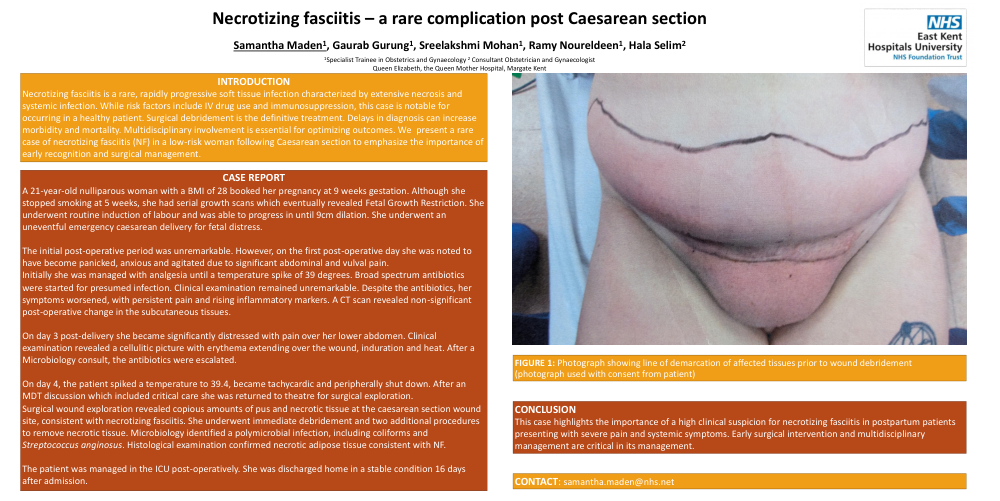
Surgical wound exploration revealed copious amounts of pus and necrotic tissue at the caesarean section wound site, consistent with necrotizing fasciitis. She underwent immediate debridement and two additional procedures to remove necrotic tissue. Microbiology identified a polymicrobial infection, including coliforms and Streptococcus anginosus. Histological examination confirmed necrotic adipose tissue consistent with NF.
The patient was managed in the ICU post-operatively. She was discharged home in a stable condition 16 days after admission.
FIGURE 1: Photograph showing line of demarcation of affected tissues prior to wound debridement (photograph used with consent from patient)
CONCLUSION
This case highlights the importance of a high clinical suspicion for necrotizing fasciitis in postpartum patients presenting with severe pain and systemic symptoms. Early surgical intervention and multidisciplinary management are critical in its management.