2,281 posters, 63 videos, 56 audios, 43 topics, 18 sessions, 6,174 authors, 2,323 institutions
ePostersLive by SciGen Technologies S.A. All rights reserved.
RCOG World Congress 2025
June 23 - 25, 2025 | ExCeL London, UK
EP.0278
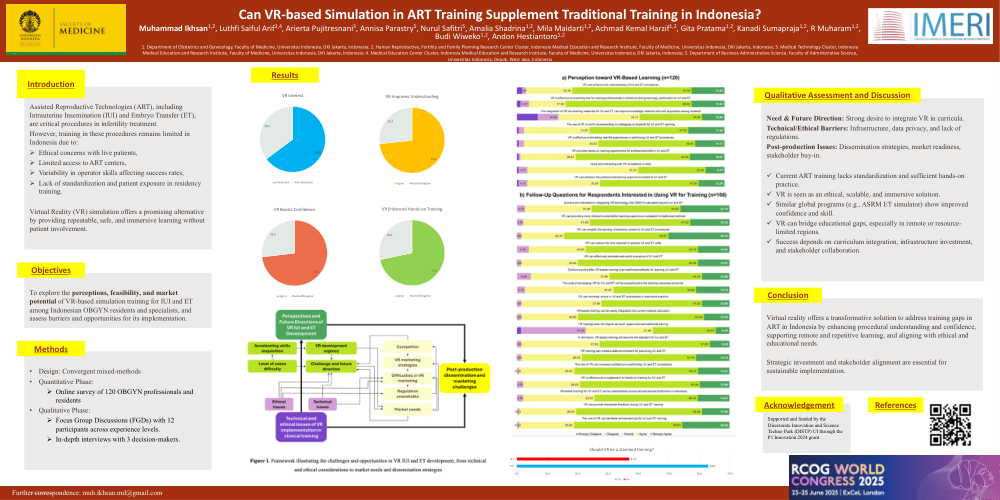
Can VR-based Simulation in ART Training Supplement Traditional Training in Indonesia?
Poster Presenter
Authors
Muhammad Ikhsan, Luthfi Saiful Arif, Arierta Pujitresnani, Annisa Parastry, Nurul Safitri, Amalia Shadrina, Mila Maidarti, Achmad Kemal Harzif, Gita Pratama, Kanadi Sumapraja, Raden Muharam, Budi Wiweko, Andon Hestiantoro
Affiliations
Department of Obstetrics and Gynecology, Faculty of Medicine, Universitas Indonesia, Medical Technology Cluster, Indonesia Medical Education and Research Institute, Faculty of Medicine, Universitas Indonesia, Medical Education Center Cluster, Indonesia Medical Education and Research Institute, Faculty of Medicine, Universitas Indonesia, Department of Business Administrative Science, Faculty of Administrative Science, Universitas Indonesia
Part of Topic
Education
Can VR-based Simulation in ART Training Supplement Traditional Training in Indonesia?
Muhammad Ikhsan1,2, Luthfi Saiful Arif3,4, Arierta Pujitresnani3, Annisa Parastry5, Nurul Safitri5, Amalia Shadrina1,2, Mila Maidarti1,2, Achmad Kemal Harzif1,2, Gita Pratama1,2, Kanadi Sumapraja1,2, R Muharam1,2, Budi Wiweko1,2, Andon Hestiantoro1,2
1. Department of Obstetrics and Gynecology, Faculty of Medicine, Universitas Indonesia, DKI Jakarta, Indonesia; 2. Human Reproductive, Fertility and Family Planning Research Center Cluster, Indonesia Medical Education and Research Institute, Faculty of Medicine, Universitas Indonesia, DKI Jakarta, Indonesia; 3. Medical Technology Cluster, Indonesia Medical Education and Research Institute, Faculty of Medicine, Universitas Indonesia, DKI Jakarta, Indonesia; 4. Medical Education Center Cluster, Indonesia Medical Education and Research Institute, Faculty of Medicine, Universitas Indonesia, DKI Jakarta, Indonesia; 5. Department of Business Administrative Science, Faculty of Administrative Science, Universitas Indonesia, Depok, West Java, Indonesia
Introduction
Assisted Reproductive Technologies (ART), including Intrauterine Insemination (IUI) and Embryo Transfer (ET), are critical procedures in infertility treatment.
However, training in these procedures remains limited in Indonesia due to:
Virtual Reality (VR) simulation offers a promising alternative by providing repeatable, safe, and immersive learning without patient involvement.
Methods
Qualitative Assessment and Discussion
Need & Future Direction: Strong desire to integrate VR in curricula.
Technical/Ethical Barriers: Infrastructure, data privacy, and lack of regulations.
Post-production Issues: Dissemination strategies, market readiness, stakeholder buy-in.
Virtual reality offers a transformative solution to address training gaps in ART in Indonesia by enhancing procedural understanding and confidence, supporting remote and repetitive learning, and aligning with ethical and educational needs.
Strategic investment and stakeholder alignment are essential for sustainable implementation.