2,281 posters, 63 videos, 56 audios, 43 topics, 18 sessions, 6,174 authors, 2,323 institutions
ePostersLive by SciGen Technologies S.A. All rights reserved.
RCOG World Congress 2025
June 23 - 25, 2025 | ExCeL London, UK
EP.0313
Caesarean Section at full dilatation - Revisited.
Poster Presenter
Authors
Celia Burrell, Irene Njoku, Gerald Igwemadu, Louise Keane, Louise Brodrick, Abbie Hession, Chineze Otigbah, Aurelie Le Gourrierec
Affiliations
Part of Topic
Education
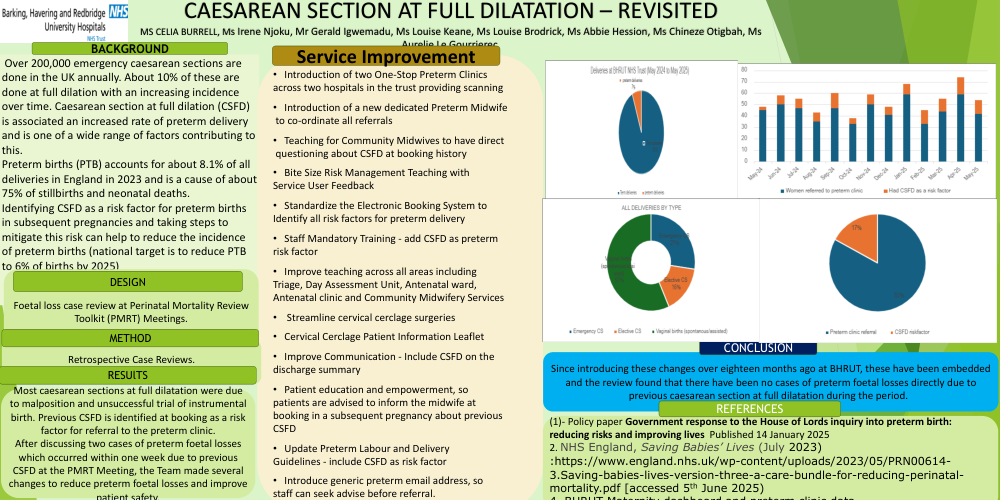
CAESAREAN SECTION AT FULL DILATATION – REVISITED
MS CELIA BURRELL, Ms Irene Njoku, Mr Gerald Igwemadu, Ms Louise Keane, Ms Louise Brodrick, Ms Abbie Hession, Ms Chineze Otigbah, Ms Aurelie Le Gourrierec
Background
Over 200,000 emergency caesarean sections are done in the UK annually. About 10% of these are done at full dilation with an increasing incidence over time. Caesarean section at full dilation (CSFD) is associated an increased rate of preterm delivery and is one of a wide range of factors contributing to this. Preterm births (PTB) accounts for about 8.1% of all deliveries in England in 2023 and is a cause of about 75% of stillbirths and neonatal deaths. Identifying CSFD as a risk factor for preterm births in subsequent pregnancies and taking steps to mitigate this risk can help to reduce the incidence of preterm births (national target is to reduce PTB to 6% of births by 2025)
DESIGN
Foetal loss case review at Perinatal Mortality Review Toolkit (PMRT) Meetings.
METHOD
Retrospective Case Reviews.
RESULTS
Most caesarean sections at full dilatation were due to malposition and unsuccessful trial of instrumental birth. Previous CSFD is identified at booking as a risk factor for referral to the preterm clinic. After discussing two cases of preterm foetal losses which occurred within one week due to previous CSFD at the PMRT Meeting, the Team made several changes to reduce preterm foetal losses and improve patient safety.
SERVICE IMPROVEMENTS
Introduction of two One-Stop Preterm Clinics across two hospitals in the trust providing scanning • Introduction of a new dedicated Preterm Midwife to co-ordinate all referrals • Teaching for Community Midwives to have direct questioning about CSFD at booking history • Bite Size Risk Management Teaching with Service User Feedback • Standardize the Electronic Booking System to Identify all risk factors for preterm delivery • Staff Mandatory Training - add CSFD as preterm risk factor • Improve teaching across all areas including Triage, Day Assessment Unit, Antenatal ward, Antenatal clinic and Community Midwifery Services • Streamline cervical cerclage surgeries • Cervical Cerclage Patient Information Leaflet • Improve Communication - Include CSFD on the discharge summary • Patient education and empowerment, so patients are advised to inform the midwife at booking in a subsequent pregnancy about previous CSFD • Update Preterm Labour and Delivery Guidelines - include CSFD as risk factor •Introduce generic preterm email address, so staff can seek advise before referral.
CONCLUSION
Since introducing these changes over eighteen months ago at BHRUT, these have been embedded and the review found that there have been no cases of preterm foetal losses directly due to previous caesarean section at full dilatation during the period.
REFERENCES
1- Policy paper Government response to the House of Lords inquiry into preterm birth: reducing risks and improving lives Published 14 January 2025
2. NHS England, Saving Babies’ Lives (July 2023) :https://www.england.nhs.uk/wp-content/uploads/2023/05/PRN00614-
3. Saving-babies-lives-version-three-a-care-bundle-for-reducing-perinatalmortality.pdf [accessed 5th June 2025)
4. BHRUT Maternity dash board and preterm clinic data