2,281 posters, 63 videos, 56 audios, 43 topics, 18 sessions, 6,174 authors, 2,323 institutions
ePostersLive by SciGen Technologies S.A. All rights reserved.
RCOG World Congress 2025
June 23 - 25, 2025 | ExCeL London, UK
EP.0311
Position Matters: A Pilot Study Exploring Clinician Choice in the Pelvic Examination
Poster Presenter
Authors
Affiliations
Part of Topic
Education
Introduction
The gynaecological examination method has seen minimal change since its introduction in the mid-19th century in the UK, with teaching positions typically passed on without critical reassessment.
In the UK, the absence of leg supports despite increasing ultrasound use during pelvic assessments makes the "frog-leg/diamond" position the default, though evidence for its superiority over the "feet apart" position is limited.
Accurate pelvic floor assessment, particularly during Valsalva manoeuvre, necessitates a relaxed pelvic floor, and therefore optimal patient positioning.
Alternative positions such as left lateral or standing are less favoured by patients, raising questions about clinician choice and supporting evidence.
Objective
To conduct a pilot investigation evaluating UK clinician practices concerning patient position during pelvic examinations when leg supports are unavailable, comparing the traditional "frog-leg/diamond" position against the "feet apart" position.
Methods
A pilot questionnaire was distributed to multidisciplinary healthcare professionals who conduct intimate pelvic examinations. The questionnaire combined multiple-choice and free-text responses to capture clinicians' rationales behind position selection. Data analysis involved descriptive statistics, linear regression for quantitative data, and thematic analysis for qualitative feedback.
Results
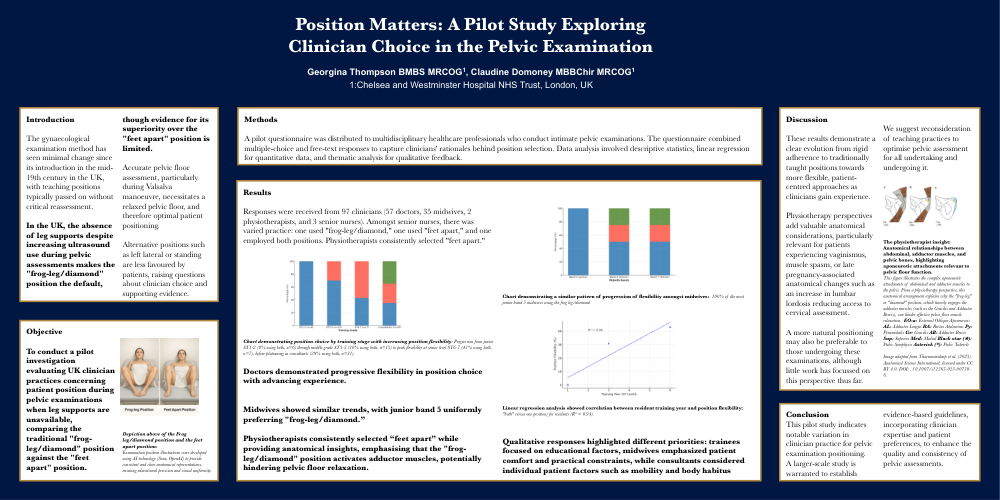
Responses were received from 97 clinicians (57 doctors, 35 midwives, 2 physiotherapists, and 3 senior nurses). Amongst senior nurses, there was varied practice: one used "frog-leg/diamond," one used "feet apart," and one employed both positions. Physiotherapists consistently selected "feet apart."
Doctors demonstrated progressive flexibility in position choice with advancing experience.
Midwives showed similar trends, with junior band 5 uniformly preferring "frog-leg/diamond.”
Physiotherapists consistently selected “feet apart” while providing anatomical insights, emphasising that the "frog-leg/diamond" position activates adductor muscles, potentially hindering pelvic floor relaxation.
Qualitative responses highlighted different priorities: trainees focused on educational factors, midwives emphasized patient comfort and practical constraints, while consultants considered individual patient factors such as mobility and body habitus
Discussion
These results demonstrate a clear evolution from rigid adherence to traditionally taught positions towards more flexible, patient-centred approaches as clinicians gain experience.
Physiotherapy perspectives add valuable anatomical considerations, particularly relevant for patients experiencing vaginismus, muscle spasm, or late pregnancy-associated anatomical changes such as an increase in lumbar lordosis reducing access to cervical assessment.
A more natural positioning may also be preferable to those undergoing these examinations, although little work has focussed on this perspective thus far.
We suggest reconsideration of teaching practices to optimise pelvic assessment for all undertaking and undergoing it.
Conclusion
This pilot study indicates notable variation in clinician practice for pelvic examination positioning.
A larger-scale study is warranted to establish evidence-based guidelines, incorporating clinician expertise and patient preferences, to enhance the quality and consistency of pelvic assessments.