2,281 posters, 63 videos, 56 audios, 43 topics, 18 sessions, 6,174 authors, 2,323 institutions
ePostersLive by SciGen Technologies S.A. All rights reserved.
RCOG World Congress 2025
June 23 - 25, 2025 | ExCeL London, UK
EP.0030
Isolated Fallopian Tube Torsion in Adolescents: Case Report and Recurrence Insights.
Part of Topic
Adolescent gynaecology
TITLE:
Isolated Fallopian Tube Torsion in Adolescents: Case Report and Recurrence Insights.
OBJECTIVE:
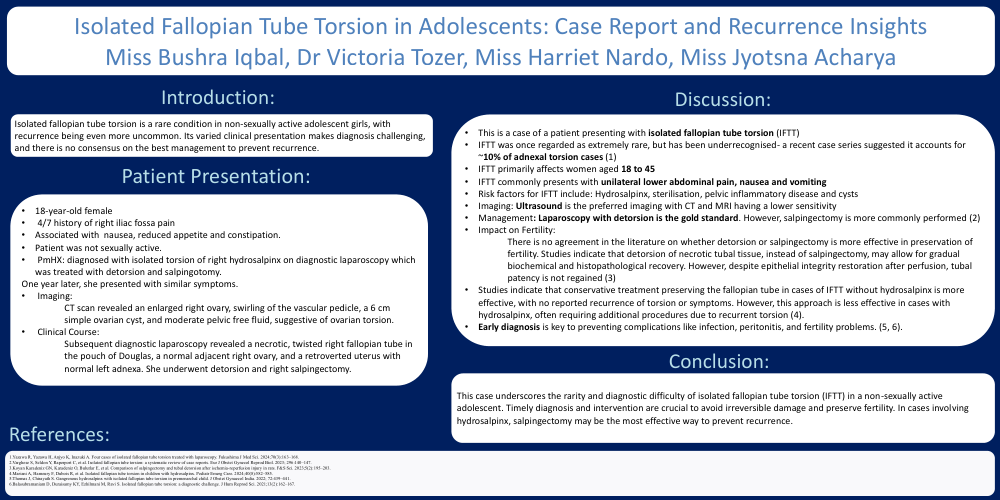
Isolated fallopian tube torsion is a rare condition in non-sexually active adolescent girls, with recurrence being even more uncommon. Its varied clinical presentation makes diagnosis challenging, and there is no consensus on the best management to prevent recurrence.
CASE REPORT:
An 18-year-old female presented with four day history of right iliac fossa pain, nausea, reduced appetite and constipation. She was not sexually active. She was diagnosed with isolated torsion of right hydrosalpinx on diagnostic laparoscopy which was treated with detorsion and salpingotomy one year back.
CT scan revealed an enlarged right ovary, swirling of the vascular pedicle, a 6 cm simple ovarian cyst, and moderate pelvic free fluid, suggestive of ovarian torsion.
Subsequently diagnostic laparoscopy revealed a necrotic, twisted right fallopian tube in the pouch of Douglas, a normal adjacent right ovary, and a retroverted uterus with normal left adnexa. She underwent detorsion, cystectomy, and right salpingectomy.
DISCUSSION:
Isolated fallopian tube torsion (IFTT), once regarded as extremely rare, has been underrecognized, and recent case series suggest it accounts for about 10% of adnexal torsion cases (1).
IFTT primarily affects women aged 18 to 45, with symptoms like unilateral lower abdominal pain, nausea, and vomiting. Risk factors include hydrosalpinx, sterilization, pelvic inflammatory disease, and cysts. Ultrasound is the preferred imaging, though CT and MRI have lower sensitivity. Laparoscopy with detorsion is the gold standard, but salpingectomy is more commonly performed. (2).
There is no agreement on whether detorsion or salpingectomy is more effective for preserving fertility. Studies indicate that detorsion of necrotic tubal tissue, instead of salpingectomy, may allow for gradual biochemical and histopathological recovery. However, while epithelial integrity can be restored after reperfusion, tubal patency is not regained. (3).
Studies indicate that conservative treatment preserving the fallopian tube in cases of IFTT without hydrosalpinx is more effective, with no reported recurrence of torsion or symptoms. However, this approach is less effective in cases with hydrosalpinx, often requiring additional procedures due to recurrent torsion (4).
Early diagnosis is key to preventing complications like infection, peritonitis, and fertility problems. (5, 6).
CONCLUSION:
This case underscores the rarity and diagnostic difficulty of isolated fallopian tube torsion (IFTT) in a non-sexually active adolescent. Timely diagnosis and intervention are crucial to avoid irreversible damage and preserve fertility. In cases involving hydrosalpinx, salpingectomy may be the most effective way to prevent recurrence.
REFERENCES:
1. Yazawa R, Yazawa H, Anjyo K, Inazuki A. Four cases of isolated fallopian tube torsion treated with laparoscopy. Fukushima J Med Sci. 2024;70(3):163–168.
2. Varghese S, Seldon Y, Raperport C, et al. Isolated fallopian tube torsion: a systematic review of case reports. Eur J Obstet Gynecol Reprod Biol. 2023; 296:140–147.
3. Koyan Karadeniz GN, Karadeniz O, Bulutlar E, et al. Comparison of salpingectomy and tubal detorsion after ischemia-reperfusion injury in rats. F&S Sci. 2023;5(2):195–203.
4. Mariani A, Hameury F, Dubois R, et al. Isolated fallopian tube torsion in children with hydrosalpinx. Pediatr Emerg Care. 2024;40(8):582–585.
5. Thomas J, Chirayath S. Gangrenous hydrosalpinx with isolated fallopian tube torsion in premenarchal child. J Obstet Gynaecol India. 2022; 72:439–441.
6. Balasubramaniam D, Duraisamy KY, Ezhilmani M, Ravi S. Isolated fallopian tube torsion: a diagnostic challenge. J Hum Reprod Sci. 2021;13(2):162–167.