2,281 posters, 63 videos, 56 audios, 43 topics, 18 sessions, 6,174 authors, 2,323 institutions
ePostersLive by SciGen Technologies S.A. All rights reserved.
RCOG World Congress 2025
June 23 - 25, 2025 | ExCeL London, UK
EP.0308
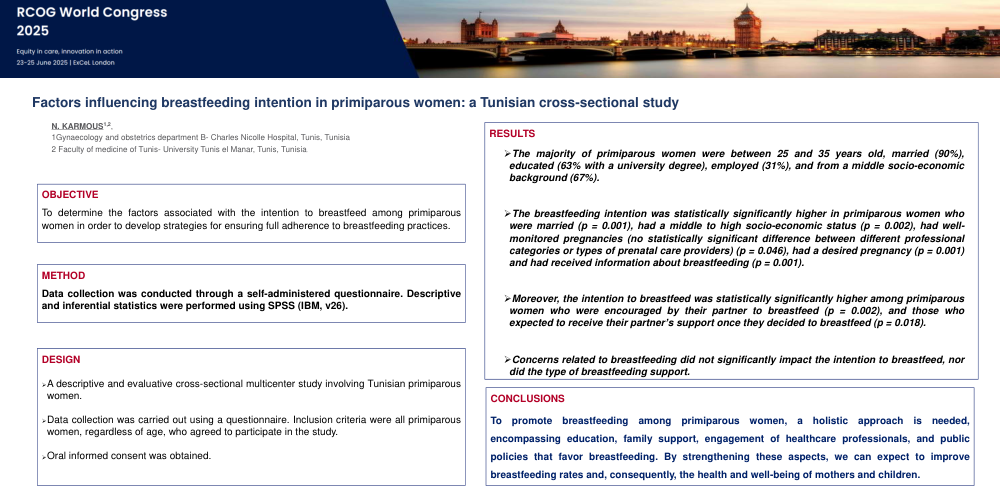
Factors influencing breastfeeding intention in primiparous women: a Tunisian cross-sectional study
Poster Presenter
Authors
Affiliations
Department of Gynaecology and Obstetrics, Charles Nicolle Hospital, Department B- Charles Nicolle Hospital, Gynaecology and Obstetrics Department B, Charles Nicolle Hospital, Department Bof Obstetrics and Gynaecology, Charles Nicolle Hospital, Department of Obstetrics and Gynecology B, Charles Nicolle Hospital, Gynaecology and Obstetrics Department B of Charles Nicolle Hospital, Gynaecology and Obstetrics department B- Charles Nicolle Hospital, Charles Nicolle Hospital, Obstetrics and Gynaecology Service B, Department B of Gynaecology and Obstetrics- Charles Nicolle Hospital, Department B of Obstetrics and Gynecology, Charles Nicolle Hospital
Part of Topic
Education
Factors influencing breastfeeding intention in primiparous women: a Tunisian cross-sectional study
Objective:
To determine the factors associated with the intention to breastfeed among primiparous women in order to develop strategies for ensuring full adherence to breastfeeding practices.
Design:
A descriptive and evaluative cross-sectional multicenter study involving Tunisian primiparous women. Data collection was carried out using a questionnaire. Inclusion criteria were all primiparous women, regardless of age, who agreed to participate in the study. Oral informed consent was obtained.
Method:
Data collection was conducted through a self-administered questionnaire. Descriptive and inferential statistics were performed using SPSS (IBM, v26).
Results:
The majority of primiparous women were between 25 and 35 years old, married (90%), educated (63% with a university degree), employed (31%), and from a middle socio-economic background (67%).
The breastfeeding intention was statistically significantly higher in primiparous women who were married (p = 0.001), had a middle to high socio-economic status (p = 0.002), had well-monitored pregnancies (no statistically significant difference between different professional categories or types of prenatal care providers) (p = 0.046), had a desired pregnancy (p = 0.001) and had received information about breastfeeding (p = 0.001).
Moreover, the intention to breastfeed was statistically significantly higher among primiparous women who were encouraged by their partner to breastfeed (p = 0.002), and those who expected to receive their partner’s support once they decided to breastfeed (p = 0.018).
Concerns related to breastfeeding did not significantly impact the intention to breastfeed, nor did the type of breastfeeding support.
Conclusions:
To promote breastfeeding among primiparous women, a holistic approach is needed, encompassing education, family support, engagement of healthcare professionals, and public policies that favor breastfeeding. By strengthening these aspects, we can expect to improve breastfeeding rates and, consequently, the health and well-being of mothers and children.