2,281 posters, 63 videos, 56 audios, 43 topics, 18 sessions, 6,174 authors, 2,323 institutions
ePostersLive by SciGen Technologies S.A. All rights reserved.
RCOG World Congress 2025
June 23 - 25, 2025 | ExCeL London, UK
EP.0306
Neurodivergence in Obstetrics & Gynaecology – Insights from a Rapid Survey
Poster Presenter
Part of Topic
Education
Neurodivergence in Obstetrics & Gynaecology – Insights from a Rapid Survey
M O'Connor, L Frodsham, R Rummery
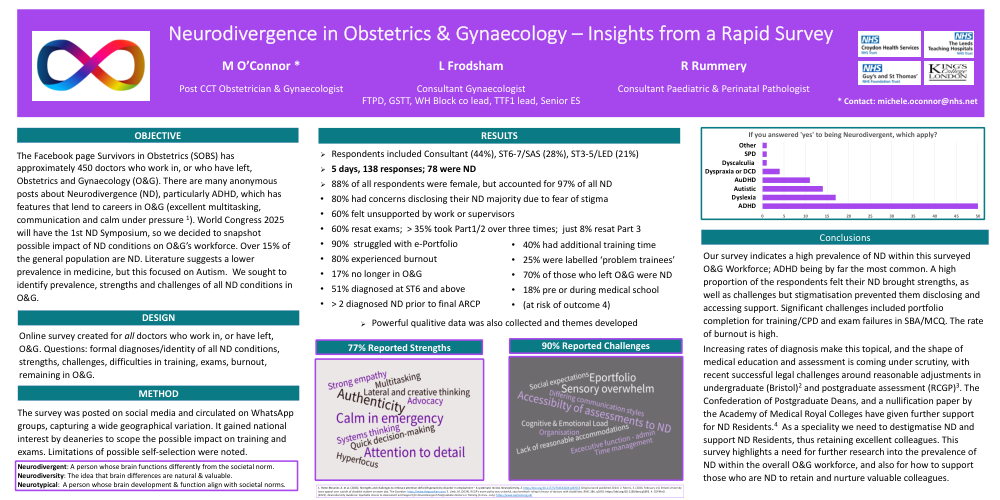
Objective: The Facebook page Survivors in Obstetrics (SOBS) has approximately 450 doctors who work in, or who have left, Obstetrics and Gynaecology (O&G). There are many anonymous posts about Neurodivergence (ND), particularly ADHD, which has features that lend to careers in O&G (excellent multitasking, communication and calm under pressure 1). World Congress 2025 will have the 1st ND Symposium, so we decided to snapshot possible impact of ND conditions on O&G’s workforce. Over 15% of the general population are ND. Literature suggests a lower prevalence in medicine, but this focused on Autism. We sought to identify prevalence, strengths and challenges of all ND conditions in O&G.
Method: Online survey created for all doctors who work in, or have left, O&G. Questions: formal diagnoses/identity of all ND conditions, strengths, challenges, difficulties in training, exams, burnout, remaining in O&G.
The survey was posted on social media and circulated on WhatsApp groups, capturing a wide geographical variation. It gained national interest by deaneries to scope the possible impact on training and exams. Limitations of possible self-selection were noted.
Neurodivergent: A person whose brain functions differently from the societal norm. Neurodiversity: The idea that brain differences are natural & valuable. Neurotypical: A person whose brain development & function align with societal norms.
Conclusions: Our survey indicates a high prevalence of ND within this surveyed O&G Workforce; ADHD being by far the most common. A high proportion of the respondents felt their ND brought strengths, as well as challenges but stigmatisation prevented them disclosing and accessing support. Significant challenges included portfolio completion for training/CPD and exam failures in SBA/MCQ. The rate of burnout is high.
Increasing rates of diagnosis make this topical, and the shape of medical education and assessment is coming under scrutiny, with recent successful legal challenges around reasonable adjustments in undergraduate (Bristol)2 and postgraduate assessment (RCGP)3. The Confederation of Postgraduate Deans, and a nullification paper by the Academy of Medical Royal Colleges have given further support for ND Residents.4 As a speciality we need to destigmatise ND and support ND Residents, thus retaining excellent colleagues. This survey highlights a need for further research into the prevalence of ND within the overall O&G workforce, and also for how to support those who are ND to retain and nurture valuable colleagues.