2,281 posters, 63 videos, 56 audios, 43 topics, 18 sessions, 6,174 authors, 2,323 institutions
ePostersLive by SciGen Technologies S.A. All rights reserved.
RCOG World Congress 2025
June 23 - 25, 2025 | ExCeL London, UK
EP.0305
Gaps in fertility knowledge among 97,414 Women actively trying to conceive
Poster Presenter
Authors
Affiliations
Part of Topic
Education
Misconceptions around cycle length, regularity and fertile window in 97,414 women trying to conceive.
Background: Variation in menstrual cycle length (1) and regularity (2)(3) make it more difficult for women with variable cycles to successfully time intercourse for conception within the fertile window (4).
With 12.1% of females between 15 and 44 years old experiencing difficulty conceiving (5), improving identification of cycle characteristics could improve women’s understanding of their ability to conceive and inform clinical decision-making.
This study aimed to assess misconceptions surrounding cycle length, regularity, and fertile window knowledge among women actively trying to conceive (TTC).
Methods:
- Retrospective, cross-sectional analysis using data collected through an online health assessment (OHA).
- 97,414 women aged 18–50+ who reported they were actively TTC via the OHA.
- Participants provided self-reported data on menstrual cycles, fertile window knowledge, and contraceptive use.
- Responses were stratified by age and time trying to conceive (in months).
- Statistical analysis included descriptive summaries performed in R.
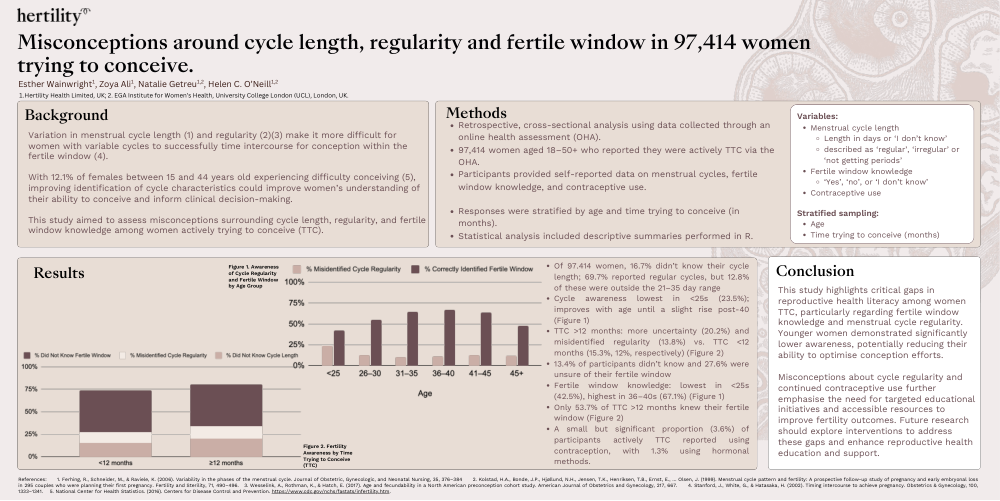
- Of 97.414 women, 16.7% didn’t know their cycle length; 69.7% reported regular cycles, but 12.8% of these were outside the 21–35 day range
- Cycle awareness lowest in <25s (23.5%); improves with age until a slight rise post-40 (Figure 1)
- TTC >12 months: more uncertainty (20.2%) and misidentified regularity (13.8%) vs. TTC <12 months (15.3%, 12%, respectively) (Figure 2)
- 13.4% of participants didn’t know and 27.6% were unsure of their fertile window
- Fertile window knowledge: lowest in <25s (42.5%), highest in 36–40s (67.1%) (Figure 1)
- Only 53.7% of TTC >12 months knew their fertile window (Figure 2)
- A small but significant proportion (3.6%) of participants actively TTC reported using contraception, with 1.3% using hormonal methods.