2,281 posters, 63 videos, 56 audios, 43 topics, 18 sessions, 6,174 authors, 2,323 institutions
ePostersLive by SciGen Technologies S.A. All rights reserved.
RCOG World Congress 2025
June 23 - 25, 2025 | ExCeL London, UK
EP.0301
HIE Deep Dive Case Review: Disseminating Learning to Improve Outcomes
Poster Presenter
Part of Topic
Education
HIE Deep Dive Case Review: Disseminating Learning to improve outcomes
Dr Priyanka Iyer, Dr Keira Heslin-Davies, Miss AlixlyneQuaye, Miss Federica Rossi, Miss ZakiaBalghari
Objective: To review suspected HIE cases (2023–2024), identify key themes, and share learning with the MDT
Design & Methods: A retrospective review was conducted at Newham University Hospital (5,273 annual births). All HIE-coded cases on Badgernetfrom January 1 to December 31, 2023, were analysed using data from Cerner (obstetric), Badgernet (neonatal), HSIB, and internal reports. The aim was to identify themes and recommend improvements in perinatal care.
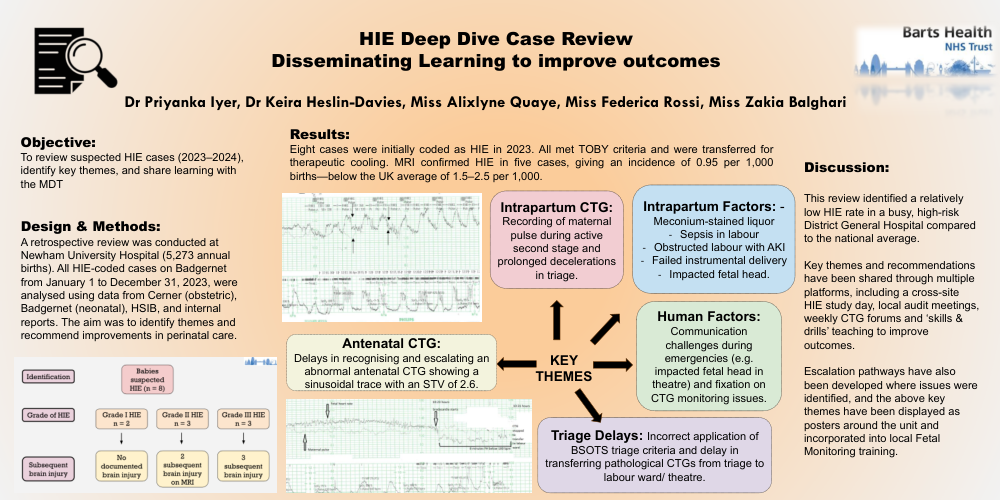
Results: Eight cases were initially coded as HIE in 2023. All met TOBY criteria and were transferred for therapeutic cooling. MRI confirmed HIE in five cases, giving an incidence of 0.95 per 1,000 births—below the UK average of 1.5–2.5 per 1,000.
Key themes:
- Intrapartum CTG: Recording of maternal pulse during active second stage and prolonged decelerations in triage.
- Intrapartum Factors: - Meconium-stained liquor, Sepsis in labour, Obstructed labour with AKI, Failed instrumental delivery, Impacted fetal head.
- Human Factors: Communication challenges during emergencies (e.g. impacted fetal head in theatre) and fixation on CTG monitoring issues.
- Antenatal CTG: Delays in recognising and escalating an abnormal antenatal CTG showing a sinusoidal trace with an STV of 2.6.
- Triage Delays: Incorrect application of BSOTS triage criteria and delay in transferring pathological CTGs from triage to labour ward/ theatre.
Discussion: This review identified a relatively low HIE rate in a busy, high-risk District General Hospital compared to the national average. Key themes and recommendations have been shared through multiple platforms, including a cross-site HIE study day, local audit meetings, weekly CTG forums and ‘skills & drills’ teaching to improve outcomes. Escalation pathways have also been developed where issues were identified, and the above key themes have been displayed as posters around the unit and incorporated into local FetalMonitoring training.