2,281 posters, 63 videos, 56 audios, 43 topics, 18 sessions, 6,174 authors, 2,323 institutions
ePostersLive by SciGen Technologies S.A. All rights reserved.
RCOG World Congress 2025
June 23 - 25, 2025 | ExCeL London, UK
EP.0295
The Silent Enemy: Impact of Misinformation on Women's Health
Poster Presenter
Part of Topic
Education
The Silent Enemy: Impact of Misinformation on Women's Health
Introduction
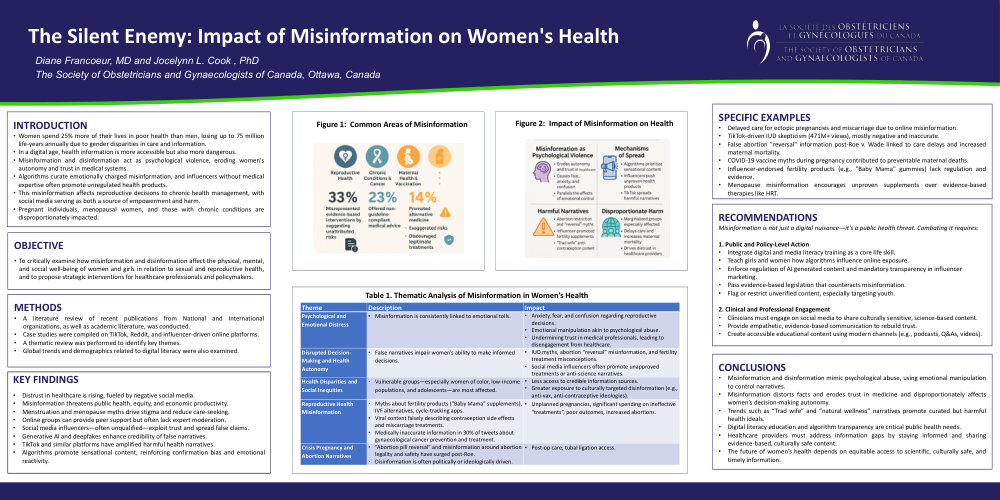
•Women spend 25% more of their lives in poor health than men, losing up to 75 million life-years annually due to gender disparities in care and information.
•In a digital age, health information is more accessible but also more dangerous.
•Misinformation and disinformation act as psychological violence, eroding women's autonomy and trust in medical systems.
•Algorithms curate emotionally charged misinformation, and influencers without medical expertise often promote unregulated health products.
•This misinformation affects reproductive decisions to chronic health management, with social media serving as both a source of empowerment and harm.
•Pregnant individuals, menopausal women, and those with chronic conditions are disproportionately impacted.
Objective
To critically examine how misinformation and disinformation affect the physical, mental, and social well-being of women and girls in relation to sexual and reproductive health, and to propose strategic interventions for healthcare professionals and policymakers.
Methods
•A literature review of recent publications from National and International organizations, as well as academic literature, was conducted.
•Case studies were compiled on TikTok, Reddit, and influencer-driven online platforms.
•A thematic review was performed to identify key themes.
•Global trends and demographics related to digital literacy were also examined.
KEY FINDINGS
•Distrust in healthcare is rising, fueled by negative social media.
•Misinformation threatens public health, equity, and economic productivity.
•Menstruation and menopause myths drive stigma and reduce care-seeking.
•Online groups can provide peer support but often lack expert moderation.
•Social media influencers—often unqualified—exploit trust and spread false claims.
•Generative AI and deepfakes enhance credibility of false narratives.
•TikTok and similar platforms have amplified harmful health narratives.
•Algorithms promote sensational content, reinforcing confirmation bias and emotional reactivity.
SPECIFIC EXAMPLES
•Delayed care for ectopic pregnancies and miscarriage due to online misinformation.
•TikTok-driven IUD skepticism (471M+ views), mostly negative and inaccurate.
•False abortion "reversal" information post-Roe v. Wade linked to care delays and increased maternal mortality.
•COVID-19 vaccine myths during pregnancy contributed to preventable maternal deaths.
•Influencer-endorsed fertility products (e.g., "Baby Mama" gummies) lack regulation and evidence.
•Menopause misinformation encourages unproven supplements over evidence-based therapies like HRT.
RECOMMENDATIONS
Misinformation is not just a digital nuisance—it's a public health threat. Combating it requires:
1. Public and Policy-Level Action
•Integrate digital and media literacy training as a core life skill.
•Teach girls and women how algorithms influence online exposure.
•Enforce regulation of AI generated content and mandatory transparency in influencer marketing.
•Pass evidence-based legislation that counteracts misinformation.
•Flag or restrict unverified content, especially targeting youth.
2. Clinical and Professional Engagement
•Clinicians must engage on social media to share culturally sensitive, science-based content.
•Provide empathetic, evidence-based communication to rebuild trust.
•Create accessible educational content using modern channels (e.g., podcasts, Q&As, videos).
CONCLUSIONS
•Misinformation and disinformation mimic psychological abuse, using emotional manipulation to control narratives.
•Misinformation distorts facts and erodes trust in medicine and disproportionately affects women’s decision-making autonomy.
•Trends such as “Trad wife” and “natural wellness” narratives promote curated but harmful health ideals.
•Digital literacy education and algorithm transparency are critical public health needs.
•Healthcare providers must address information gaps by staying informed and sharing evidence-based, culturally safe content.
•The future of women’s health depends on equitable access to scientific, culturally safe, and timely information.