2,281 posters, 63 videos, 56 audios, 43 topics, 18 sessions, 6,174 authors, 2,323 institutions
ePostersLive by SciGen Technologies S.A. All rights reserved.
RCOG World Congress 2025
June 23 - 25, 2025 | ExCeL London, UK
EP.0294
Kangaroo Mother Care (KMC): Transforming Neonatal Care By Power Of Touch
Poster Presenter
Authors
Affiliations
Part of Topic
Education
Kangaroo Mother Care (KMC): Transforming Neonatal Care By Power Of Touch
Sobia Nawaz, Tallat Farkhanda2, Sadia Khan3, Saima Bibi4,Amna Iftikhar5, Rabia Noor6
Associate Professor OBGYN Rawalpindi Medical university,2Dean OBGYN Rawalpindi Medical University,3Associate Professor Rawalpindi Medical university,"Assistant professor
Rawalpindi medical university, Postgraduate Resident OBGYN Unit-1 Holy Family Hospital Rawalpindi
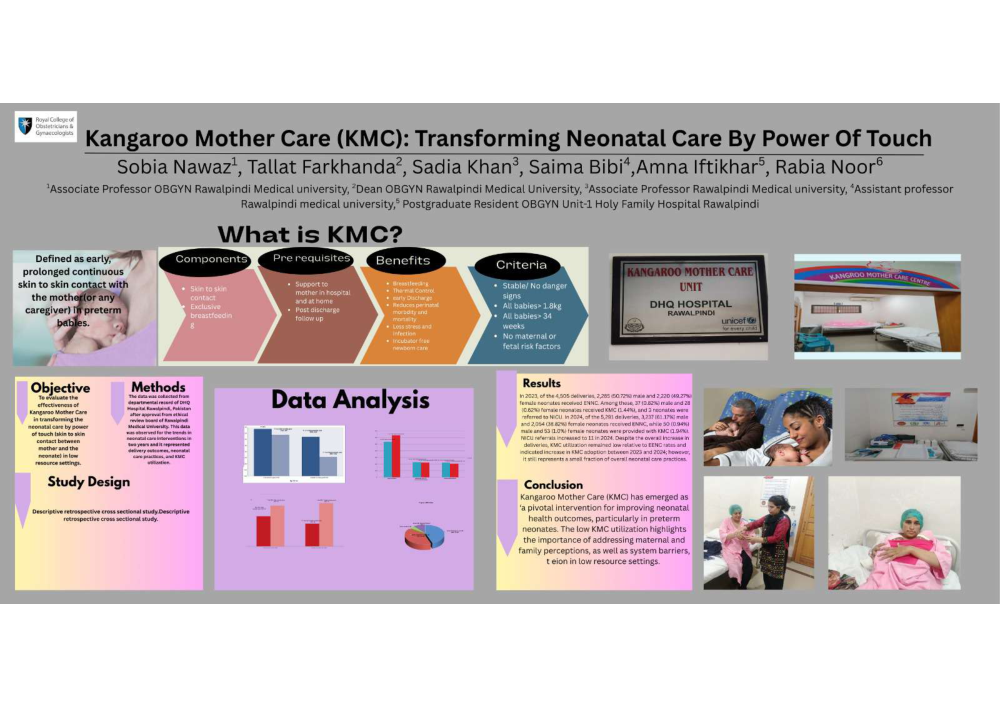
KANGAROO MOTHER CARE
KANGROO MOTHER CARE CENTRE includes skin to skin contact with Support to mother for Breastfeeding
promotes early Discharge, Reduces perinatal morbidity in preterm and low birth weight babies.
Objective : To evaluate the effectiveness of Kangroo mother care in transforming neonatal care by power of touch.
Methods: the data was collected from the departmental record of DHQ hospital of Rawalpindi medical university after approval from ethical committee..
Results
Data Analysis: This data of touch and skin to skin neonatal care interventions in between two years and it represented as follows: In 2023, of the 4,505 deliverles, 2,285 (50.72%) male and 2,220 (49.27%)(0.62%) female neonates received KMC (1.44%), and 3 neonates wereand 2,054 (38.82%6) female neonates received ENNC, while 50 (0.94%)male and 53 (1.0%) female neonates were provided with KMC (1.94%).NICU referrals increased to 11 in 2024.
Study Design
Descriptive retrospective cross sectional study.Descriptive
retrospective cross sectional study.
Conclusion: Kangaroo Mother Care (KMC) has emerged as'a pivotal intervention for improving neonatalhealth outcomes, particularly in pretermneonates.The low KMC utilization highlights the importance of addressing maternal andfamily perceptions, as well as system barriers,t eion in low resource settings.