2,281 posters, 63 videos, 56 audios, 43 topics, 18 sessions, 6,174 authors, 2,323 institutions
ePostersLive by SciGen Technologies S.A. All rights reserved.
RCOG World Congress 2025
June 23 - 25, 2025 | ExCeL London, UK
EP.0291
“A Day in GAU”: A near-peer, classroom-based approach to undergraduate gynaecology teaching
Poster Presenter
Authors
Affiliations
Part of Topic
Education
Introduction
- Medical students can find gynaecology placements an intimidating place to learn, owing to the sensitive nature of presentations, wealth of new information, and high service acuity. Overcoming this barrier is essential to enhancing the educational experience in gynaecology.
- Near-peer education is a model where individuals close in age or educational level provide instruction to less experienced peers.
- Evidence suggests near-peer education can create a relaxed learning environment, and has previously been successfully utilised for undergraduate gynaecology teaching.
Objective
- We investigated student’s experiences and preferences regarding gynaecology teaching
- We explored whether a near-peer, classroom-based approach using simulation to teachgynaecology is effective and enjoyable for students.
- We also assessed whether this method of teaching helps to reduce intimidation and increase student confidence in the clinical environment.
Methods
- 45 4th year medical students attended teaching designed and implemented by near-peer clinical teaching fellows entitled “A Day in GAU (gynaecology assessment unit)”.
- Students encountered 6 simulated patients with a range of presentations covering benign gynaecology, early pregnancy, emergencies and oncology, and completed different tasks for each.
- Tasks comprised history taking (irregular periods and postmenopausal bleeding), breaking bad news (miscarriage) ,prescribing pain management (endometriosis), and managing a shocked patient with acute ovarian torsion.
- Students completed anonymised questionnaires collecting quantitative and qualitative data.
Results
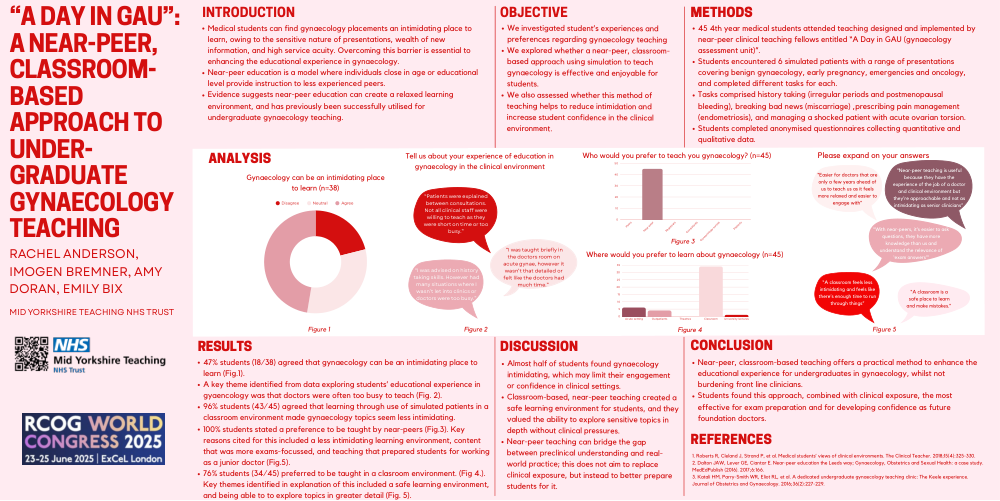
- 47% students (18/38) agreed that gynaecology can be an intimidating place to learn (Fig.1).
- A key theme identified from data exploring students’ educational experience in gyaencology was that doctors were often too busy to teach (Fig. 2).
- 96% students (43/45) agreed that learning through use of simulated patients in a classroom environment made gynaecology topics seem less intimidating.
- 100% students stated a preference to be taught by near-peers (Fig.3). Key reasons cited for this included a less intimidating learning environment, content that was more exams-focussed, and teaching that prepared students for working as a junior doctor (Fig.5).
- 76% students (34/45) preferred to be taught in a clasroom environment. (Fig 4.). Key themes identified in explanation of this included a safe learning environment, and being able to to explore topics in greater detail (Fig. 5).
Discussion
- Almost half of students found gynaecology intimidating, which may limit their engagement or confidence in clinical settings.
- Classroom-based, near-peer teaching created a safe learning environment for students, and they valued the ability to explore sensitive topics in depth without clinical pressures.
- Near-peer teaching can bridge the gap between preclinical understanding and real-world practice; this does not aim to replace clinical exposure, but instead to better prepare students for it.
Conclusion
- Near-peer, classroom-based teaching offers a practical method to enhance the educational experience for undergraduates in gynaecology, whilst not burdening front line clinicians.
- Students found this approach, combined with clinical exposure, the most effective for exam preparation and for developing confidence as future foundation doctors.