2,281 posters, 63 videos, 56 audios, 43 topics, 18 sessions, 6,174 authors, 2,323 institutions
ePostersLive by SciGen Technologies S.A. All rights reserved.
RCOG World Congress 2025
June 23 - 25, 2025 | ExCeL London, UK
EP.0266
Diagnosis and Management of Spontaneous Live Heterotopic Pregnancy Without Any Predisposing Factors
Poster Presenter
Part of Topic
Early pregnancy complications/early pregnancy and acute gynaecology
Diagnosis and Management of Spontaneous Live Heterotopic Pregnancy Without Any Predisposing Factors
Princess Alexandra Hospital NHS Trust, Obstetrics and Gynaecology, Harlow, United Kingdom
Objective: To discuss the diagnosis and surgical management of a spontaneous live heterotopic pregnancy without any risk factors.
Case report: A 31-year-old, G2P1 with a history of one prior uneventful normal vaginal delivery presented with generalized abdominal pain at 8 weeks of gestation in her second planned spontaneous conception. She denied any previous abdominal surgery or history of STI, and she did not have any medical conditions.
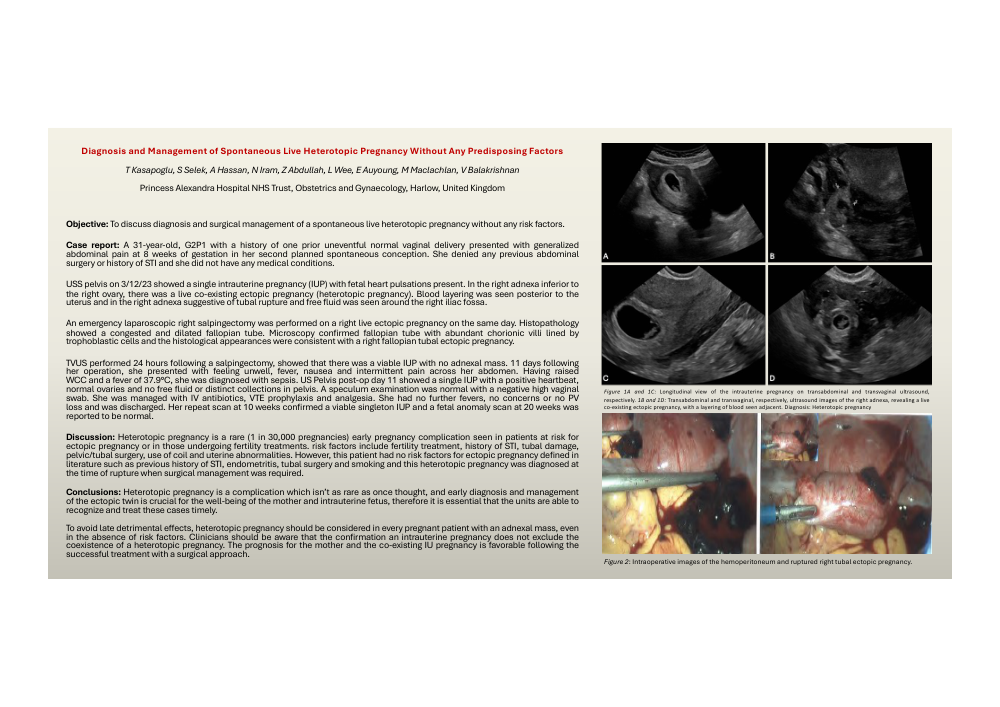
USS pelvis on 3/12/23 showed a single intrauterine pregnancy (IUP) with fetal heart pulsations present. In the right adnexa inferior to the right ovary, there was a live co-existing ectopic pregnancy (heterotopic pregnancy). Blood layering was seen posterior to the uterus and in the right adnexa, suggestive of tubal rupture and free fluid was seen around the right iliac fossa.
An emergency laparoscopic right salpingectomy was performed on a right live ectopic pregnancy on the same day. Histopathology showed a congested and dilated fallopian tube. Microscopy confirmed a fallopian tube with abundant chorionic villi lined by trophoblastic cells, and the histological appearances were consistent with a right fallopian tubal ectopic pregnancy.
TVUS performed 24 hours following a salpingectomy, showed that there was a viable IUP with no adnexal mass. 11 days following her operation, she presented with feeling unwell, fever, nausea and intermittent pain across her abdomen. Having raised WCC and a fever of 37.9°C, she was diagnosed with sepsis. US Pelvis post-op day 11 showed a single IUP with a positive heartbeat, normal ovaries and no free fluid or distinct collections in the pelvis. A speculum examination was normal with a negative high vaginal swab. She was managed with IV antibiotics, VTE prophylaxis and analgesia. She had no further fevers, no concerns or no PV loss and was discharged. Her repeat scan at 10 weeks confirmed a viable singleton IUP, and a fetal anomaly scan at 20 weeks was reported to be normal.
Discussion: Heterotopic pregnancy is a rare (1 in 30,000 pregnancies) early pregnancy complication seen in patients at risk for ectopic pregnancy or in those undergoing fertility treatments. Risk factors include fertility treatment, history of STI, tubal damage, pelvic/tubal surgery, use of coil and uterine abnormalities. However, this patient had no risk factors for ectopic pregnancy defined in literature, such as previous history of STI, endometritis, tubal surgery and smoking, and this heterotopic pregnancy was diagnosed at the time of rupture when surgical management was required.
Conclusions: Heterotopic pregnancy is a complication which isn’t as rare as once thought, and early diagnosis and management of the ectopic twin is crucial for the well-being of the mother and intrauterine fetus, therefore, it is essential that the units can recognise and treat these cases in a timely.
To avoid late detrimental effects, heterotopic pregnancy should be considered in every pregnant patient with an adnexal mass, even in the absence of risk factors. Clinicians should be aware that the confirmation of an intrauterine pregnancy does not exclude the coexistence of a heterotopic pregnancy. The prognosis for the mother and the co-existing IU pregnancy is favourable following the successful treatment with a surgical approach.