2,281 posters, 63 videos, 56 audios, 43 topics, 18 sessions, 6,174 authors, 2,323 institutions
ePostersLive by SciGen Technologies S.A. All rights reserved.
RCOG World Congress 2025
June 23 - 25, 2025 | ExCeL London, UK
EP.0264
AVM in the Context of Ruptured Ectopic Pregnancy: Diagnostic and Therapeutic Challenge
Poster Presenter
Authors
Affiliations
Part of Topic
Early pregnancy complications/early pregnancy and acute gynaecology
Title
Unforeseen Arteriovenous Malformation in the Context of Ruptured Ectopic Pregnancy: A Diagnostic and Therapeutic Challenge: Case report
Authors & Affiliations : Ms Sarojini Burugapalli ( Consultant Obstetrics & Gynaecology), Dr Firas Wael Musa Naffa ( Clinical Fellow )
Objective:
Ruptured ectopic pregnancy is a critical medical emergency requiring swift surgical intervention. However, the emergence of unexpected complications, such as the development of an arteriovenous malformation (AVM), can significantly impact patient management and necessitate innovative treatment strategies.
We would like to present a case who presented with ruptured ectopic pregnancy, later diagnosed with AVM following uterine trauma.
Case Presentation:
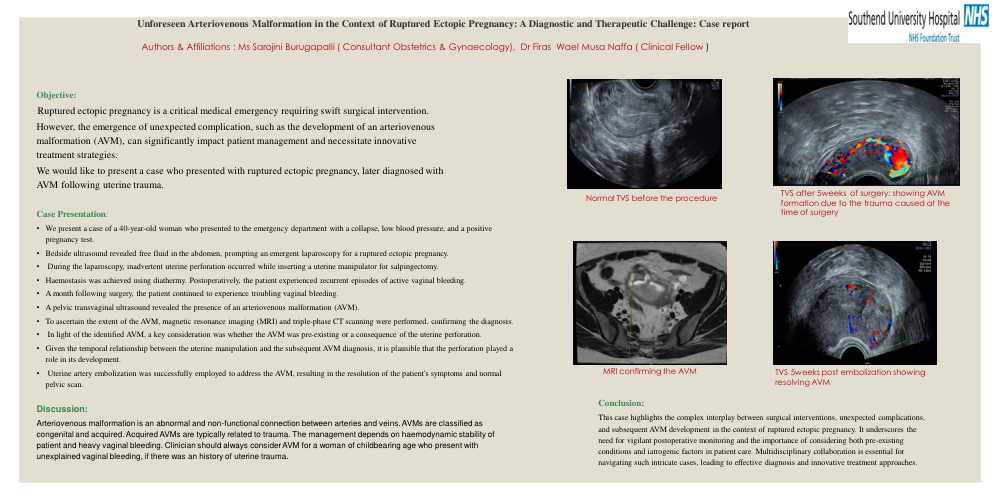
We present a case of a 40-year-old woman who presented to the emergency department with a collapse, low blood pressure, and a positive pregnancy test. Bedside ultrasound revealed free fluid in the abdomen, prompting an emergent laparoscopy for a ruptured ectopic pregnancy. During the laparoscopy, inadvertent uterine perforation occurred while inserting a uterine manipulator for salpingectomy. Haemostasis was achieved using diathermy. Postoperatively, the patient experienced recurrent episodes of active vaginal bleeding.
A month following surgery, the patient continued to experience troubling vaginal bleeding. A pelvic transvaginal ultrasound revealed the presence of an arteriovenous malformation (AVM). To ascertain the extent of the AVM, magnetic resonance imaging (MRI) and triple-phase CT scanning were performed, confirming the diagnosis.
In light of the identified AVM, a key consideration was whether the AVM was preexisting or a consequence of the uterine perforation. Given the temporal relationship between the uterine manipulation and the subsequent AVM diagnosis, it is plausible that the perforation played a role in its development. Uterine artery embolization was successfully employed to address the AVM, resulting in the resolution of the patient's symptoms and normal pelvic scan.
Discussion:
Arteriovenous malformation is an abnormal and non-functional connection between arteries and veins. AVMs are classified as congenital and acquired. Acquired AVMs are typically related to trauma. The management depends on haemodynamic stability of patient and heavy vaginal bleeding. Clinician should always consider AVM for a woman of childbearing age who present with unexplained vaginal bleeding, if there was an history of uterine trauma.
Conclusion: This case highlights the complex interplay between surgical interventions, unexpected complications, and subsequent AVM development in the context of ruptured ectopic pregnancy. It underscores the need for vigilant postoperative monitoring and the importance of considering both preexisting conditions and iatrogenic factors in patient care. Multidisciplinary collaboration is essential for navigating such intricate cases, leading to effective diagnosis and innovative treatment approaches.