2,281 posters, 63 videos, 56 audios, 43 topics, 18 sessions, 6,174 authors, 2,323 institutions
ePostersLive by SciGen Technologies S.A. All rights reserved.
RCOG World Congress 2025
June 23 - 25, 2025 | ExCeL London, UK
EP.0263
Successful Laparoscopic Management of a Non-Communicating Rudimentary Horn Pregnancy
Poster Presenter
Part of Topic
Early pregnancy complications/early pregnancy and acute gynaecology
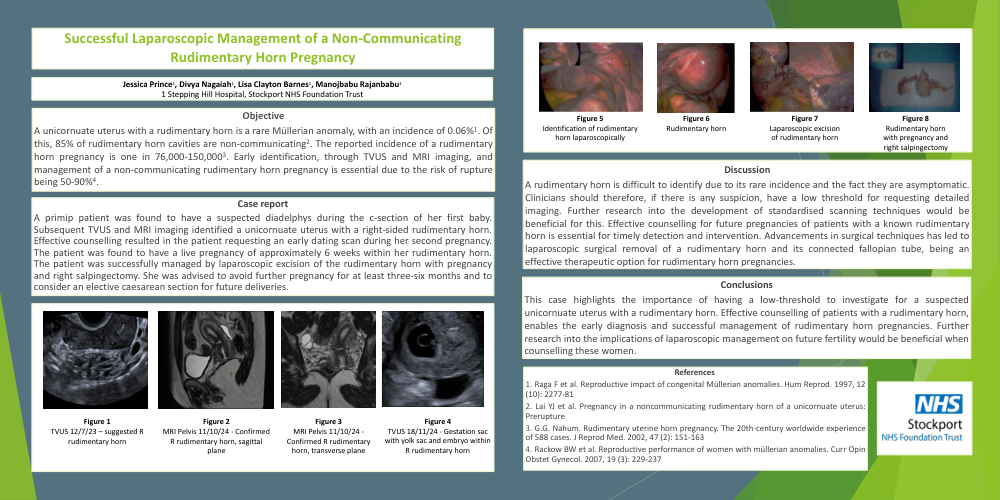
Successful Laparoscopic Management of a Non-Communicating Rudimentary Horn Pregnancy
A unicornuate uterus with a rudimentary horn is a rare Müllerian anomaly, with an incidence of 0.06%1. Of this, 85% of rudimentary horn cavities are non-communicating2. The reported incidence of a rudimentary horn pregnancy is one in 76,000-150,0003. Early identification, through TVUS and MRI imaging, and management of a non-communicating rudimentary horn pregnancy is essential due to the risk of rupture being 50-90%4.
Case report
A primip patient was found to have a suspected diadelphys during the c-section of her first baby. Subsequent TVUS and MRI imaging identified a unicornuate uterus with a right-sided rudimentary horn. Effective counselling resulted in the patient requesting an early dating scan during her second pregnancy. The patient was found to have a live pregnancy of approximately 6 weeks within her rudimentary horn. The patient was successfully managed by laparoscopic excision of the rudimentary horn with pregnancy and right salpingectomy. She was advised to avoid further pregnancy for at least three-six months and to consider an elective caesarean section for future deliveries.
Discussion
A rudimentary horn is difficult to identify due to its rare incidence and the fact they are asymptomatic. Clinicians should therefore, if there is any suspicion, have a low threshold for requesting detailed imaging. Further research into the development of standardised scanning techniques would be beneficial for this. Effective counselling for future pregnancies of patients with a known rudimentary horn is essential for timely detection and intervention. Advancements in surgical techniques has led to laparoscopic surgical removal of a rudimentary horn and its connected fallopian tube, being an effective therapeutic option for rudimentary horn pregnancies.
Conclusions
This case highlights the importance of having a low-threshold to investigate for a suspected unicornuate uterus with a rudimentary horn. Effective counselling of patients with a rudimentary horn, enables the early diagnosis and successful management of rudimentary horn pregnancies. Further research into the implications of laparoscopic management on future fertility would be beneficial when counselling these women.
References
1. Raga F et al. Reproductive impact of congenital Müllerian anomalies. Hum Reprod. 1997, 12 (10): 2277-81
2. Lai YJ et al. Pregnancy in a noncommunicating rudimentary horn of a unicornuate uterus: Prerupture
3. G.G. Nahum. Rudimentary uterine horn pregnancy. The 20th-century worldwide experience of 588 cases. J Reprod Med. 2002, 47 (2): 151-163
4. Rackow BW et al. Reproductive performance of women with müllerian anomalies. Curr Opin Obstet Gynecol. 2007, 19 (3): 229-237