2,281 posters, 63 videos, 56 audios, 43 topics, 18 sessions, 6,174 authors, 2,323 institutions
ePostersLive by SciGen Technologies S.A. All rights reserved.
RCOG World Congress 2025
June 23 - 25, 2025 | ExCeL London, UK
EP.0256
Ovarian Torsion in Early Pregnancy and Complications Post-Cystectomy
Poster Presenter
Authors
Affiliations
Part of Topic
Early pregnancy complications/early pregnancy and acute gynaecology
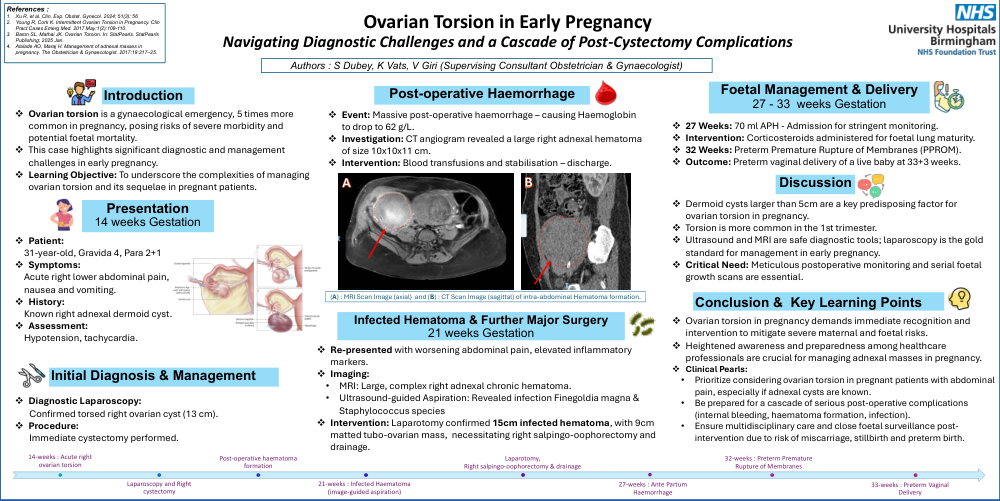
Ovarian Torsion in Early Pregnancy : Navigating Diagnostic Challenges and a Cascade of Post-Cystectomy Complications
Authors : S Dubey, K Vats, V Giri (Supervising Consultant Obstetrician & Gynaecologist)
Introduction :
❖ Ovarian torsion is a gynaecological emergency, 5 times more
common in pregnancy, posing risks of severe morbidity and
potential foetal mortality.
❖ This case highlights significant diagnostic and management
challenges in early pregnancy.
❖ Learning Objective: To underscore the complexities of managing
ovarian torsion and its sequelae in pregnant patients.
Presentation
14 weeks Gestation :
❖ Patient:
31-year-old, Gravida 4, Para 2+1
❖ Symptoms:
Acute right lower abdominal pain,
nausea and vomiting.
❖ History:
Known right adnexal dermoid cyst.
❖ Assessment:
Hypotension, tachycardia.
Initial Diagnosis & Management :
❖ Diagnostic Laparoscopy:
Confirmed torsed right ovarian cyst (13 cm).
❖ Procedure:
Immediate cystectomy performed.
Post-operative Haemorrhage :
❖ Event: Massive post-operative haemorrhage – causing Haemoglobin
to drop to 62 g/L.
❖ Investigation: CT angiogram revealed a large right adnexal hematoma
of size 10x10x11 cm.
❖ Intervention: Blood transfusions and stabilisation – discharge.
Infected Hematoma & Further Major Surgery
21 weeks Gestation :
❖ Re-presented with worsening abdominal pain, elevated inflammatory
markers.
❖ Imaging:
• MRI: Large, complex right adnexal chronic hematoma.
• Ultrasound-guided Aspiration: Revealed infection Finegoldia magna &
Staphylococcus species
❖ Intervention: Laparotomy confirmed 15cm infected hematoma, with 9cm
matted tubo-ovarian mass, necessitating right salpingo-oophorectomy and
drainage.
Foetal Management & Delivery
27 - 33 weeks Gestation:
❖ 27 Weeks: 70 ml APH - Admission for stringent monitoring.
❖ Intervention: Corticosteroids administered for foetal lung maturity.
❖ 32 Weeks: Preterm Premature Rupture of Membranes (PPROM).
❖ Outcome: Preterm vaginal delivery of a live baby at 33+3 weeks.
Discussion :
❖ Dermoid cysts larger than 5cm are a key predisposing factor for
ovarian torsion in pregnancy.
❖ Torsion is more common in the 1st trimester.
❖ Ultrasound and MRI are safe diagnostic tools; laparoscopy is the gold
standard for management in early pregnancy.
❖ Critical Need: Meticulous postoperative monitoring and serial foetal
growth scans are essential.
Conclusion & Key Learning Points :
❖ Ovarian torsion in pregnancy demands immediate recognition and
intervention to mitigate severe maternal and foetal risks.
❖ Heightened awareness and preparedness among healthcare
professionals are crucial for managing adnexal masses in pregnancy.
❖ Clinical Pearls:
• Prioritize considering ovarian torsion in pregnant patients with abdominal
pain, especially if adnexal cysts are known.
• Be prepared for a cascade of serious post-operative complications
(internal bleeding, haematoma formation, infection).
• Ensure multidisciplinary care and close foetal surveillance post-
intervention due to risk of miscarriage, stillbirth and preterm birth.