2,281 posters, 63 videos, 56 audios, 43 topics, 18 sessions, 6,174 authors, 2,323 institutions
ePostersLive by SciGen Technologies S.A. All rights reserved.
RCOG World Congress 2025
June 23 - 25, 2025 | ExCeL London, UK
EP.0255
Phenomenon of “Hook effect” in partial molar pregnancy
Part of Topic
Early pregnancy complications/early pregnancy and acute gynaecology
Title: Phenomenon of “Hook effect” in partial molar pregnancy
Objective:
Molar pregnancies are commonly associated with markedly elevated hCG levels. A “hook effect” can occur at high serum levels of hCG, resulting in a falsely low or negative value. Hook effect can lead to missed or delayed diagnosis which affects patient’s safety.
Case Study
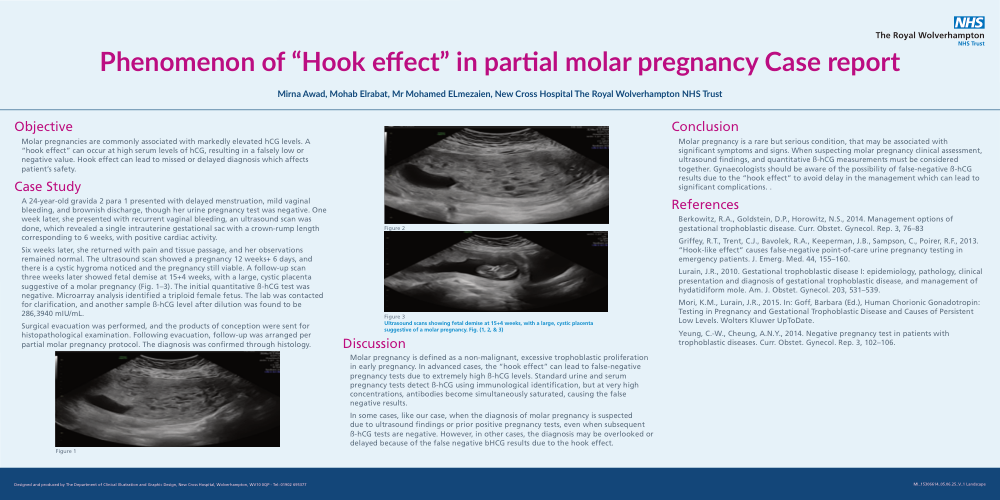
A 24-year-old gravida 2 para 1 presented with delayed menstruation, mild vaginal bleeding, and brownish discharge, though her urine pregnancy test was negative. One week later, she presented with recurrent vaginal bleeding, an ultrasound scan was done, which revealed a single intrauterine gestational sac with a crown-rump length corresponding to 6 weeks, with positive cardiac activity.
Six weeks later, she returned with pain and tissue passage, and her observations remained normal. The ultrasound scan showed a pregnancy 12 weeks+ 6days, and there is a cystic hygroma noticed and the pregnancy still viable. A follow-up scan three weeks later showed fetal demise at 15+4 weeks, with a large, cystic placenta suggestive of a molar pregnancy. The initial quantitative β-hCG test was negative. Microarray analysis identified a triploid female fetus. The lab was contacted for clarification, and another sample β-hCG level after dilution was found to be 286,3940 mIU/mL.
Surgical evacuation was performed, and the products of conception were sent for histopathological examination. Following evacuation, follow-up was arranged per partial molar pregnancy protocol. The diagnosis was confirmed through histology.
Discussion
Molar pregnancy is defined as a non-malignant, excessive trophoblastic proliferation in early pregnancy. In advanced cases, the “hook effect” can lead to false-negative pregnancy tests due to extremely high β-hCG levels. Standard urine and serum pregnancy tests detect β-hCG using immunological identification, but at very high concentrations, antibodies become simultaneously saturated, causing the false negative results.
In some cases, like our case, when the diagnosis of molar pregnancy is suspected due to ultrasound findings or prior positive pregnancy tests, even when subsequent β-hCG tests are negative. However, in other cases, the diagnosis may be overlooked or delayed because of the false negative bHCG results due to the hook effect.
Conclusion
Molar pregnancy is a rare but serious condition, that may be associated with significant symptoms and signs. When suspecting molar pregnancy clinical assessment, ultrasound findings, and quantitative β-hCG measurements must be considered together. Gynaecologists should be aware of the possibility of false-negative β-hCG results due to the “hook effect” to avoid delay in the management which can lead to significant complications.
References
Berkowitz, R.A., Goldstein, D.P., Horowitz, N.S., 2014. Management options of gestational trophoblastic disease. Curr. Obstet. Gynecol. Rep. 3, 76–83
Griffey, R.T., Trent, C.J., Bavolek, R.A., Keeperman, J.B., Sampson, C., Poirer, R.F., 2013. “Hook-like effect” causes false-negative point-of-care urine pregnancy testing in emergency patients. J. Emerg. Med. 44, 155–160.
Lurain, J.R., 2010. Gestational trophoblastic disease I: epidemiology, pathology, clinical presentation and diagnosis of gestational trophoblastic disease, and management of hydatidiform mole. Am. J. Obstet. Gynecol. 203, 531–539.
Mori, K.M., Lurain, J.R., 2015. In: Goff, Barbara (Ed.), Human Chorionic Gonadotropin: Testing in Pregnancy and Gestational Trophoblastic Disease and Causes of Persistent Low Levels. Wolters Kluwer UpToDate.
Yeung, C.-W., Cheung, A.N.Y., 2014. Negative pregnancy test in patients with trophoblastic diseases. Curr. Obstet. Gynecol. Rep. 3, 102–106.